Loading…
🩺 Medicine · Part 3 revision hub
Renal Medicine
Everything you need to revise this Part in one place — the one‑page note for every concept, a rapid‑revision sheet, exam‑style questions that point you back to the right concept, flashcards, staged cases and viva practice.
13 concepts20 MCQs20 flashcards5 cases15 viva questions
📝 The plate wall
Every concept in this Part as a one‑page handwritten note. Open one to read it in full and zoom.
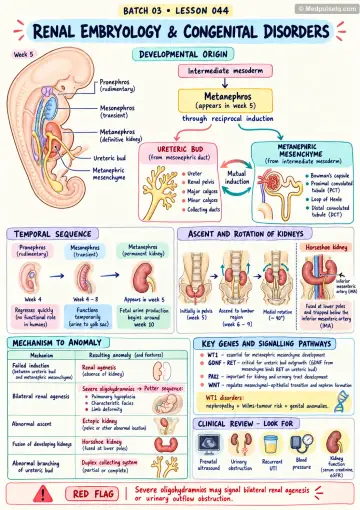
Concept 44
How the Kidneys Are Built Before Birth
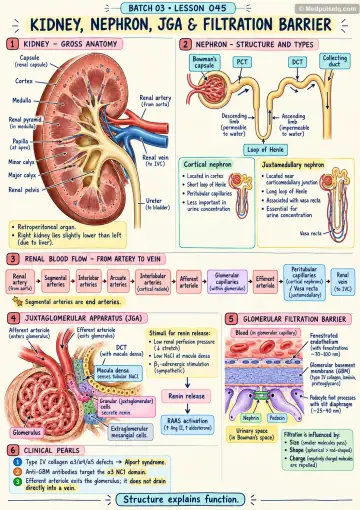
Concept 45
Kidney Structure: the nephron, JGA and filter
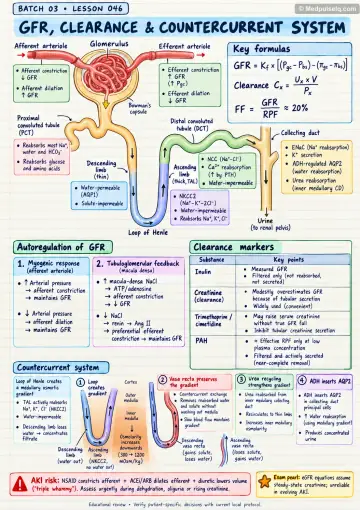
Concept 46
GFR, Clearance and Concentrated Urine
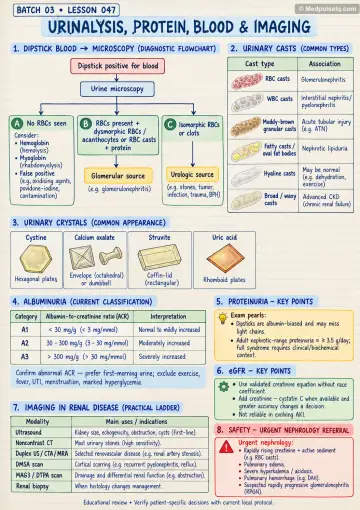
Concept 47
Reading the Urine Like a Bedside Biopsy
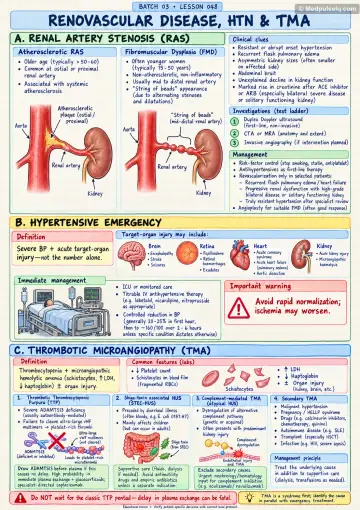
Concept 48
Renal Blood Vessels, Severe BP and TMA
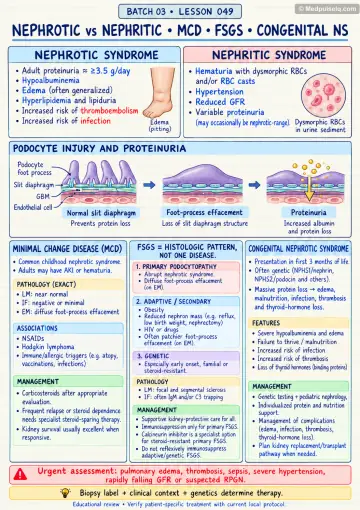
Concept 49
Nephrotic and Nephritic Patterns, MCD and FSGS
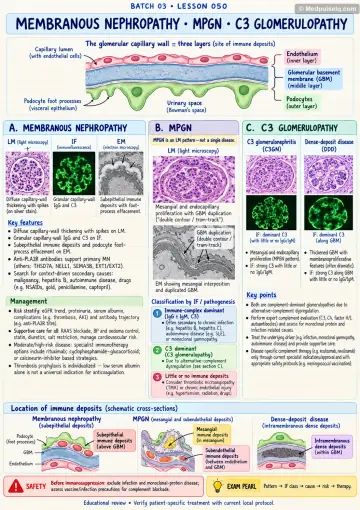
Concept 50
Membranous Nephropathy, MPGN and C3 Disease
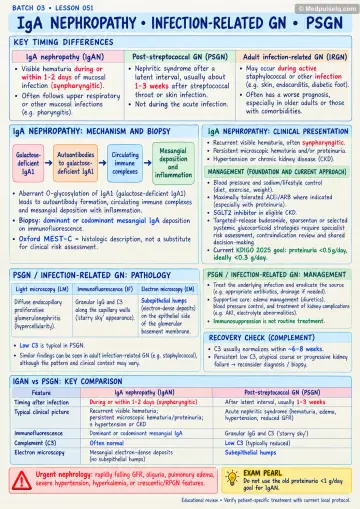
Concept 51
IgA Nephropathy and Post-Infectious GN
Concept 52
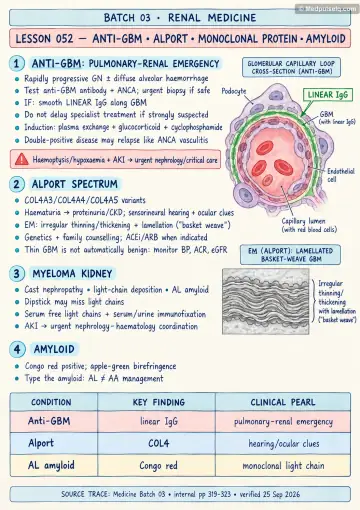
Anti-GBM, Alport, Myeloma Kidney and Amyloid
Concept 53
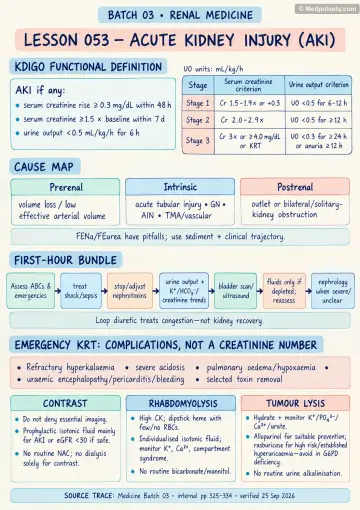
Acute Kidney Injury: act before the cause is perfect
Concept 54
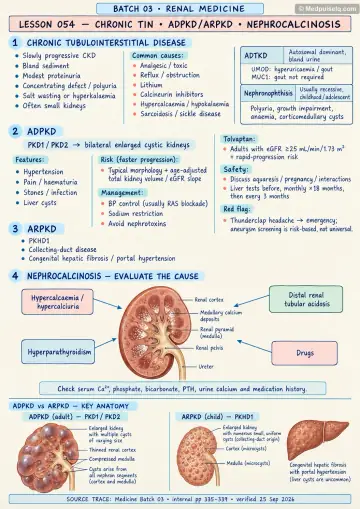
Chronic TIN, ADPKD and Nephrocalcinosis
Concept 55
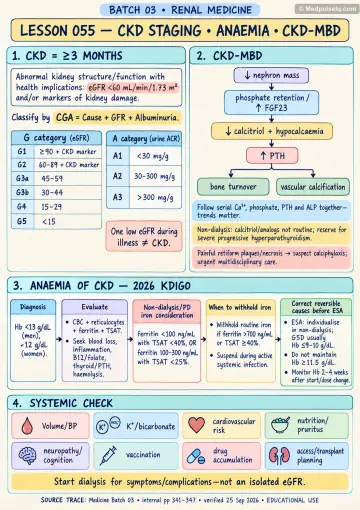
CKD Staging, Anaemia and Mineral Bone Disease
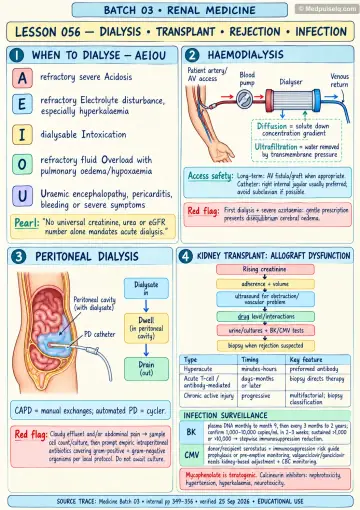
Concept 56
Dialysis, Peritoneal Dialysis and Kidney Transplant
⚡ Rapid revision
The whole Part on one screen — read it the night before.
Development and structure
- Ureteric bud forms ureter, pelvis, calyces and collecting ducts; metanephric mesenchyme forms nephron through distal tubule.
- Bilateral renal agenesis causes severe oligohydramnios and Potter sequence; horseshoe kidney is trapped during ascent.
- Filtration barrier: fenestrated endothelium, GBM and podocyte slit diaphragm.
- Juxtamedullary nephrons and vasa recta are essential for urine concentration.
- The JGA links tubular salt delivery and perfusion pressure to renin release.
Function and urine clues
- Creatinine clearance slightly overestimates GFR because of tubular secretion.
- Trimethoprim can raise creatinine without true GFR fall by inhibiting secretion.
- eGFR equations assume steady state and are unreliable in evolving AKI.
- Use A1, A2 and A3 albuminuria categories; avoid the old “microalbuminuria” wording.
- RBC casts suggest glomerular bleeding; muddy-brown casts suggest acute tubular injury; fatty casts suggest nephrotic lipiduria.
- Dipstick heme with few or no RBCs suggests myoglobin or haemoglobin.
Glomerular and vascular anchors
- Renal artery stenosis clues: resistant or abrupt hypertension, flash pulmonary oedema, asymmetric kidneys, abdominal bruit, or creatinine rise after ACEi/ARB.
- TMA is thrombocytopenia plus microangiopathic haemolysis with schistocytes, often with organ injury.
- MCD: near-normal LM, negative or minimal IF, diffuse foot-process effacement.
- FSGS is a pattern; classify primary, adaptive, genetic or secondary before immunosuppression.
- Membranous nephropathy: subepithelial deposits, granular capillary IF and PLA2R in many primary cases.
- IgA nephropathy is often synpharyngitic; PSGN follows a latent interval and often has low C3.
- Anti-GBM disease gives linear IgG and may cause pulmonary–renal emergency.
AKI, CKD and replacement
- AKI criteria: creatinine rise 0.3 mg/dL in 48 hours, 1.5 times baseline in 7 days, or urine output under 0.5 mL/kg/hour for 6 hours.
- Treat AKI emergencies first: hyperkalaemia, pulmonary oedema, severe acidosis, uraemic complications, obstruction and sepsis.
- CKD needs at least 3 months and is classified by cause, GFR category and albuminuria category.
- SGLT2 inhibitor therapy is kidney-protective in eligible CKD; hold during prolonged fasting, surgery or critical illness.
- ESA therapy should not maintain Hb at 11.5 g/dL or higher.
- Dialysis begins for complications, symptoms or trajectory, not an isolated creatinine, urea or eGFR number.
- Preferred routine tunneled dialysis catheter site is usually the right internal jugular vein; avoid subclavian when possible.
- PD peritonitis clue: cloudy effluent or abdominal pain; sample and treat promptly.
🎯 Single‑best‑answer MCQs
Pick an answer to see the explanation — and the concept to revisit if you missed it. Your answers are saved on this device.
Score 0 / 00 of 20 answered
Question 1
Which permanent structure derives from the ureteric bud?
Question 2
A drug raises serum creatinine by inhibiting tubular secretion without reducing true GFR. The classic example is:
Question 3
A2 albuminuria is:
Question 4
Dipstick is strongly positive for blood but microscopy shows no RBCs after crush injury. The most likely explanation is:
Question 5
Which cast most strongly supports glomerular haematuria?
Question 6
Nephrotic syndrome with normal light microscopy and diffuse foot-process effacement suggests:
Question 7
The first question after a biopsy reports FSGS should be:
Question 8
Linear GBM IgG is typical of:
Question 9
The current proteinuria goal in IgA nephropathy is:
Question 10
Which fulfills an AKI definition?
Question 11
Best initial step in suspected postrenal AKI with retention is:
Question 12
In evolving AKI, eGFR is unreliable mainly because:
Question 13
A clear dialysis indication is:
Question 14
First drug in hyperkalaemia with a wide QRS is:
Question 15
Anaemia therapy with ESA should generally avoid maintaining Hb:
Question 16
Which adult with CKD clearly meets a strong kidney-protective SGLT2 inhibitor indication?
Question 17
The preferred routine site for a tunneled dialysis catheter is usually:
Question 18
Cloudy peritoneal-dialysis effluent with abdominal pain requires:
Question 19
BK DNAemia persisting above 1,000 copies/mL after transplant is principally managed by:
Question 20
A patient with typical ADPKD, eGFR 48 and rapid progression may be considered for:
🃏 Flashcards
Say the answer out loud before you flip. Shuffle once you know the order.
Card 1 of 20
🩺 Staged clinical cases
Read the presentation, decide what is going on and what you would do — then reveal the reasoning.
Case 1 — Oliguria after gastroenteritis
Stage A: A 64-year-old with CKD G3, diabetes and hypertension has 3 days of diarrhoea, dizziness and oliguria. Current drugs include an ARB, furosemide, metformin and ibuprofen.
Case 2 — Haemoptysis with rapidly rising creatinine
Stage A: A 28-year-old has dyspnoea, falling Hb, bilateral lung opacities, haematuria with RBC casts and creatinine rising over 48 hours.
Case 3 — Frothy urine and thrombosis risk
Stage A: A 47-year-old has oedema, proteinuria 8 g/day, serum albumin 2.1 g/dL, preserved eGFR and positive anti-PLA2R.
Case 4 — ADPKD and unsafe water advice
Stage A: A 36-year-old with bilateral enlarged cystic kidneys, family kidney failure, eGFR 68 and rapid-progression imaging asks if drinking huge volumes of water will prevent kidney failure.
Case 5 — Transplant creatinine rise
Stage A: Seven months after kidney transplant, creatinine rises from 1.2 to 1.8 mg/dL. The patient feels well; tacrolimus trough is high after clarithromycin.
🎤 Viva practice
Answer aloud as if an examiner asked you — then check the model points.
Viva 1
Define renal clearance.
Viva 2
Why does creatinine clearance exceed GFR?
Viva 3
Name the filtration barrier layers.
Viva 4
Define CKD.
Viva 5
What is CGA?
Viva 6
Define AKI.
Viva 7
Why can FENa mislead?
Viva 8
Differentiate nephritic and nephrotic syndrome.
Viva 9
What does linear IF suggest?
Viva 10
Why is FSGS not a final aetiologic diagnosis?
Viva 11
List AEIOU.
Viva 12
How do you protect future dialysis access?
Viva 13
Core PD peritonitis action?
Viva 14
Modern BK strategy?
Viva 15
Major ESA safety principle?
Keep going
Educational only — not a substitute for clinical judgement, supervision, or local guidelines.