Loading…
🌸 Gynaecology · Part 4 revision hub
Structure and its disorders
Everything you need to revise this Part in one place — the one‑page note for every concept, a rapid‑revision sheet, exam‑style questions that point you back to the right concept, flashcards, staged cases and viva practice.
3 concepts10 MCQs15 flashcards3 cases12 viva questions
📝 The plate wall
Every concept in this Part as a one‑page handwritten note. Open one to read it in full and zoom.
⚡ Rapid revision
The whole Part on one screen — read it the night before.
Pelvic map
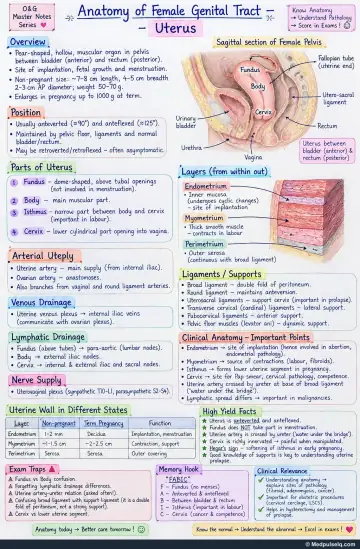
- Uterus lies between bladder and rectum; parts are fundus, body, isthmus and cervix.
- "Water under the bridge" means ureter under uterine artery near the cervix.
- Cardinal and uterosacral ligaments are key apical supports; round ligament maintains anteversion, not prolapse support.
- Posterior vaginal fornix is deepest and relates to the pouch of Douglas.
Müllerian anomalies
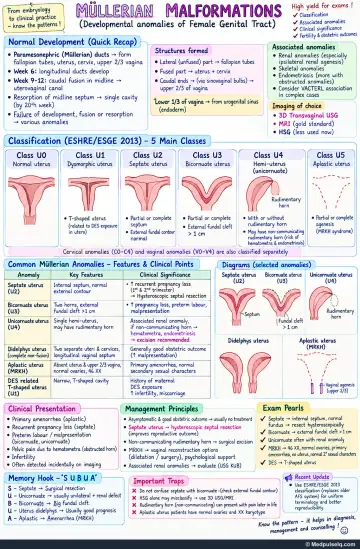
- Müllerian ducts must form, fuse and resorb the septum.
- Septate uterus has normal external contour; bicornuate uterus has external fundal cleft.
- HSG alone cannot distinguish septate from bicornuate because it cannot assess outer fundal contour.
- MRKH has 46,XX, normal ovaries and secondary sexual characters, absent uterus/upper vagina and primary amenorrhoea.
Prolapse
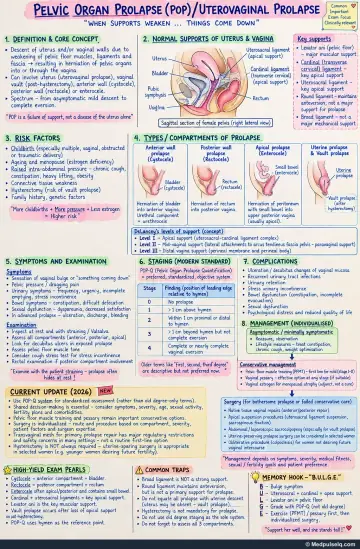
- POP is support failure by compartment: anterior cystocele/urethrocele, posterior rectocele/enterocele, apical uterine or vault.
- POP-Q uses the hymen as reference: negative above, zero at, positive beyond.
- Treat symptoms and goals, not anatomy alone: PFMT, pessary, vaginal estrogen for atrophy, then surgery when needed.
- Transvaginal synthetic mesh for primary prolapse repair is restricted and not routine first-line.
🎯 Single‑best‑answer MCQs
Pick an answer to see the explanation — and the concept to revisit if you missed it. Your answers are saved on this device.
Score 0 / 00 of 10 answered
Question 1
"Water under the bridge" in pelvic surgery refers to which relationship?
Question 2
Which support is most accurately described as maintaining anteversion rather than being a major anti-prolapse support?
Question 3
The posterior fornix is clinically important because it is related to which space?
Question 4
Failure of septal resorption most classically causes which anomaly?
Question 5
Which imaging principle best distinguishes septate from bicornuate uterus?
Question 6
A 16-year-old has primary amenorrhoea, normal breasts, normal pubic hair and absent uterus on imaging. Which diagnosis best fits?
Question 7
Which prolapse compartment corresponds to cystocele?
Question 8
In POP-Q, the hymen is used as what?
Question 9
An asymptomatic stage II prolapse is found incidentally. What principle should guide care?
Question 10
Which statement about transvaginal synthetic mesh for primary prolapse repair is most accurate?
🃏 Flashcards
Say the answer out loud before you flip. Shuffle once you know the order.
Card 1 of 15
🩺 Staged clinical cases
Read the presentation, decide what is going on and what you would do — then reveal the reasoning.
Case 1 — Ureter at hysterectomy
Stage A: During a teaching hysterectomy, a resident asks why the ureter is dissected before clamping the uterine vessels.
Linked concepts: 23. The Map of the Pelvis
Case 2 — Recurrent loss with a divided cavity
Stage A: A 29-year-old has recurrent first-trimester losses. HSG shows two endometrial cavities.
Linked concepts: 24. When the Tubes Don't Fuse Properly
Case 3 — Bulge after hysterectomy
Stage A: A 68-year-old post-hysterectomy patient reports a vaginal bulge and incomplete bladder emptying.
Linked concepts: 23. The Map of the Pelvis, 25. Prolapse: When the Support Gives Way
🎤 Viva practice
Answer aloud as if an examiner asked you — then check the model points.
Viva 1
What are the uterine wall layers from inside out?
Viva 2
What is "water under the bridge"?
Viva 3
Which ligament carries ovarian vessels?
Viva 4
Which vaginal fornix is deepest?
Viva 5
What does the cardinal ligament support?
Viva 6
List the Müllerian development steps.
Viva 7
How do septate and bicornuate uterus differ externally?
Viva 8
Why screen kidneys in Müllerian anomalies?
Viva 9
What is MRKH?
Viva 10
Name the three prolapse compartments.
Viva 11
What is vault prolapse?
Viva 12
What is first-line conservative treatment for mild symptomatic prolapse?
Keep going
Educational only — not a substitute for clinical judgement, supervision, or local guidelines.