Loading…
❤️ Physiology · Part 3 revision hub
Nerve and Muscle Physiology
Everything you need to revise this Part in one place — the one‑page note for every concept, a rapid‑revision sheet, exam‑style questions that point you back to the right concept, flashcards, staged cases and viva practice.
11 concepts20 MCQs20 flashcards4 cases15 viva questions
📝 The plate wall
Every concept in this Part as a one‑page handwritten note. Open one to read it in full and zoom.
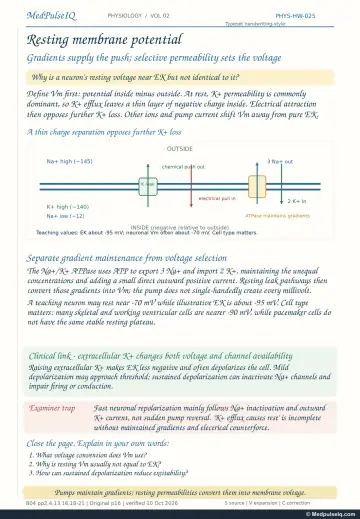
Concept 21
The Resting Membrane Potential
Concept 22
The Action Potential: a nerve's all-or-none message
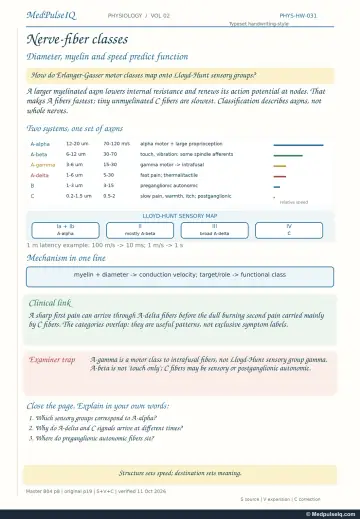
Concept 23
Nerve Fibres: speed and myelin
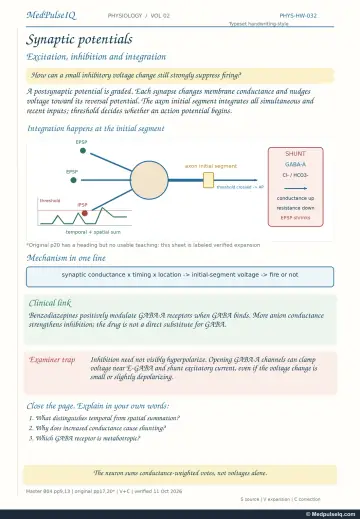
Concept 24
The Synapse: where neurons talk
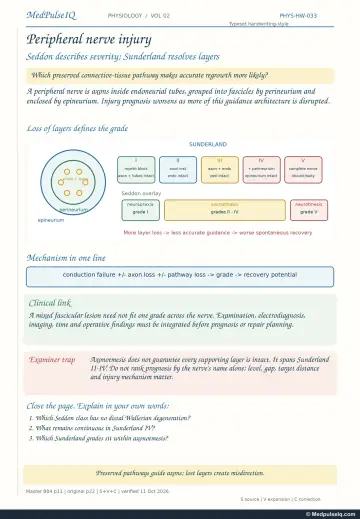
Concept 25
Nerve Injury and Repair
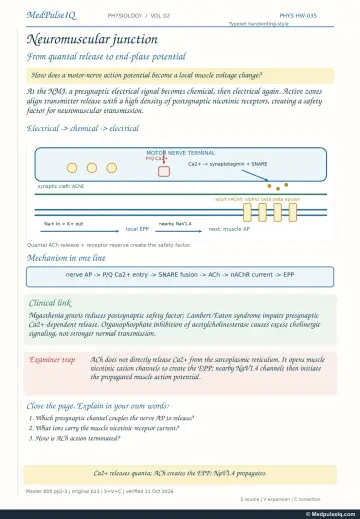
Concept 26
The Neuromuscular Junction
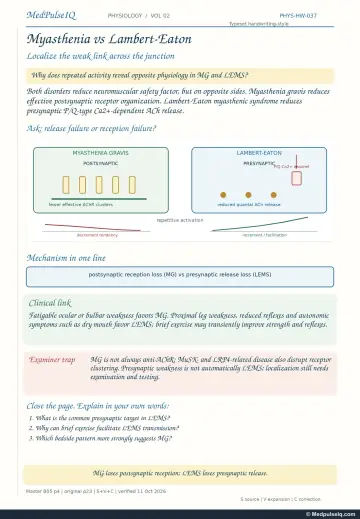
Concept 27
When the Junction Fails: myasthenia and Lambert–Eaton
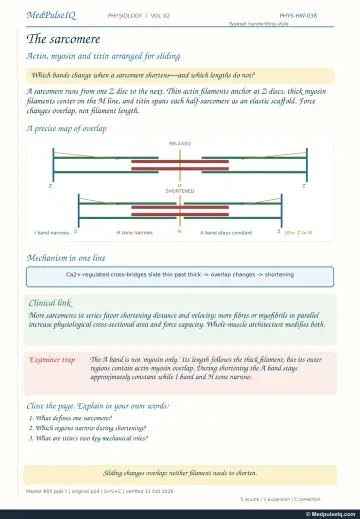
Concept 28
The Sarcomere and How a Signal Becomes a Squeeze
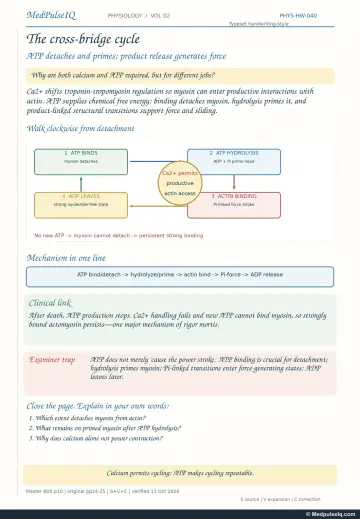
Concept 29
The Cross-Bridge Cycle and Muscle Mechanics
Concept 30
Motor Units, Fibre Types and Fatigue
Concept 31
Smooth Muscle: slow, strong and sustained
⚡ Rapid revision
The whole Part on one screen — read it the night before.
Excitability
- Nernst: E = (61.5/z) log(out/in) → E_K ≈ −95, E_Na ≈ +66, E_Cl ≈ −64, E_Ca ≈ +125 mV.
- GHK weights permeabilities; P_K ≫ P_Na at rest → Vm near E_K.
- Hyperkalaemia depolarises then inactivates Na⁺ channels; hypocalcaemia lowers threshold (tetany).
- AP: Na⁺ activation (positive feedback) → Na⁺ inactivation + K⁺ efflux → AHP; refractory periods ensure one‑way spread.
- Local potentials: graded, summate, decremental; APs: all‑or‑none, regenerated.
Conduction and synapses
- CV ∝ diameter and myelin (myelinated ≈ 6 × d m/s); Aα 70–120, C 0.5–2 m/s.
- Block sensitivity: pressure A > B > C; hypoxia B > A > C; local anaesthetic C > B > A.
- Demyelination: slow CV, long latency, dispersion, block; axonal: low amplitude.
- Synaptic delay ≈ 0.5 ms; EPSP (glutamate, cation), IPSP (GABA‑A, glycine Cl⁻; GABA‑B K⁺); shunting inhibition.
Injury and NMJ
- Seddon: neurapraxia (I), axonotmesis (II–IV), neurotmesis (V); regrowth ≈ 1–3 mm/day.
- Distal CMAP lost ~7–10 days after axonal injury; fibrillations ~2–3 weeks.
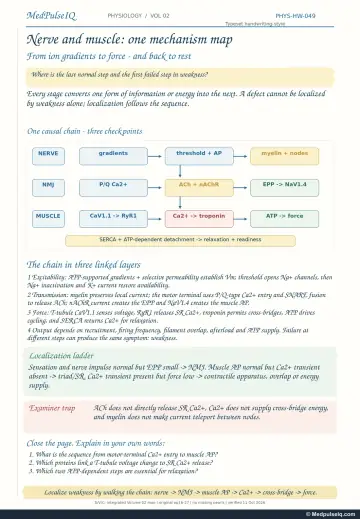
- NMJ: P/Q Ca²⁺ → ACh quanta → nAChR (α₂βδε) → EPP (safety factor 3–5) → Nav1.4.
- MG: postsynaptic, decrement, ocular/bulbar; LEMS: presynaptic VGCC, increment, proximal + autonomic + areflexia, SCLC.
- Succinylcholine + burns/denervation → hyperkalaemia; organophosphates → SLUDGE + paralysis.
Muscle
- Skeletal E–C: CaV1.1 mechanically opens RyR1 (no extracellular Ca²⁺ needed); cardiac: CICR via RyR2.
- MH: RYR1/CACNA1S, ↑ EtCO₂, rigidity → dantrolene.
- ATP detaches myosin (rigor without it); Pi release → power stroke.
- Optimal sarcomere ≈ 2.0–2.2 µm; Hill force–velocity; power max at ~⅓ Fmax.
- Size principle; type I oxidative/slow, IIx glycolytic/fast.
- Smooth muscle: calmodulin–MLCK; latch; Rho kinase sensitises; NO/cGMP and β₂/cAMP relax.
🎯 Single‑best‑answer MCQs
Pick an answer to see the explanation — and the concept to revisit if you missed it. Your answers are saved on this device.
Score 0 / 00 of 20 answered
Question 1
If extracellular K⁺ rises from 4 to 8 mmol/L (intracellular 140), E_K changes approximately from −95 mV to:
Question 2
The resting membrane potential of a neuron is closest to E_K because:
Question 3
The absolute refractory period is due mainly to:
Question 4
Hypocalcaemia causes tetany because it:
Question 5
Which fibres are blocked first by local anaesthetics?
Question 6
Markedly slowed conduction with temporal dispersion and conduction block suggests:
Question 7
Strychnine causes convulsions by antagonising:
Question 8
Opening GABA‑A channels when E_Cl equals resting Vm inhibits a neuron by:
Question 9
Seven days after a complete axonal transection, stimulation distal to the injury will most likely:
Question 10
Which injury involves loss of axon continuity with intact endoneurial tubes?
Question 11
Succinylcholine may cause life‑threatening hyperkalaemia in a patient with burns because:
Question 12
Train‑of‑four fade is characteristic of:
Question 13
A smoker has proximal leg weakness, dry mouth and absent reflexes that appear after 10 s of maximal contraction. The antibody target is most likely:
Question 14
The most sensitive electrophysiological test for a neuromuscular junction disorder is:
Question 15
In skeletal muscle, RyR1 is opened mainly by:
Question 16
During isotonic shortening, which length remains constant?
Question 17
Rigor mortis occurs because:
Question 18
Maximal mechanical power output of a muscle occurs:
Question 19
Large, long‑duration polyphasic motor unit potentials with reduced recruitment suggest:
Question 20
Rho‑kinase increases smooth muscle tone by:
🃏 Flashcards
Say the answer out loud before you flip. Shuffle once you know the order.
Card 1 of 20
🩺 Staged clinical cases
Read the presentation, decide what is going on and what you would do — then reveal the reasoning.
Case 1 — Peaked T waves and weakness
Stage A: A 64‑year‑old with CKD on an ACE inhibitor and spironolactone has generalised weakness. K⁺ 7.4 mmol/L; ECG shows peaked T waves and a widening QRS.
Case 2 — Wrist drop after a deep sleep
Stage A: A 30‑year‑old wakes after sleeping with his arm over a chair back and cannot extend his wrist or fingers. Sensation is reduced over the dorsal first web space.
Linked concepts: 25. Nerve Injury and Repair, 23. Nerve Fibres: speed and myelin
Case 3 — Droopy eyelids by evening
Stage A: A 26‑year‑old woman has ptosis and diplopia worse in the evening and after reading; pupils and sensation are normal; reflexes are normal.
Case 4 — Rigid jaw and rising end‑tidal CO₂
Stage A: During general anaesthesia with sevoflurane and succinylcholine, a 19‑year‑old develops masseter spasm, tachycardia and an end‑tidal CO₂ rising from 38 to 70 mmHg despite increased ventilation.
🎤 Viva practice
Answer aloud as if an examiner asked you — then check the model points.
Viva 1
Define equilibrium potential and write the Nernst equation.
Viva 2
Why is resting potential not equal to E_K?
Viva 3
Describe the ionic basis of the action potential.
Viva 4
Differentiate absolute and relative refractory periods.
Viva 5
What are rheobase and chronaxie?
Viva 6
What is saltatory conduction and its advantages?
Viva 7
Give the order of susceptibility of nerve fibres to pressure, hypoxia and local anaesthetics.
Viva 8
List properties of synapses.
Viva 9
What is Wallerian degeneration?
Viva 10
Describe neuromuscular transmission.
Viva 11
Contrast MG and LEMS.
Viva 12
Describe excitation–contraction coupling in skeletal muscle.
Viva 13
What is the size principle?
Viva 14
Explain the latch state.
Viva 15
Why can't cardiac muscle be tetanised?
Keep going
Educational only — not a substitute for clinical judgement, supervision, or local guidelines.