Loading…
❤️ Physiology · Part 7 revision hub
Renal Physiology and Acid–Base Balance
Everything you need to revise this Part in one place — the one‑page note for every concept, a rapid‑revision sheet, exam‑style questions that point you back to the right concept, flashcards, staged cases and viva practice.
12 concepts20 MCQs20 flashcards4 cases15 viva questions
📝 The plate wall
Every concept in this Part as a one‑page handwritten note. Open one to read it in full and zoom.
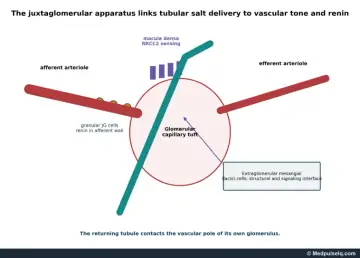
Concept 72
The Kidney's Plumbing and Blood Supply
Concept 73
The Glomerular Filter
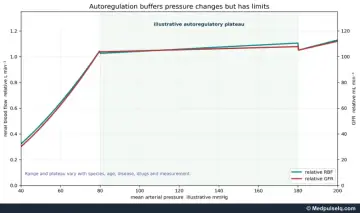
Concept 74
Keeping Filtration Steady
Concept 75
Clearance: measuring what the kidney does
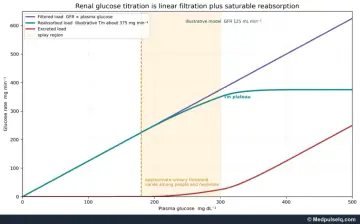
Concept 76
The Proximal Tubule: the bulk reclaimer
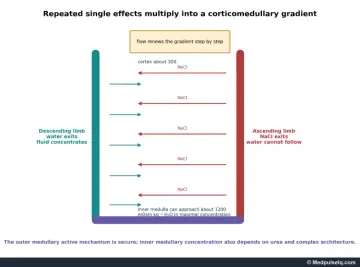
Concept 77
The Loop of Henle and Countercurrent
Concept 78
The Distal Nephron and Potassium
Concept 79
Renin, Angiotensin and Aldosterone
Concept 80
ADH and Water Balance
Concept 81
Acid–Base I: buffers, lungs and kidneys
Concept 82
Acid–Base II: reading a blood gas
Concept 83
Diuretics and Bladder Control
⚡ Rapid revision
The whole Part on one screen — read it the night before.
Filtration
- RBF ≈ 1.1–1.25 L/min (20–25% CO); RPF ≈ 625; GFR ≈ 125 mL/min (180 L/day); FF ≈ 20%.
- Medulla receives < 10% of flow; PO₂ ≈ 10–20 mmHg → TAL and S3 vulnerable.
- GFR = Kf × [(P_GC − P_BS) − (π_GC − π_BS)]; NFP ≈ 10 mmHg.
- Barrier: glycocalyx/fenestrated endothelium, GBM (type IV collagen), podocyte slit diaphragm (nephrin, podocin).
- Autoregulation (MAP ~80–180): myogenic + TGF (macula densa → adenosine → afferent constriction).
- Afferent constriction ↓RBF ↓GFR; moderate efferent constriction ↓RBF ↑GFR ↑FF; ACEi/ARB dilate efferent; NSAIDs constrict afferent.
Clearance and tubules
- C = UV/P; inulin = GFR; creatinine overestimates (secretion); PAH = ERPF.
- KDIGO G1–G5 + A1–A3; CKD needs > 3 months. FENa < 1% prerenal, > 2% ATN.
- PCT: ~65% Na⁺/water, all glucose/amino acids, 80–90% HCO₃⁻; glucose threshold ~180–200 mg/dL, Tm ~375 mg/min.
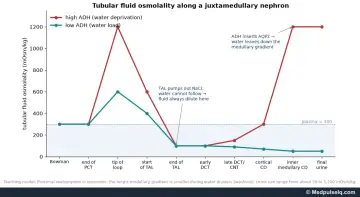
- TAL: NKCC2, ROMK recycling, lumen‑positive → Ca²⁺/Mg²⁺ paracellular; diluting segment (~100 mOsm).
- Countercurrent multiplier (loop) + exchanger (vasa recta) + urea recycling → 1,200 mOsm at papilla.
- DCT: NCC (thiazide), TRPV5 Ca²⁺ (PTH). Principal cells: ENaC/ROMK/BK (aldosterone), AQP2 (ADH). Intercalated A: H⁺ secretion; B: HCO₃⁻.
- K⁺ secretion ↑ with aldosterone, distal Na⁺/flow, plasma K⁺, alkalosis.
Hormones and acid–base
- Renin ↑ with ↓ afferent pressure, ↓ macula densa NaCl, β₁; Ca²⁺ inhibits renin release.
- Ang II: vasoconstriction, efferent tone, PCT NHE3, aldosterone, thirst, ADH.
- Aldosterone stimuli: Ang II, K⁺, ACTH; 11β‑HSD2 protects MR.
- ADH threshold ~280–285 mOsm/kg; V2 → cAMP → AQP2; urine 50–1,200 mOsm/kg.
- pH = 6.1 + log(HCO₃⁻/0.03 PaCO₂); net acid excretion = NH₄⁺ + TA − HCO₃⁻; NH₄⁺ rises 5–10× in chronic acidosis.
- Winter: PaCO₂ = 1.5 × HCO₃⁻ + 8 ± 2. AG = Na − (Cl + HCO₃) ≈ 8–12; correct for albumin.
- RTA 1: K⁺↓, urine pH > 5.5, stones; RTA 2: HCO₃⁻ wasting, Fanconi; RTA 4: K⁺↑, hypoaldosteronism.
- Loop: strongest, Ca²⁺ loss; thiazide: Ca²⁺ retention; MR antagonists/ENaC blockers: K⁺‑sparing.
🎯 Single‑best‑answer MCQs
Pick an answer to see the explanation — and the concept to revisit if you missed it. Your answers are saved on this device.
Score 0 / 00 of 20 answered
Question 1
The renal region most vulnerable to hypoxic injury is the:
Question 2
Glomerular capillary oncotic pressure rises along the capillary because:
Question 3
A ureteric stone reduces GFR mainly by increasing:
Question 4
Moderate efferent arteriolar constriction typically:
Question 5
Tubuloglomerular feedback responds to:
Question 6
U_x 20 mg/mL, V 1 mL/min, P_x 0.2 mg/mL. Clearance is:
Question 7
Trimethoprim raises serum creatinine without changing GFR by:
Question 8
Glycosuria, phosphaturia, aminoaciduria and bicarbonaturia with normal plasma glucose suggest:
Question 9
Approximately what fraction of filtered sodium is reabsorbed in the proximal tubule?
Question 10
The thick ascending limb is called the diluting segment because it:
Question 11
Loop diuretics increase urinary calcium because they:
Question 12
Hypertension, hypokalaemia, alkalosis with low renin and low aldosterone, responsive to amiloride, suggests:
Question 13
Hypokalaemia, hypomagnesaemia and hypocalciuria with normal BP suggest:
Question 14
Which does NOT stimulate renin release?
Question 15
Liquorice causes hypertension and hypokalaemia by:
Question 16
ADH increases water permeability of the collecting duct via:
Question 17
Polyuria with urine osmolality 80 mOsm/kg that rises to 600 after desmopressin indicates:
Question 18
The main adaptable route of renal acid excretion in chronic acidosis is:
Question 19
pH 7.25, PaCO₂ 60 mmHg, HCO₃⁻ 26 mmol/L. The disorder is:
Question 20
Which diuretic is most likely to cause hyperkalaemia?
🃏 Flashcards
Say the answer out loud before you flip. Shuffle once you know the order.
Card 1 of 20
🩺 Staged clinical cases
Read the presentation, decide what is going on and what you would do — then reveal the reasoning.
Case 1 — Kidney injury after a dental abscess
Stage A: A 72‑year‑old with hypertension (ramipril, furosemide) takes ibuprofen for 5 days for dental pain and has vomiting. Creatinine rises from 90 to 310 µmol/L; urine output is low.
Linked concepts: 74. Keeping Filtration Steady, 75. Clearance: measuring what the kidney does
Case 2 — Hypertension with low potassium
Stage A: A 42‑year‑old with BP 168/102 despite three drugs has K⁺ 2.9 mmol/L and HCO₃⁻ 31 mmol/L.
Linked concepts: 79. Renin, Angiotensin and Aldosterone, 78. The Distal Nephron and Potassium
Case 3 — Thirsty and passing litres
Stage A: After transsphenoidal surgery, a patient passes 6 L/day of urine with osmolality 90 mOsm/kg; serum Na⁺ 148 mmol/L.
Linked concepts: 80. ADH and Water Balance, 77. The Loop of Henle and Countercurrent
Case 4 — Drowsy diabetic breathing deeply
Stage A: A 19‑year‑old with type 1 diabetes: pH 7.12, PaCO₂ 20 mmHg, HCO₃⁻ 6 mmol/L, Na⁺ 134, Cl⁻ 98, glucose 28 mmol/L, ketones high.
🎤 Viva practice
Answer aloud as if an examiner asked you — then check the model points.
Viva 1
List the functions of the kidney.
Viva 2
Describe the glomerular filtration barrier.
Viva 3
What are the Starling forces in the glomerulus?
Viva 4
Explain renal autoregulation.
Viva 5
Define clearance and give examples.
Viva 6
What is Tm? Give an example.
Viva 7
Explain the countercurrent mechanism.
Viva 8
Why is the TAL called the diluting segment?
Viva 9
How does aldosterone cause hypokalaemia?
Viva 10
Describe the RAAS.
Viva 11
What regulates ADH secretion?
Viva 12
How do kidneys excrete acid?
Viva 13
Define anion gap and its use.
Viva 14
Classify diuretics by site.
Viva 15
Describe the micturition reflex.
Keep going
Educational only — not a substitute for clinical judgement, supervision, or local guidelines.