Loading…
🌏 Community Medicine · Part 5 revision hub
Demography and Family Planning
Everything you need to revise this Part in one place — the one‑page note for every concept, a rapid‑revision sheet, exam‑style questions that point you back to the right concept, flashcards, staged cases and viva practice.
8 concepts20 MCQs20 flashcards4 cases15 viva questions
📝 The plate wall
Every concept in this Part as a one‑page handwritten note. Open one to read it in full and zoom.
Concept 38
How Populations Change
Concept 39
Where Population Numbers Come From
Concept 40
Counting Births — Fertility
Concept 41
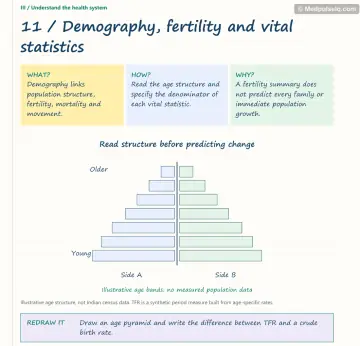
Reading a Population's Shape
Concept 42
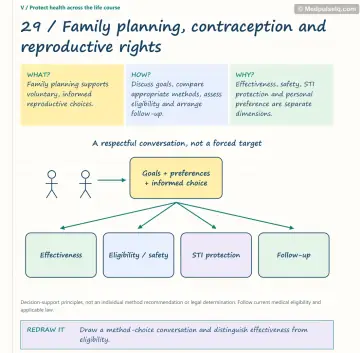
Choosing Contraception
Concept 43
Spacing Methods
Concept 44
Permanent Methods and Emergency Contraception
Concept 45
Family Planning Programme, Safe Abortion and the Law
⚡ Rapid revision
The whole Part on one screen — read it the night before.
Demography
- Population change = B − D + I − E. Natural increase = B − D.
- Demographic cycle: high stationary → early expanding → late expanding → low stationary → declining. India: late expanding moving to low stationary.
- India (SRS 2023): CBR 18.4, CDR 6.4, TFR 1.9, IMR 25. SRB 917 (SRS 2021–23). NFHS‑6 (2023–24) TFR 2.0.
- Census 2011: 121 crore; sex ratio 943; child sex ratio 918; literacy 74.04%; density 382. Census 2027: reference date 1 March 2027 (1 October 2026 snow‑bound); first digital census; caste enumeration.
- Population momentum: growth continues after replacement TFR because of a young age structure.
Data sources
- Census (decennial), CRS (RBD Act 1969, amended 2023; register within 21 days), SRS (dual record system, annual), NFHS (IIPS), HMIS, MCCD, LASI.
Fertility and composition
- CBR (total population) → GFR (women 15–49) → ASFR → TFR = 5 × ΣASFR/1,000 → GRR (daughters) → NRR (surviving daughters; 1 = replacement ≈ TFR 2.1).
- Dependency ratio = (0–14 + 65+)/(15–64) × 100. Pyramids: expansive, constrictive, stationary.
Contraception
- Pearl Index = failures × 1,200/months of exposure (per 100 woman‑years).
- Basket: Nirodh, Mala‑N, Chhaya (centchroman 30 mg twice weekly × 3 months, then weekly), Antara (DMPA 150 mg every 3 months), Cu‑T 380A (10 years), Cu 375 (5 years), PPIUCD (within 48 h), ECP (LNG 1.5 mg within 72 h), sterilisation.
- WHO MEC 6th edition (November 2025): categories 1–4. COC category 4: migraine with aura, < 6 weeks postpartum while breastfeeding, VTE, BP ≥ 160/100, smoker ≥ 35 years (≥ 15/day).
- LAM: amenorrhoea + full breastfeeding + infant < 6 months.
- Vasectomy: semen analysis at 12 weeks; condoms until azoospermia. Cu‑IUD is the most effective EC (within 5 days).
- Target‑free since 1996; NPP 2000; Mission Parivar Vikas 2016; Devika Biswas (2016) ended camp approach.
- MTP Act (amended 2021): ≤ 20 weeks 1 RMP; 20–24 weeks 2 RMPs (special categories); > 24 weeks Medical Board (foetal abnormality); any time to save life. Adult woman's consent alone; guardian for minor.
- PCPNDT 1994/2003: bans sex selection; registration; Form F; penalties up to 3 years + ₹10,000 (first offence).
🎯 Single‑best‑answer MCQs
Pick an answer to see the explanation — and the concept to revisit if you missed it. Your answers are saved on this device.
Score 0 / 00 of 20 answered
Question 1
In which stage of the demographic cycle is population growth most rapid?
Question 2
Continued population growth after fertility falls to replacement level is due to:
Question 3
The Sample Registration System in India uses:
Question 4
Under the Registration of Births and Deaths Act, a birth should be registered within:
Question 5
The denominator of the general fertility rate is:
Question 6
ASFRs for seven five‑year age groups sum to 440 per 1,000 women. The TFR is:
Question 7
A net reproduction rate of 1 means:
Question 8
Child sex ratio in India in Census 2011 was:
Question 9
Dependency ratio is calculated as:
Question 10
The Pearl Index is expressed as failures per:
Question 11
India's family planning programme became target‑free in:
Question 12
The weekly non‑steroidal oral contraceptive in India's programme is:
Question 13
Antara (DMPA) is given:
Question 14
Which is a WHO MEC category 4 condition for combined oral contraceptives?
Question 15
The Cu‑T 380A is effective for:
Question 16
After vasectomy, the couple should use another method until:
Question 17
The most effective method of emergency contraception is:
Question 18
Under the amended MTP Act (2021), termination between 20 and 24 weeks requires:
Question 19
Under the PCPNDT Act, records of ultrasound for pregnant women are maintained in:
Question 20
For MTP in an adult woman, consent required is that of:
🃏 Flashcards
Say the answer out loud before you flip. Shuffle once you know the order.
Card 1 of 20
🩺 Staged clinical cases
Read the presentation, decide what is going on and what you would do — then reveal the reasoning.
Case 1 — Two districts, two transitions
Stage A: District A (TFR 1.6) has a constrictive pyramid with 14% aged 60+. District B (TFR 2.7) has an expansive pyramid with 40% under 15.
Case 2 — The breastfeeding mother with migraine
Stage A: A 26‑year‑old, 5 weeks postpartum and exclusively breastfeeding, has migraine with aura. She asks for "the pill".
Linked concepts: 43. Spacing Methods, 42. Choosing Contraception
Case 3 — "I can stop condoms now"
Stage A: A man had NSV 2 weeks ago and plans to stop condoms.
Linked concepts: 44. Permanent Methods and Emergency Contraception
Case 4 — Twenty‑two weeks after assault
Stage A: A 16‑year‑old presents at 22 weeks' gestation after sexual assault by a relative, accompanied by her mother.
Linked concepts: 45. Family Planning Programme, Safe Abortion and the Law, 101. Concept 101
🎤 Viva practice
Answer aloud as if an examiner asked you — then check the model points.
Viva 1
Define demography.
Viva 2
Describe the demographic cycle.
Viva 3
What is population momentum?
Viva 4
Sources of demographic data in India?
Viva 5
What is the dual record system?
Viva 6
Define TFR, GRR and NRR.
Viva 7
What is an eligible couple?
Viva 8
Define the Pearl Index.
Viva 9
Name the contraceptives available in India's programme.
Viva 10
What are the WHO MEC categories?
Viva 11
What are the conditions for LAM?
Viva 12
Advantages of NSV over tubectomy?
Viva 13
Emergency contraception methods?
Viva 14
Summarise the amended MTP Act.
Viva 15
Key provisions of the PCPNDT Act?
Keep going
Educational only — not a substitute for clinical judgement, supervision, or local guidelines.