Loading…
🩺 Medicine · Part 4 revision hub
Neurology I — Headache, Seizures, Nerve, Muscle and CNS Infection
Everything you need to revise this Part in one place — the one‑page note for every concept, a rapid‑revision sheet, exam‑style questions that point you back to the right concept, flashcards, staged cases and viva practice.
15 concepts20 MCQs20 flashcards5 cases15 viva questions
📝 The plate wall
Every concept in this Part as a one‑page handwritten note. Open one to read it in full and zoom.
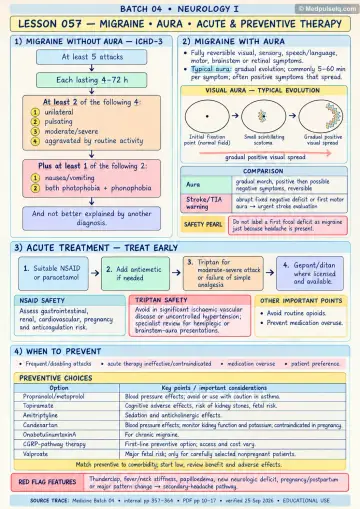
Concept 57
Migraine and Aura
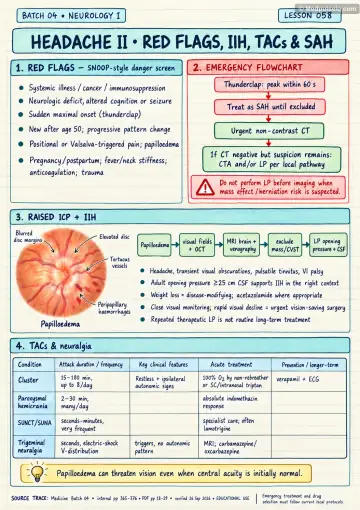
Concept 58
Dangerous Headache, Raised Pressure and Facial Pain
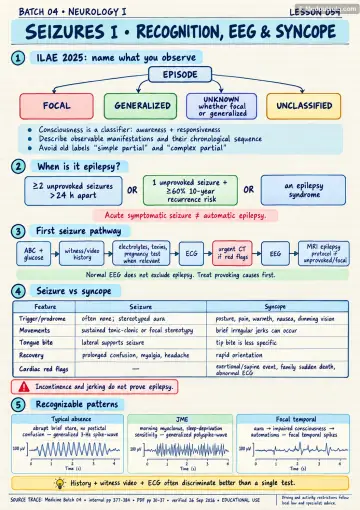
Concept 59
Seizure Recognition
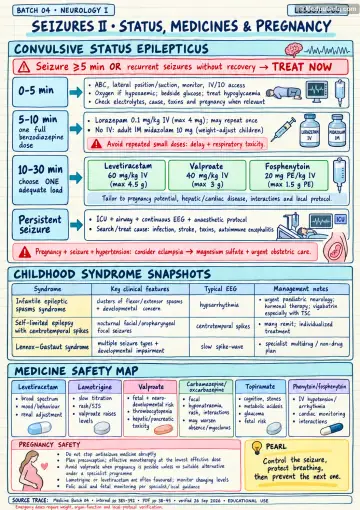
Concept 60
Status Epilepticus and Seizure Medicine Safety
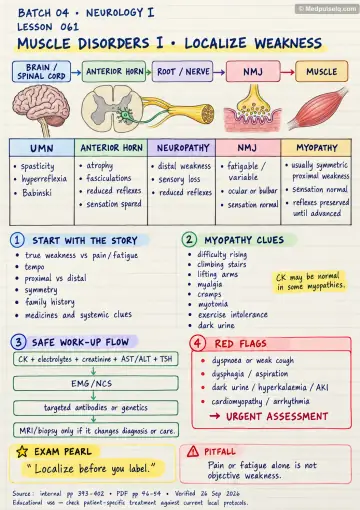
Concept 61
Localizing Weakness
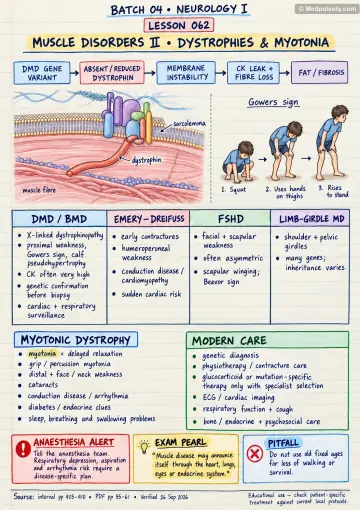
Concept 62
Dystrophies and Myotonia
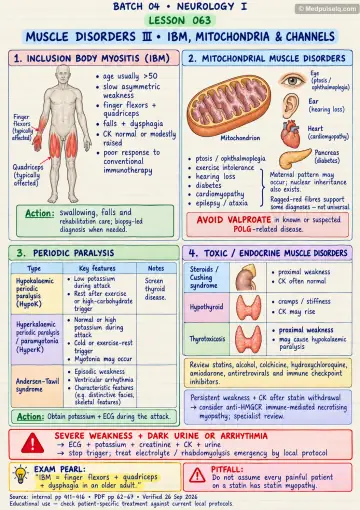
Concept 63
Inclusion Body, Mitochondrial and Channel Myopathies
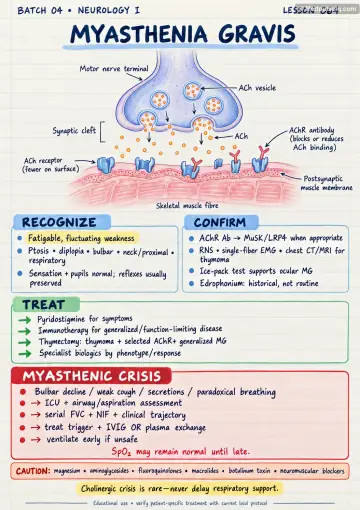
Concept 64
Myasthenia Gravis
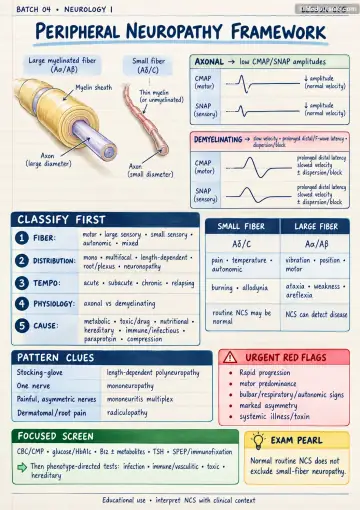
Concept 65
Peripheral Neuropathy Framework
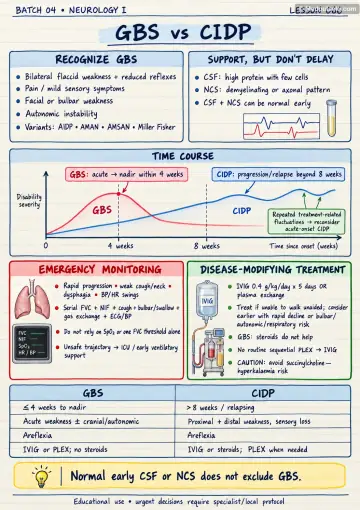
Concept 66
Guillain-Barre Syndrome and CIDP
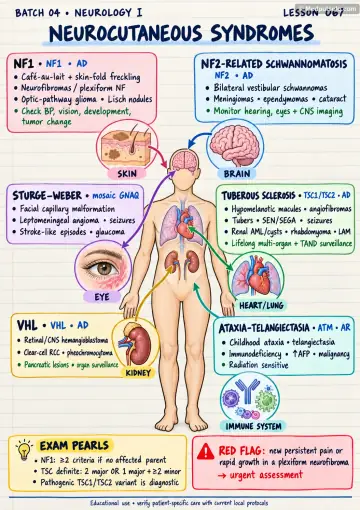
Concept 67
Neurocutaneous Syndromes
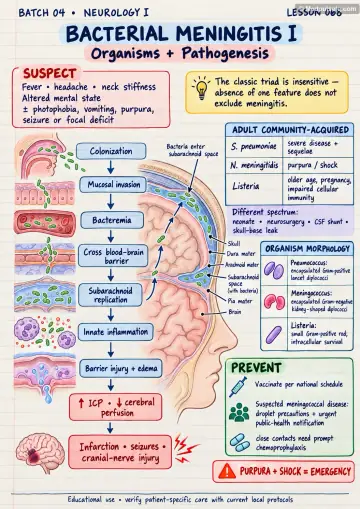
Concept 68
Bacterial Meningitis: Organisms and Danger Signs
Concept 69
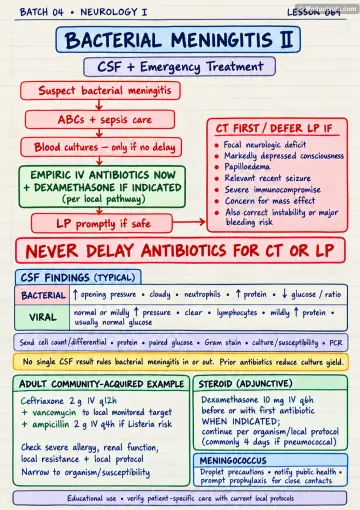
Bacterial Meningitis: CSF and Emergency Treatment
Concept 70
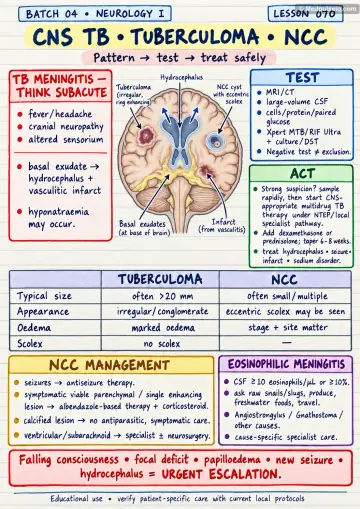
CNS Tuberculosis, Tuberculoma and Neurocysticercosis
Concept 71
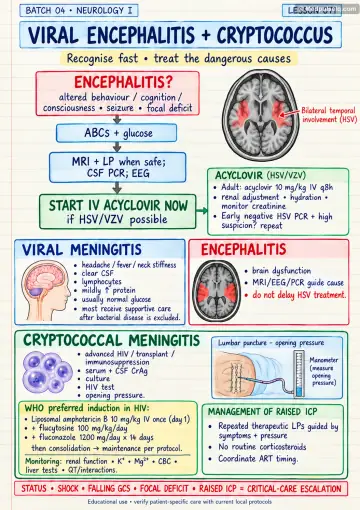
Viral Encephalitis and Cryptococcus
⚡ Rapid revision
The whole Part on one screen — read it the night before.
Headache and seizures
- Headache triage starts with red flags: thunderclap, fever/neck stiffness, papilloedema, pregnancy/postpartum, neurologic deficit, seizure, anticoagulation, cancer/immunosuppression, trauma or progressive pattern change.
- Thunderclap means maximal intensity within 60 seconds; use the SAH pathway.
- Migraine: 4–72 hours, pulsating or activity-aggravated pain, nausea or photo/phonophobia; typical aura spreads gradually and reverses.
- IIH: papilloedema, transient visual obscurations, pulsatile tinnitus and VI palsy; MRI/MRV then safe LP, protect vision, no routine serial LP.
- Use current seizure language: focal, generalized, unknown or unclassified; describe awareness and sequence.
- Status epilepticus is treated at 5 minutes: full benzodiazepine, then one adequate levetiracetam/valproate/fosphenytoin load, then ICU anaesthetic/EEG if refractory.
Weakness, muscle and junction
- Localize weakness before naming disease: UMN, anterior horn cell, root/nerve, NMJ or muscle.
- Sensory loss argues against pure muscle or NMJ disease; CK may be normal in some myopathies.
- DMD/BMD: dystrophinopathy with proximal weakness, Gowers sign, high CK and cardiac/respiratory surveillance.
- IBM: older adult, finger-flexor plus quadriceps weakness, dysphagia, poor steroid response.
- MG: fatigable ocular/bulbar/proximal/respiratory weakness with normal pupils and sensation; crisis is a respiratory and bulbar emergency.
Neuropathy, neurocutaneous and infection
- Neuropathy classification: fibre, distribution, tempo, physiology and cause; axonal loses amplitude, demyelination slows conduction.
- GBS: acute bilateral flaccid weakness/areflexia, bulbar/autonomic/respiratory risk; early CSF/NCS may be normal; IVIG or PLEX, not steroids.
- Neurocutaneous syndromes need surveillance: NF1, NF2-related schwannomatosis, TSC, VHL, Sturge-Weber and ataxia-telangiectasia.
- Meningitis: cultures if no delay, immediate antibiotics/dexamethasone when indicated, LP if safe; CT-before-LP never delays treatment.
- TBM: subacute meningitis with cranial neuropathy, hydrocephalus or basal infarcts; negative Xpert does not exclude.
- HSV encephalitis: start acyclovir immediately. Cryptococcus: measure/control CSF pressure and coordinate ART timing.
🎯 Single‑best‑answer MCQs
Pick an answer to see the explanation — and the concept to revisit if you missed it. Your answers are saved on this device.
Score 0 / 00 of 20 answered
Question 1
A thunderclap headache is defined chiefly by:
Question 2
A typical migraine aura usually:
Question 3
Long-term serial LP is routine IIH therapy.
Question 4
First-line acute treatment for cluster headache is:
Question 5
Current terminology for “complex partial seizure” is:
Question 6
Convulsive status treatment should begin at:
Question 7
No IV access in adult status epilepticus: best initial option is:
Question 8
Which drug may worsen juvenile myoclonic epilepsy?
Question 9
Lateral tongue bite and prolonged confusion favor:
Question 10
Proximal weakness with sensory loss most strongly argues against:
Question 11
Finger-flexor and quadriceps weakness in an older adult suggests:
Question 12
Pupils in autoimmune myasthenia gravis are generally:
Question 13
Best disease-modifying GBS therapy is:
Question 14
Normal CSF in week 1 excludes GBS.
Question 15
A pathogenic TSC1/TSC2 variant:
Question 16
Pigment-only NF1-like features require consideration of:
Question 17
Suspected bacterial meningitis with focal deficit requires:
Question 18
Add ampicillin to adult empiric meningitis therapy mainly for:
Question 19
Best immediate treatment when HSV encephalitis is possible:
Question 20
Critical cryptococcal meningitis management includes:
🃏 Flashcards
Say the answer out loud before you flip. Shuffle once you know the order.
Card 1 of 20
🩺 Staged clinical cases
Read the presentation, decide what is going on and what you would do — then reveal the reasoning.
Case 1 — Thunderclap headache
Stage A: A 42-year-old develops maximal occipital pain within 20 seconds while lifting weight, with vomiting but normal neurologic examination.
Linked concepts: 58. Dangerous Headache, Raised Pressure and Facial Pain
Case 2 — Ongoing convulsion
Stage A: A 70-kg adult has generalized convulsions for 7 minutes. No IV access is ready.
Linked concepts: 60. Status Epilepticus and Seizure Medicine Safety
Case 3 — Ascending weakness after diarrhoea
Stage A: A patient develops tingling feet, leg-arm weakness, facial weakness and labile BP over 3 days after diarrhoeal illness.
Linked concepts: 65. Peripheral Neuropathy Framework, 66. Guillain-Barre Syndrome and CIDP
Case 4 — Fluctuating diplopia and dysphagia
Stage A: Ptosis worsens by evening, pupils are normal, reflexes and sensation are intact, and dysphagia begins after azithromycin.
Linked concepts: 64. Myasthenia Gravis
Case 5 — Fever, headache and confusion
Stage A: A 64-year-old has fever, neck stiffness, confusion, hypotension and focal arm weakness.
🎤 Viva practice
Answer aloud as if an examiner asked you — then check the model points.
Viva 1
Define thunderclap headache and list five causes.
Viva 2
State diagnostic criteria for migraine without aura.
Viva 3
What are symptoms and diagnostic pathway for IIH?
Viva 4
Differentiate seizure from convulsive syncope.
Viva 5
Define epilepsy and convulsive status epilepticus.
Viva 6
Give first two drug stages of adult status treatment.
Viva 7
Localize proximal symmetric weakness with normal sensation.
Viva 8
Compare Duchenne and Becker dystrophinopathy.
Viva 9
List five drugs that can worsen MG.
Viva 10
How do you recognize myasthenic crisis?
Viva 11
Classify neuropathy by fibre and physiology.
Viva 12
State GBS indications and options for immunotherapy.
Viva 13
Give updated NF1 and TSC diagnostic principles.
Viva 14
When is brain imaging required before LP?
Viva 15
Outline empiric adult bacterial meningitis therapy and cryptococcal pressure management.
Keep going
Educational only — not a substitute for clinical judgement, supervision, or local guidelines.