Loading…
🌸 Gynaecology · Part 1 revision hub
Foundations & the reproductive axis
Everything you need to revise this Part in one place — the one‑page note for every concept, a rapid‑revision sheet, exam‑style questions that point you back to the right concept, flashcards, staged cases and viva practice.
7 concepts15 MCQs17 flashcards4 cases10 viva questions
📝 The plate wall
Every concept in this Part as a one‑page handwritten note. Open one to read it in full and zoom.
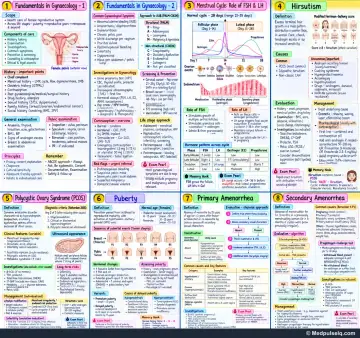
Concept 1
What Gynaecology Really Is
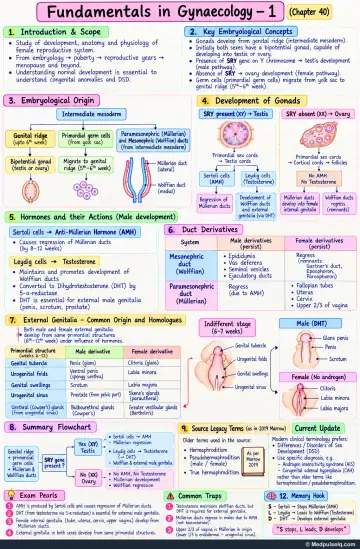
Concept 2
Boy or Girl? The Story of One Switch
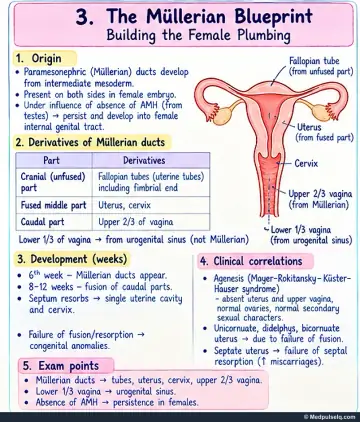
Concept 3
Building the Female Plumbing
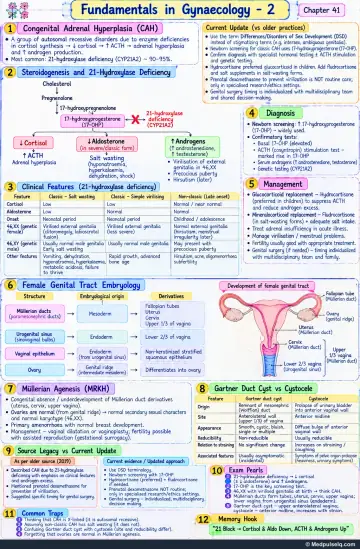
Concept 4
When Development Takes a Different Path
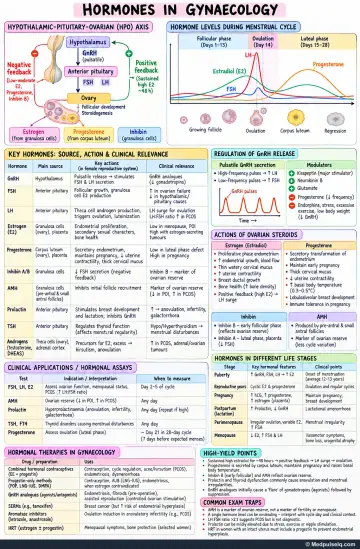
Concept 5
The Brain–Ovary Conversation (HPO Axis)
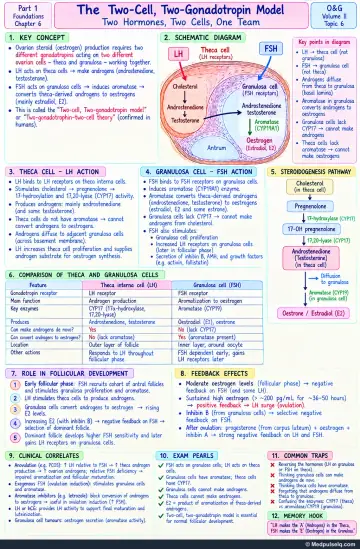
Concept 6
Two Hormones, Two Cells, One Team
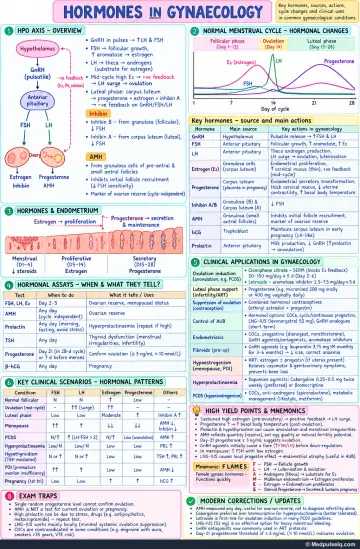
Concept 7
Estrogen and Progesterone: Build and Prepare
⚡ Rapid revision
The whole Part on one screen — read it the night before.
First safety moves
- Reproductive-age pain, amenorrhoea or bleeding: exclude pregnancy before clever diagnosis.
- Acute pelvic pain plus positive pregnancy test means ectopic until safely excluded.
- Postmenopausal bleeding, shock, sepsis, torsion-like pain and sexual assault need urgent escalation.
- Examination requires consent, privacy, explanation and chaperone-sensitive practice.
Development map
- SRY working leads to testes; Sertoli cells make AMH and Leydig cells make testosterone.
- AMH removes Müllerian ducts; testosterone supports Wolffian ducts; DHT supports male external genitalia.
- Müllerian ducts form tubes, uterus, cervix and upper vagina; ovaries arise separately from the genital ridge.
- DSD reasoning uses three axes: chromosomes, gonad and phenotype.
CAH and DSD anchors
- Classic 21-hydroxylase CAH: low cortisol, high ACTH, high 17-OHP, high androgens.
- Salt-wasting CAH adds low aldosterone with hyponatraemia, hyperkalaemia and shock.
- Use DSD terminology and multidisciplinary counselling; do not rush non-urgent irreversible decisions.
- Uterus absent versus present often tells whether AMH worked.
HPO and follicle physiology
- Pulsatile GnRH stimulates FSH/LH; continuous GnRH agonist flares then suppresses.
- Sustained high estradiol causes positive feedback and the LH surge.
- LH acts on theca to make androgen; FSH acts on granulosa aromatase to make estradiol.
- High FSH with low estrogen localises hypogonadism to ovarian failure.
Steroid effects
- Estrogen builds proliferative endometrium and thin cervical mucus.
- Progesterone makes secretory endometrium, thick mucus and a small temperature rise.
- Progesterone withdrawal causes menses.
- Unopposed estrogen causes irregular bleeding, hyperplasia risk and cancer concern.
🎯 Single‑best‑answer MCQs
Pick an answer to see the explanation — and the concept to revisit if you missed it. Your answers are saved on this device.
Score 0 / 00 of 15 answered
Question 1
A 30-year-old has acute pelvic pain and a delayed period. Which first test most directly protects against a missed emergency?
Question 2
Which cell and hormone pairing causes Müllerian duct regression in typical male differentiation?
Question 3
A 46,XX adolescent has normal breasts, normal ovaries and absent uterus. Which embryological fact explains this?
Question 4
A neonate with virilised genitalia has vomiting, hyponatraemia and hyperkalaemia. The most likely enzyme deficiency is:
Question 5
Why do long-acting GnRH agonists ultimately suppress ovarian steroid production?
Question 6
In the two-cell model, LH primarily stimulates which cell to make which substrate?
Question 7
Which hormone pattern best explains irregular bleeding and endometrial hyperplasia risk in chronic anovulation?
Question 8
A 46,XY patient has testes, female external phenotype and absent uterus. Which mechanism best explains the absent uterus?
Question 9
Which adult structure is mainly derived from the urogenital sinus rather than the Müllerian duct?
Question 10
The best immediate investigation set in a virilised unwell newborn is:
Question 11
Sustained high estradiol in the late follicular phase causes:
Question 12
Letrozole helps ovulation induction in many PCOS patients mainly by:
Question 13
Which cervical mucus pattern is expected under progesterone dominance?
Question 14
Which presentation is a red flag rather than routine outpatient reassurance?
Question 15
High FSH with low estradiol in amenorrhoea most directly localises the problem to:
🃏 Flashcards
Say the answer out loud before you flip. Shuffle once you know the order.
Card 1 of 17
🩺 Staged clinical cases
Read the presentation, decide what is going on and what you would do — then reveal the reasoning.
Case 1 — Missed period and fainting
Stage A: A 24-year-old presents with six weeks of amenorrhoea, lower abdominal pain and presyncope. Pulse is 118/min and BP is 88/56 mmHg.
Case 2 — Atypical genitalia in a newborn
Stage A: A term newborn has virilised genitalia. The baby is feeding poorly on day 9 and has vomiting.
Case 3 — Normal breasts, no periods
Stage A: A 16-year-old has primary amenorrhoea. Breasts are Tanner 5. She has normal pubic hair and no cyclic pain.
Case 4 — Oligomenorrhoea and hirsutism
Stage A: A 22-year-old has cycles every 50-70 days, acne and terminal facial hair. Pregnancy test is negative.
🎤 Viva practice
Answer aloud as if an examiner asked you — then check the model points.
Viva 1
What is the safest first question in reproductive-age pelvic pain?
Viva 2
What does SRY do?
Viva 3
Name the two key testicular fetal hormones and their jobs.
Viva 4
What are the Müllerian duct derivatives?
Viva 5
Why can MRKH have normal breasts?
Viva 6
What is the emergency in salt-wasting CAH?
Viva 7
What does continuous GnRH agonist therapy do after the initial flare?
Viva 8
State the two-cell model in one line.
Viva 9
What causes menstruation in a normal cycle?
Viva 10
Why must estrogen be opposed in an intact uterus?
Keep going
Educational only — not a substitute for clinical judgement, supervision, or local guidelines.