Loading…
🌸 Gynaecology · Part 2 revision hub
The menstrual cycle
Everything you need to revise this Part in one place — the one‑page note for every concept, a rapid‑revision sheet, exam‑style questions that point you back to the right concept, flashcards, staged cases and viva practice.
8 concepts16 MCQs18 flashcards3 cases12 viva questions
📝 The plate wall
Every concept in this Part as a one‑page handwritten note. Open one to read it in full and zoom.
Concept 8
The Ovary's Monthly Cycle
Concept 9
The LH Surge and Ovulation
Concept 10
The Corpus Luteum: the Ovary's Temporary Gland
Concept 11
The Womb Lining's Cycle
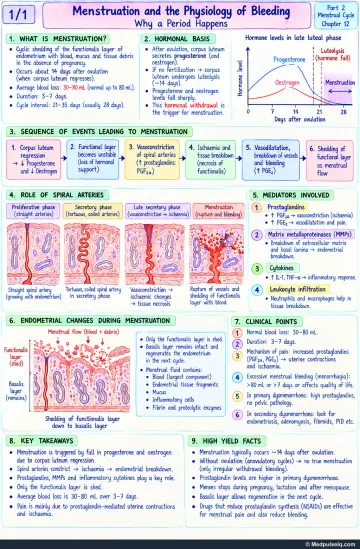
Concept 12
Why a Period Happens
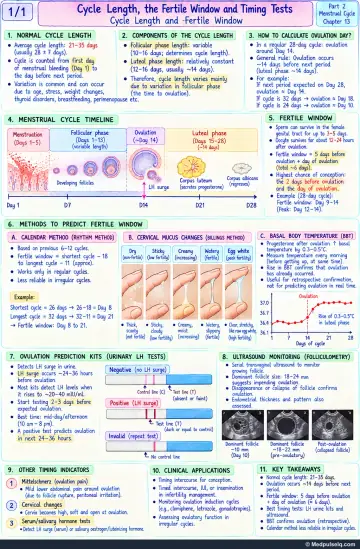
Concept 13
Cycle Length and the Fertile Window
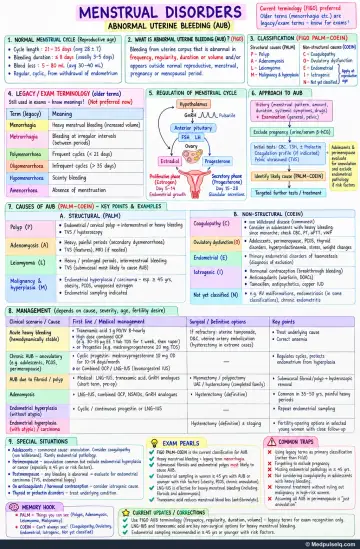
Concept 14
When Ovulation Doesn't Happen
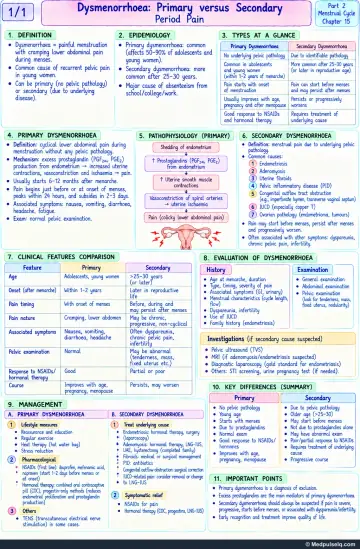
Concept 15
Period Pain (Dysmenorrhoea)
⚡ Rapid revision
The whole Part on one screen — read it the night before.
Cycle axis and ovulation
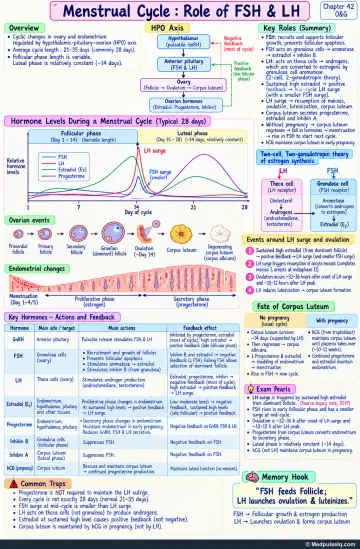
- Pulsatile GnRH drives FSH and LH; FSH supports granulosa cells and follicle growth, while LH supports theca androgen production and ovulation.
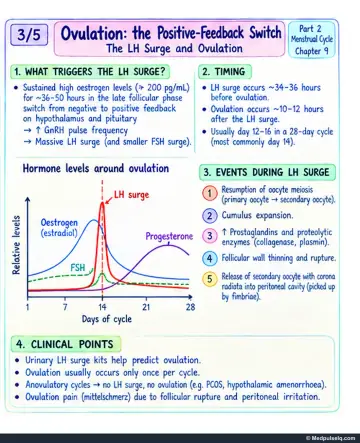
- Sustained high estradiol flips feedback positive and triggers the LH surge; ovulation follows about 32-36 hours after surge onset.
- FSH surge is smaller than the LH surge; the LH surge resumes meiosis and luteinises the follicle.
- The follicular phase varies; the luteal phase is relatively constant at about 14 days.
Luteal and endometrial logic
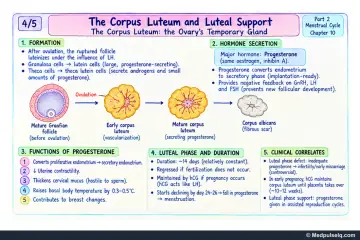
- Corpus luteum makes progesterone, estradiol and inhibin A; hCG rescues it in early pregnancy.
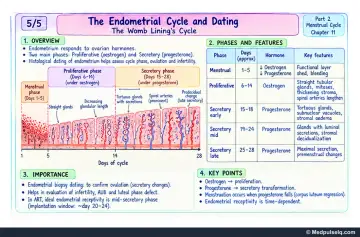
- Estradiol produces proliferative endometrium; progesterone produces secretory endometrium.
- Subnuclear vacuoles are the classic early histological sign of progesterone action after ovulation.
- Menstruation is progesterone withdrawal with prostaglandin rise, spiral-arteriole constriction and functionalis shedding.
Timing and fertile window
- Estimate ovulation by counting back about 14 days from the next period.
- Fertile window spans the 5 days before ovulation and the day of ovulation.
- Mid-luteal progesterone means about 7 days before expected menses, not automatically day 21.
- Estrogenic cervical mucus is thin, stretchy and sperm-permeable; progesterone makes it thick.
AUB and pain
- AUB is described by frequency, regularity, duration and volume; exclude pregnancy first in reproductive-age patients.
- PALM structural causes are polyp, adenomyosis, leiomyoma, malignancy and hyperplasia.
- COEIN non-structural causes are coagulopathy, ovulatory dysfunction, endometrial, iatrogenic and not yet classified.
- Primary dysmenorrhoea is prostaglandin pain with a normal pelvis; secondary dysmenorrhoea means search for disease.
🎯 Single‑best‑answer MCQs
Pick an answer to see the explanation — and the concept to revisit if you missed it. Your answers are saved on this device.
Score 0 / 00 of 16 answered
Question 1
A student asks why a 34-day cycle usually ovulates later than day 14. Which phase varies most?
Question 2
Which cell-hormone pairing is most accurate in the two-cell two-gonadotropin model?
Question 3
The immediate trigger for ovulation in a natural cycle is:
Question 4
Ovulation usually occurs:
Question 5
Which hormone rescues the corpus luteum in early pregnancy?
Question 6
No pregnancy occurs after ovulation. What event most directly leads to menstruation?
Question 7
Which histological finding is the classic early sign of post-ovulatory progesterone action?
Question 8
A proliferative endometrium is seen when secretory change was expected. The best interpretation is:
Question 9
Which sequence best explains normal menstruation?
Question 10
An adolescent reports heavy bleeding since menarche and easy bruising. Which PALM-COEIN group must be considered?
Question 11
A woman with regular 24-day cycles should have mid-luteal progesterone checked around:
Question 12
Which cervical mucus pattern best indicates the fertile window?
Question 13
In FIGO PALM-COEIN, leiomyoma belongs to:
Question 14
The first test in reproductive-age abnormal uterine bleeding is usually:
Question 15
Which feature most strongly suggests secondary rather than primary dysmenorrhoea?
Question 16
First-line treatment for typical primary dysmenorrhoea is best explained by:
🃏 Flashcards
Say the answer out loud before you flip. Shuffle once you know the order.
Card 1 of 18
🩺 Staged clinical cases
Read the presentation, decide what is going on and what you would do — then reveal the reasoning.
Case 1 — The misleading day-21 progesterone
Stage A: A 27-year-old trying to conceive has regular 35-day cycles. A day-21 progesterone is low, and she is told she is anovulatory.
Case 2 — Heavy irregular bleeding in a perimenopausal patient
Stage A: A 46-year-old with obesity and oligomenorrhoea has 8 months of irregular heavy bleeding and fatigue.
Linked concepts: 12. Why a Period Happens, 14. When Ovulation Doesn't Happen
Case 3 — Painful periods that are not just cramps
Stage A: A 19-year-old has worsening dysmenorrhoea, missed college, dyschezia during menses and little relief despite correctly used NSAIDs and combined pills for 5 months.
Linked concepts: 12. Why a Period Happens, 15. Period Pain (Dysmenorrhoea)
🎤 Viva practice
Answer aloud as if an examiner asked you — then check the model points.
Viva 1
Why does the follicular phase vary more than the luteal phase?
Viva 2
What converts estradiol feedback from negative to positive?
Viva 3
What is the clinical use of a urinary LH kit?
Viva 4
What rescues the corpus luteum in pregnancy?
Viva 5
What does secretory endometrium tell you?
Viva 6
Why does a period happen?
Viva 7
How do you time mid-luteal progesterone?
Viva 8
Define AUB in current terms.
Viva 9
List PALM causes.
Viva 10
List COEIN causes.
Viva 11
What separates primary from secondary dysmenorrhoea?
Viva 12
When should endometriosis be suspected in an adolescent with period pain?
Keep going
Educational only — not a substitute for clinical judgement, supervision, or local guidelines.