Loading…
❤️ Physiology · Part 12 revision hub
Integrated Physiology
Everything you need to revise this Part in one place — the one‑page note for every concept, a rapid‑revision sheet, exam‑style questions that point you back to the right concept, flashcards, staged cases and viva practice.
4 concepts20 MCQs20 flashcards5 cases15 viva questions
📝 The plate wall
Every concept in this Part as a one‑page handwritten note. Open one to read it in full and zoom.
⚡ Rapid revision
The whole Part on one screen — read it the night before.
Temperature
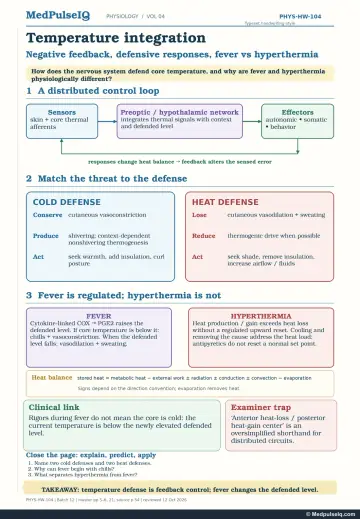
- Heat balance: S = M − W ± R ± C ± K − E. Radiation dominates at rest; evaporation is the only route when air > skin temperature; humidity defeats it.
- Preoptic area integrates; cold → vasoconstriction, shivering, brown fat (β₃/UCP1); heat → vasodilation, sweating (sympathetic cholinergic).
- Fever: cytokines → COX‑2 → PGE₂ → EP3 → raised set point → rigors. Antipyretics work.
- Hyperthermia (heat stroke, MH, NMS, serotonin syndrome): set point normal — cool or treat cause; MH → dantrolene.
- Heat stroke = core > 40 °C + CNS dysfunction → rapid cooling (< 39 °C within 30 min).
- Hypothermia: mild 32–35, moderate 28–32 (shivering stops, J waves), severe < 28 (VF). "Not dead until warm and dead."
Exercise
- Fick: VO₂ = CO × (CaO₂ − CvO₂). 1 MET ≈ 3.5 mL/kg/min.
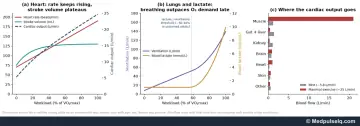
- CO 5 → 25 L/min; HR keeps rising; SV plateaus ~40–60% VO₂max; a–v O₂ difference 5 → 15 mL/dL.
- Central command + exercise pressor reflex + baroreflex reset. Functional sympatholysis in muscle; splanchnic/renal constriction.
- SBP ↑, DBP ↔/↓ (dynamic); isometric → DBP ↑.
- Ventilatory threshold: HCO₃⁻ buffering of lactic acid → extra CO₂ → VE/VCO₂ ↑.
- VO₂max limited mainly by O₂ delivery (cardiac output). High VE/VCO₂ slope = poor prognosis in heart failure.
- Endurance: eccentric hypertrophy, ↑ SV, bradycardia, ↑ mitochondria. Resistance: fibre hypertrophy.
Altitude, diving, space, birth
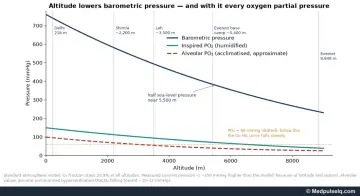
- PiO₂ = 0.21 × (PB − 47); PB ≈ ½ at 5,500 m; summit PiO₂ ≈ 43 mmHg.
- Acclimatisation: hypoxic ventilatory response (carotid body) → renal HCO₃⁻ loss → 2,3‑BPG → EPO (HIF‑2α).
- AMS (headache); HACE (ataxia, confusion — dexamethasone); HAPE (uneven HPV — nifedipine); all → descend + O₂. Acetazolamide prevents.
- Diving: +1 atm per 10 m. Boyle → barotrauma, AGE; Henry → DCS; O₂ toxicity > 1.4–1.6 atm. Treat with 100% O₂ and recompression.
- Microgravity: cephalad fluid shift, ↓ plasma volume, orthostatic intolerance, bone loss ~1–1.5%/month, SANS.
- Fetal: high PVR, low SVR; ductus venosus, foramen ovale, ductus arteriosus; HbF P50 ~19 mmHg; RV dominant.
- Birth: aeration → PVR falls; cord clamped → SVR rises; LA > RA → FO closes; ↑ PO₂, ↓ PGE₂ → ductus closes (24–72 h).
- PGE₁ keeps the duct open (duct‑dependent lesions); NSAIDs/paracetamol close a PDA.
🎯 Single‑best‑answer MCQs
Pick an answer to see the explanation — and the concept to revisit if you missed it. Your answers are saved on this device.
Score 0 / 00 of 20 answered
Question 1
The mediator that raises the hypothalamic set point in fever is:
Question 2
In hot, humid conditions, the heat‑loss route that becomes ineffective is:
Question 3
Paracetamol is ineffective in heat stroke because:
Question 4
Malignant hyperthermia is treated with:
Question 5
J (Osborn) waves on the ECG are characteristic of:
Question 6
During incremental exercise, the variable that plateaus earliest is:
Question 7
During dynamic exercise, diastolic blood pressure typically:
Question 8
VO₂max in a healthy untrained person is limited mainly by:
Question 9
The ventilatory threshold occurs because:
Question 10
Endurance training lowers resting heart rate mainly by:
Question 11
At the summit of Everest, the fraction of oxygen in inspired air is about:
Question 12
The first response to acute ascent to high altitude is:
Question 13
Acetazolamide prevents acute mountain sickness by:
Question 14
High‑altitude pulmonary oedema results from:
Question 15
Decompression sickness is best explained by:
Question 16
In the fetus, the ductus venosus allows blood to bypass the:
Question 17
Fetal haemoglobin has a higher O₂ affinity because it:
Question 18
The foramen ovale closes at birth because:
Question 19
A drug used to keep the ductus arteriosus open in duct‑dependent congenital heart disease is:
Question 20
Antenatal corticosteroids are given before preterm delivery chiefly to:
🃏 Flashcards
Say the answer out loud before you flip. Shuffle once you know the order.
Card 1 of 20
🩺 Staged clinical cases
Read the presentation, decide what is going on and what you would do — then reveal the reasoning.
Case 1 — Collapse on a construction site in May
Stage A: A 28‑year‑old labourer working outdoors in 46 °C heat with high humidity collapses, confused and combative. Skin hot; HR 140/min; BP 88/50 mmHg; rectal temperature 41.8 °C.
Linked concepts: 127. Body Temperature and Fever, 128. Exercise
Case 2 — Breathless trekker at Leh
Stage A: A 35‑year‑old from Chennai flies to Leh (~3,500 m) and treks to 4,500 m on day 2. On night 3 he is breathless at rest with a cough producing pink frothy sputum. SpO₂ 62% on air; crackles at the right base.
Linked concepts: 129. High Mountains, Deep Water and Space, 66. Concept 66
Case 3 — Joint pain after a dive in the Andamans
Stage A: A 40‑year‑old diver completed two dives to 30 m, ascending rapidly from the second after running low on air. Two hours later he has deep shoulder pain, a mottled rash and tingling in both legs.
Linked concepts: 129. High Mountains, Deep Water and Space
Case 4 — A newborn who turns grey on day 3
Stage A: A term baby, well at birth, becomes poorly feeding, tachypnoeic and grey on day 3. Femoral pulses are weak; right‑arm BP is much higher than leg BP.
Linked concepts: 130. Before and After Birth, 51. Concept 51
Case 5 — Breathless on exertion: heart or lungs?
Stage A: A 58‑year‑old with previous anterior MI complains of breathlessness climbing one flight of stairs. Resting echo shows LVEF 35%. He also smokes.
Linked concepts: 128. Exercise, 50. Concept 50
🎤 Viva practice
Answer aloud as if an examiner asked you — then check the model points.
Viva 1
List the routes of heat loss and when each dominates.
Viva 2
Explain the mechanism of fever.
Viva 3
Differentiate fever from hyperthermia.
Viva 4
Describe the stages of hypothermia.
Viva 5
Write the Fick equation for exercise.
Viva 6
How does blood flow redistribute during exercise?
Viva 7
What is central command?
Viva 8
Explain the ventilatory threshold.
Viva 9
Describe the effects of endurance training.
Viva 10
Describe acclimatisation to high altitude.
Viva 11
What is HAPE and how is it treated?
Viva 12
Explain decompression sickness.
Viva 13
What happens to the body in microgravity?
Viva 14
Describe the fetal circulation.
Viva 15
What changes occur at birth?
Keep going
Educational only — not a substitute for clinical judgement, supervision, or local guidelines.