Loading…
❤️ Physiology · Part 6 revision hub
Respiratory Physiology
Everything you need to revise this Part in one place — the one‑page note for every concept, a rapid‑revision sheet, exam‑style questions that point you back to the right concept, flashcards, staged cases and viva practice.
15 concepts20 MCQs20 flashcards4 cases15 viva questions
📝 The plate wall
Every concept in this Part as a one‑page handwritten note. Open one to read it in full and zoom.
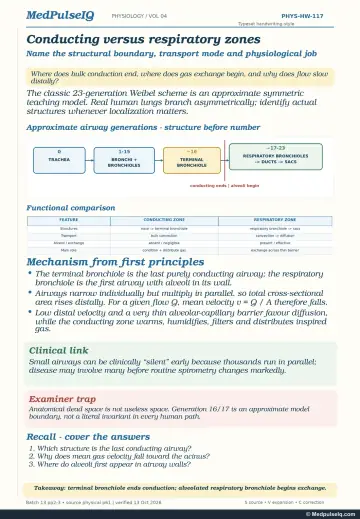
Concept 57
Airways and the Lung's Cleaning System
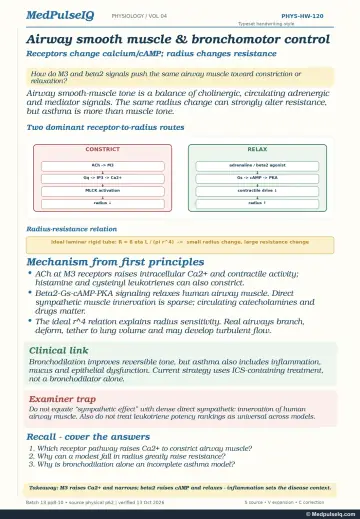
Concept 58
Airway Muscle and Resistance
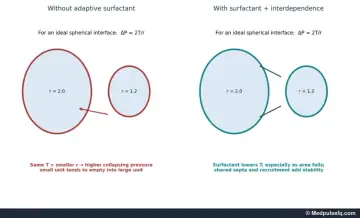
Concept 59
Surfactant: keeping the air sacs open
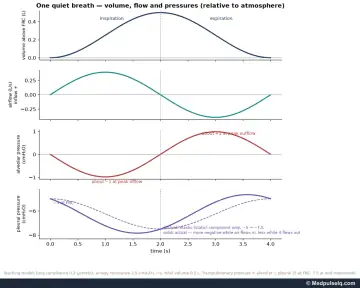
Concept 60
How a Breath Happens
Concept 61
Compliance and the Work of Breathing
Concept 62
Lung Volumes and Capacities
Concept 63
Spirometry and Flow–Volume Loops
Concept 64
Fresh Air and Dead Space
Concept 65
The Lung's Own Circulation
Concept 66
Matching Air to Blood
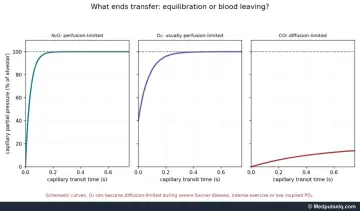
Concept 67
Crossing the Membrane: diffusion
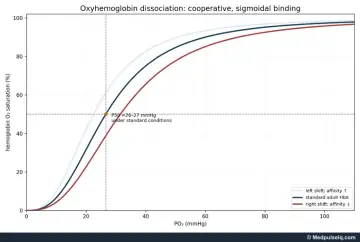
Concept 68
Carrying Oxygen
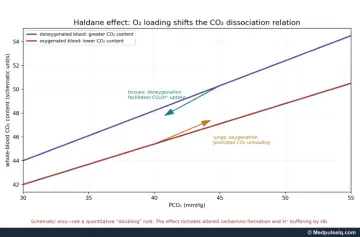
Concept 69
Carrying Carbon Dioxide
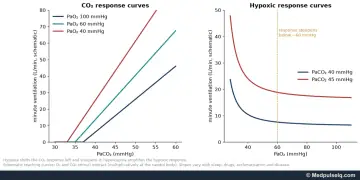
Concept 70
Who Tells Us to Breathe?
Concept 71
Hypoxia, Cyanosis and Oxygen Therapy
⚡ Rapid revision
The whole Part on one screen — read it the night before.
Structure and mechanics
- Conducting zone to terminal bronchiole (~gen 16, dead space ~150 mL); respiratory bronchiole is the first alveolated airway.
- Mucociliary clearance: mucus gel + hydrated periciliary layer + 9+2 cilia (dynein) + cough. CF dehydrates; PCD paralyses.
- Raw highest in medium bronchi; falls with lung volume; M3/Ca²⁺ constricts, β₂/cAMP relaxes; asthma = muscle + inflammation + mucus.
- Laplace P = 2T/r; surfactant (DPPC, SP‑B/C mechanics, SP‑A/D defence) from AT2 cells ↑ compliance, stabilises alveoli, keeps them dry.
- FRC: Palv 0, Ppl ≈ −5, Ptp ≈ +5 cmH₂O; end‑inspiration Ppl ≈ −7.5. Quiet expiration passive.
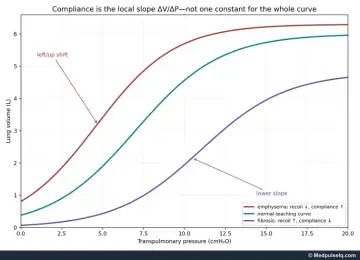
- CL ≈ Ccw ≈ 0.2 L/cmH₂O; Crs ≈ 0.1. Fibrosis ↓C; emphysema ↑C, ↓ recoil. τ = R × C. PIP − Pplat = resistive load.
Volumes and tests
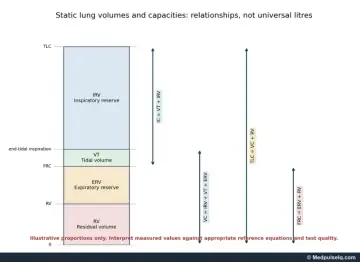
- TV 0.5, IRV 3, ERV 1.1, RV 1.2, FRC 2.3, VC 4.6, TLC 5.8 L. Spirometry cannot measure RV/FRC/TLC.
- Helium dilution/N₂ washout miss trapped gas; plethysmography includes it.
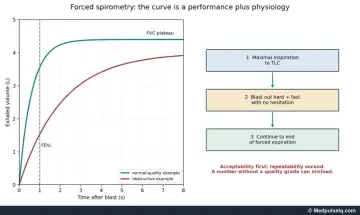
- Obstruction: FEV₁/FVC < LLN (GOLD < 0.70 post‑BD). Restriction: TLC < LLN.
- Flow–volume: variable extrathoracic → inspiratory flattening; variable intrathoracic → expiratory; fixed → both.
- DLCO ↓ emphysema, ILD, PVD, anaemia; ↑ polycythaemia, haemorrhage, asthma, shunt.
Gas exchange and transport
- V̇A = (VT − VD) × f; PaCO₂ = 0.863 × V̇CO₂/V̇A; PAO₂ = FIO₂(PB − 47) − PaCO₂/0.8 ≈ 100 mmHg.
- Normal A–a 5–15 (≈ age/4 + 4). Hypoxaemia: low PIO₂, hypoventilation (normal A–a), V/Q mismatch, shunt (O₂‑refractory), diffusion.
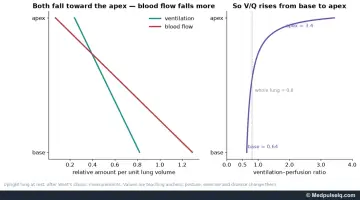
- V/Q ≈ 0.8; apex ~3, base ~0.6. HPV: local help, global harm (PH).
- PH: mPAP > 20 mmHg; pre‑capillary PVR > 2 WU, PAWP ≤ 15.
- CaO₂ = 1.34 × Hb × SaO₂ + 0.003 × PaO₂ ≈ 20 mL/dL; DO₂ ≈ 1,000; V̇O₂ ≈ 250 mL/min; P50 ≈ 27.
- Right shift: CO₂, H⁺, heat, 2,3‑BPG. Left: HbF, CO, MetHb, alkalosis, cold.
- CO₂: ~70% HCO₃⁻ (CA + chloride shift), ~20–25% carbamino, ~5–10% dissolved. Haldane: O₂ loading unloads CO₂.
Control and hypoxia
- preBötC rhythm; central chemoreceptors → CO₂/H⁺ (main driver); carotid bodies → PaO₂ < ~60, acidosis.
- Cheyne–Stokes (HF), Kussmaul (metabolic acidosis), ataxic (medulla), apneustic (pons).
- Hypoxia: hypoxaemic, anaemic, stagnant, histotoxic (↓ extraction, ↑ SvO₂).
- O₂ targets 94–98%; 88–92% if hypercapnic risk. O₂‑induced hypercapnia: V/Q (HPV release) + Haldane > drive.
🎯 Single‑best‑answer MCQs
Pick an answer to see the explanation — and the concept to revisit if you missed it. Your answers are saved on this device.
Score 0 / 00 of 20 answered
Question 1
The first airway generation that contains alveoli in its wall is the:
Question 2
Most normal airway resistance resides in:
Question 3
Surfactant stabilises alveoli of different sizes mainly because:
Question 4
Which factor delays fetal surfactant maturation?
Question 5
At FRC, intrapleural pressure is negative because:
Question 6
In a ventilated patient PIP rises from 25 to 40 cmH₂O while plateau pressure stays at 20. The likely problem is:
Question 7
Lung compliance is increased in:
Question 8
Which method detects gas trapped behind closed airways?
Question 9
FEV₁ 2.0 L, FVC 2.3 L, TLC 62% predicted. The pattern is:
Question 10
A flattened inspiratory limb with a normal expiratory limb suggests:
Question 11
VT 450 mL, VD 150 mL, rate 16/min. Alveolar ventilation is:
Question 12
On room air at sea level, PaCO₂ 60 mmHg, R 0.8. Expected PAO₂ is about:
Question 13
Hypoxic pulmonary vasoconstriction:
Question 14
Hypoxaemia that fails to correct with 100% oxygen is most consistent with:
Question 15
PaO₂ 55 mmHg, PaCO₂ 70 mmHg on air; PAO₂ calculates to 62.5 mmHg. The mechanism is:
Question 16
DLCO is typically increased in:
Question 17
Which shifts the oxyhaemoglobin curve to the left?
Question 18
Hb 8 g/dL, SaO₂ 98%, PaO₂ 95 mmHg. Arterial O₂ content is about:
Question 19
The chloride shift refers to:
Question 20
The main stimulus for ventilation in a healthy person at rest is:
🃏 Flashcards
Say the answer out loud before you flip. Shuffle once you know the order.
Card 1 of 20
🩺 Staged clinical cases
Read the presentation, decide what is going on and what you would do — then reveal the reasoning.
Case 1 — The breathless smoker with a barrel chest
Stage A: A 64‑year‑old with 40 pack‑years has progressive exertional breathlessness. FEV₁ 1.1 L (40% predicted), FVC 2.9 L, FEV₁/FVC 0.38 post‑bronchodilator.
Case 2 — Hypoxic on 15 litres
Stage A: A 30‑year‑old with severe pancreatitis develops bilateral infiltrates. On a non‑rebreather mask SpO₂ is 86%; PaO₂ 58 mmHg on FIO₂ ~0.8.
Case 3 — Headache in a closed room
Stage A: A family of four presents in winter with headache, nausea and drowsiness after sleeping with a charcoal brazier indoors. SpO₂ readings are 98–99%.
Linked concepts: 68. Carrying Oxygen, 71. Hypoxia, Cyanosis and Oxygen Therapy
Case 4 — Drowsy on oxygen with COPD
Stage A: A man with severe COPD is given 15 L/min oxygen in the ambulance. On arrival SpO₂ is 99%, he is drowsy; pH 7.21, PaCO₂ 82 mmHg, PaO₂ 180 mmHg.
🎤 Viva practice
Answer aloud as if an examiner asked you — then check the model points.
Viva 1
Distinguish the conducting and respiratory zones.
Viva 2
Describe mucociliary clearance.
Viva 3
What is surfactant and its functions?
Viva 4
Explain the law of Laplace in the lung.
Viva 5
Describe the pressure changes in a quiet breath.
Viva 6
Define compliance and give values.
Viva 7
What is hysteresis?
Viva 8
Why can't spirometry measure RV?
Viva 9
Differentiate obstructive and restrictive patterns.
Viva 10
What is physiological dead space?
Viva 11
State the alveolar gas equation.
Viva 12
What are West zones?
Viva 13
List causes of hypoxaemia with normal A–a gradient.
Viva 14
Describe CO₂ transport.
Viva 15
Classify hypoxia.
Keep going
Educational only — not a substitute for clinical judgement, supervision, or local guidelines.