Loading…
🩻 Radiology · Part 7 revision hub
Genitourinary, Obstetric and Breast Imaging
Everything you need to revise this Part in one place — the one‑page note for every concept, a rapid‑revision sheet, exam‑style questions that point you back to the right concept, flashcards, staged cases and viva practice.
8 concepts20 MCQs20 flashcards4 cases15 viva questions
📝 The plate wall
Every concept in this Part as a one‑page handwritten note. Open one to read it in full and zoom.
⚡ Rapid revision
The whole Part on one screen — read it the night before.
Urinary tract
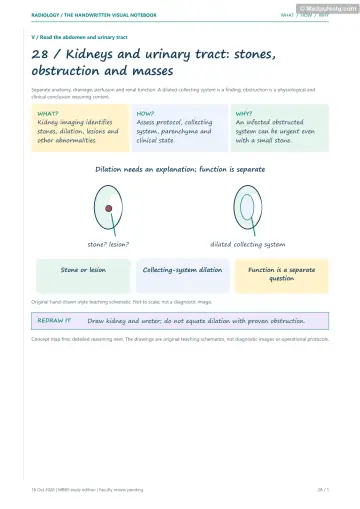
- Renal colic: NCCT KUB (adults); US (pregnancy, children). Positive contrast hides stones.
- Calcium oxalate commonest; struvite = staghorn (Proteus); uric acid = X‑ray lucent, CT visible (DECT, dissolvable); cystine = ground glass; indinavir = CT invisible.
- Rim sign = ureteric stone; comet tail = phlebolith. Impaction: PUJ, pelvic brim, VUJ. Steinstrasse after ESWL.
- Obstructed infected kidney = emergency drainage. Medullary nephrocalcinosis: MSK, RTA type 1, HPT; cortical: cortical necrosis.
- Pyelonephritis: striated nephrogram. Emphysematous pyelonephritis: parenchymal gas, diabetics. XGP: staghorn + bear paw. Renal TB: moth‑eaten calyx, phantom calyx, Kerr kink, thimble bladder, putty kidney, beaded ureter.
- Bosniak 2019: I/II benign; IIF follow; III ~50%; IV enhancing nodule (surgery). AML = macroscopic fat (TS; bleed > 4 cm). RCC: enhancing, renal vein/IVC thrombus, VHL. Oncocytoma: central scar, spoke‑wheel. TCC: filling defect, goblet sign, stipple sign; CT urography. Wilms': claw sign, displaces vessels; neuroblastoma: calcified, encases vessels.
- Horseshoe: isthmus below IMA, anterior to aorta; PUJ obstruction, stones, Wilms'. Weigert–Meyer: upper moiety obstructs (inferomedial, ureterocele, ectopic, dribbling girl); lower moiety refluxes. Drooping lily. Cobra head = ureterocele. Reverse J = retrocaval ureter.
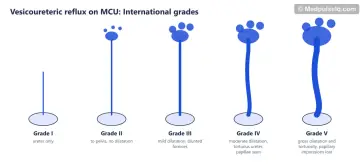
- CT urography for haematuria; MCU for VUR/PUV; RGU for anterior urethra (strictures, injury; before catheter if blood at meatus). VUR grades I–V (V: papillary impressions lost). PUV: dilated posterior urethra + shelf; antenatal keyhole.
- Bladder TCC: CTU + cystoscopy; VI‑RADS. Schistosomiasis: wall calcification, SCC. Christmas‑tree bladder = neurogenic. BPH: J‑shaped ureters.
- Prostate cancer: peripheral zone, mpMRI PI‑RADS v2.1 (DWI dominant PZ, T2 dominant TZ), sclerotic mets, PSMA PET.
- Scrotum: torsion = absent flow, whirlpool, operate first; epididymo‑orchitis = increased flow; intratesticular solid = malignant (seminoma); nodes drain to renal hilum; new right varicocele → retroperitoneal mass.
Obstetrics, gynaecology and breast
- TVS: sac ~5 wk, heartbeat ~6 wk; discriminatory β‑hCG ~1500–3500. CRL dates best. Failed pregnancy: CRL ≥ 7 mm no heartbeat or MSD ≥ 25 mm no embryo. Chorionicity: λ sign (DCDA) vs T sign (MC).
- NT 11–13⁺⁶ weeks (≥ 3.5 mm abnormal). Anomaly scan 18–22 weeks. Lemon + banana = spina bifida. Anencephaly earliest major anomaly. Gastroschisis (right, no membrane) vs omphalocele (midline, membrane, aneuploidy).
- Polyhydramnios: atresias, diabetes, anencephaly. Oligohydramnios: renal agenesis, PUV, ROM, FGR. Absent/reversed EDF = severe placental insufficiency. MCA PSV = fetal anaemia. Praevia: TVS. Accreta: previous caesarean, lacunae, lost clear zone.
- PC‑PNDT Act 1994/2003: sex determination/disclosure prohibited; register every machine; Form F for every pregnant woman; records 2 years; display board; imprisonment and deregistration.
- Haemorrhagic cyst = lace‑like; endometrioma = ground glass (T1 bright, T2 shading); dermoid = tip of the iceberg, dot‑dash, fat; malignant = solid with flow (O‑RADS); PCOS ≥ 20 follicles; torsion = enlarged ovary, peripheral follicles, whirlpool (flow may persist).
- Ectopic assessment: an empty uterus is non-diagnostic; look for adnexal ring (ring of fire), haemoperitoneum; pseudosac vs double decidual sign. Complete mole: snowstorm, no fetus, theca‑lutein cysts, very high β‑hCG.
- Fibroid T2 dark; adenomyosis JZ ≥ 12 mm, venetian blind; PMB endometrium > 4 mm → biopsy; cervical cancer staging MRI; HSG beaded tubes = TB.
- Breast: < 30 → US; ≥ 40 → mammography (CC + MLO); high risk → MRI. Spiculated mass most specific; fine linear branching calcification = DCIS; popcorn = fibroadenoma; taller‑than‑wide + shadowing = malignant. BI‑RADS 2025: 0 incomplete, 1 negative, 2 benign, 3 ≤ 2% (6‑month), 4 biopsy (A/B/C), 5 ≥ 95%, 6 proven.
🎯 Single‑best‑answer MCQs
Pick an answer to see the explanation — and the concept to revisit if you missed it. Your answers are saved on this device.
Score 0 / 00 of 20 answered
Question 1
The investigation of choice for suspected ureteric colic in a non‑pregnant adult is:
Question 2
A urinary calculus not visible on a plain radiograph but clearly seen on CT is most likely:
Question 3
A staghorn calculus is typically composed of:
Question 4
A renal lesion containing macroscopic fat (−40 HU) on CT is most likely:
Question 5
A renal cyst with an enhancing soft‑tissue nodule is classified as:
Question 6
Gas within the renal parenchyma in a septic diabetic patient indicates:
Question 7
According to the Weigert–Meyer rule, the upper‑moiety ureter of a complete duplex kidney:
Question 8
A "reverse J" or fish‑hook deformity of the right proximal ureter suggests:
Question 9
The investigation of choice to diagnose posterior urethral valves is:
Question 10
A man with a pelvic fracture has blood at the urethral meatus. Before catheterisation, the appropriate investigation is:
Question 11
In vesicoureteric reflux, gross dilatation and tortuosity of the ureter with loss of papillary impressions is grade:
Question 12
A 14‑year‑old has sudden severe testicular pain for 2 hours with a high‑riding testis. The best next step is:
Question 13
The imaging modality of choice to localise clinically significant prostate cancer before biopsy is:
Question 14
The most accurate parameter for dating a pregnancy in the first trimester is:
Question 15
The lemon and banana signs on a mid‑trimester scan indicate:
Question 16
Under the PC‑PNDT Act, which record must be maintained for every pregnant woman undergoing ultrasonography?
Question 17
An adnexal cyst with a reticular "lace‑like" internal pattern and no internal vascularity is most likely:
Question 18
A "snowstorm" appearance in the uterus with markedly raised β‑hCG and bilateral multiloculated ovarian cysts suggests:
Question 19
The first imaging investigation for a palpable breast lump in a 25‑year‑old woman is:
Question 20
A BI‑RADS 3 lesion has a likelihood of malignancy of:
🃏 Flashcards
Say the answer out loud before you flip. Shuffle once you know the order.
Card 1 of 20
🩺 Staged clinical cases
Read the presentation, decide what is going on and what you would do — then reveal the reasoning.
Case 1 — Febrile colic in a diabetic
Stage A: A 54‑year‑old diabetic woman has right loin pain, fever 39.5 °C, rigors and hypotension. US: moderate right hydronephrosis.
Linked concepts: 85. Kidney Stones, 86. Kidney Infections and Lumps
Case 2 — The incidental renal cyst
Stage A: A 49‑year‑old has a 3.5 cm left renal cyst on CT done for diverticulitis: two thin septa, no enhancement, 15 HU.
Linked concepts: 86. Kidney Infections and Lumps
Case 3 — The young woman with pelvic pain
Stage A: A 24‑year‑old with 7 weeks' amenorrhoea has lower abdominal pain and spotting. Urine pregnancy test positive. β‑hCG 3800 IU/L. BP 96/60 mmHg.
Linked concepts: 91. Imaging the Uterus and Ovaries, 90. Pregnancy Scans
Case 4 — The breast lump at 26
Stage A: A 26‑year‑old has a painless, mobile 2 cm lump in the left breast.
Linked concepts: 92. Breast Imaging
🎤 Viva practice
Answer aloud as if an examiner asked you — then check the model points.
Viva 1
Why is NCCT the IOC for renal colic?
Viva 2
How do you distinguish a ureteric calculus from a phlebolith on CT?
Viva 3
What is the significance of an obstructed infected kidney?
Viva 4
Describe the Bosniak classification.
Viva 5
What are the imaging features of renal TB?
Viva 6
Explain the Weigert–Meyer rule.
Viva 7
What are the radiological features of a horseshoe kidney?
Viva 8
How is vesicoureteric reflux graded?
Viva 9
What are the MCU features of posterior urethral valves?
Viva 10
How do you differentiate testicular torsion from epididymo‑orchitis on Doppler?
Viva 11
What is assessed at the NT scan?
Viva 12
Summarise the key provisions of the PC‑PNDT Act.
Viva 13
List the TVS signs of ectopic pregnancy.
Viva 14
How do you differentiate a dermoid from an endometrioma?
Viva 15
What are the BI‑RADS categories and their management?
Keep going
Educational only — not a substitute for clinical judgement, supervision, or local guidelines.