Loading…
Chest radiograph — fluid in the pleural cavity
Plain radiograph · Posteroanterior, erect · Thorax
Before you comment on anything
This film is really an anatomy question dressed as a radiology one. The pleural cavity is a closed potential space, and in the erect position its most dependent part is the costophrenic recess. So fluid goes there first, and the sharp angle you were taught to look for disappears. Name the anatomy and the finding explains itself.
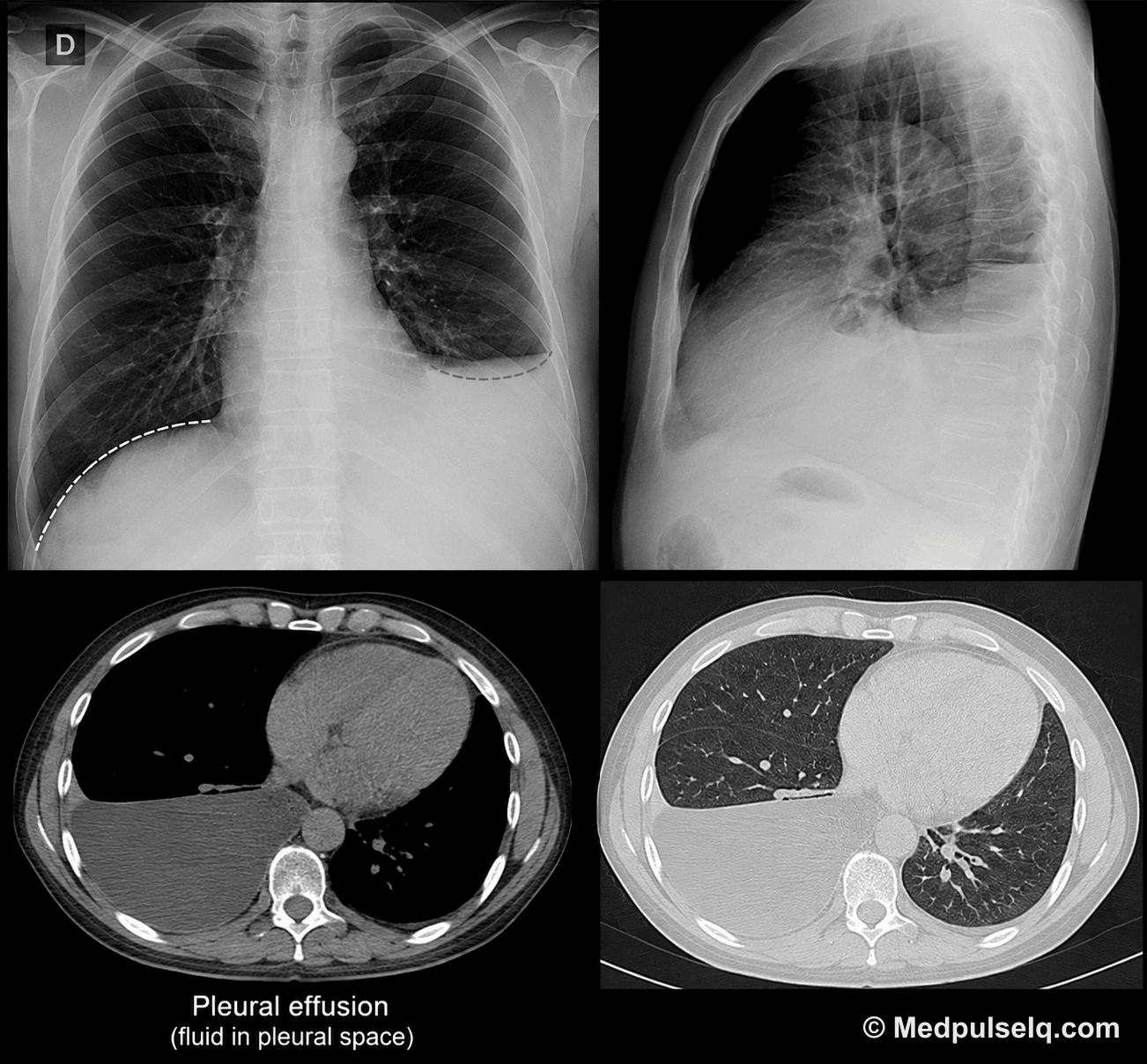
Plain radiograph · Posteroanterior, erect · © MedpulseIq.com
Read it in order
0 of 8
Work down the list. The answer unlocks when you have been through all of it.
Landmarks to name
Costophrenic recess
The acute angle where the hemidiaphragm meets the chest wall laterally
The most dependent part of the erect pleural cavity, so the first place fluid collects.
Meniscus sign
The upper limit of the opacity, concave and rising laterally
Reflects surface tension and the shape of the pleural cavity, and distinguishes fluid from consolidation.
Hemidiaphragm outline
The dome at the lung base
The silhouette is lost where soft-tissue density lies directly against it.
Trachea and mediastinum
Midline of the upper chest
A large collection pushes them away; collapse pulls them towards the abnormal side.
Viva voce
1 of 5 · 0 answeredSay your answer out loud before you open it. That is the exam skill.
Why does fluid collect at the costophrenic angle first in an erect patient?
Senior’s 30-second takeaway
Chest radiograph — fluid in the pleural cavity — the whole bench in four lines. Read this on the way in.
- If you see this
- A blunted costophrenic angle · A homogeneous basal opacity with a concave upper margin · Loss of the hemidiaphragm outline
- If asked to identify it
- There is a homogeneous basal opacity with a meniscus and blunting of the costophrenic angle.
- If asked one more
- The costodiaphragmatic recess is the most dependent part of the erect pleural cavity.
- If asked why it matters
- Mediastinal shift away from the side indicates a large collection under tension of volume.
Then stop. Let the examiner ask the next question.