Loading…
Erect chest radiograph — gas beneath the diaphragm
Plain radiograph · Erect, including both domes of the diaphragm · Upper abdomen and thorax
Before you comment on anything
A film worth understanding as pure anatomy. The peritoneal cavity is a closed sac; gas inside it rises to the highest point, and in an erect patient that is under the domes of the diaphragm. On the right the liver sits immediately beneath, so a black rim there is unmistakable. On the left the stomach bubble is normal, which is exactly why students are caught out.
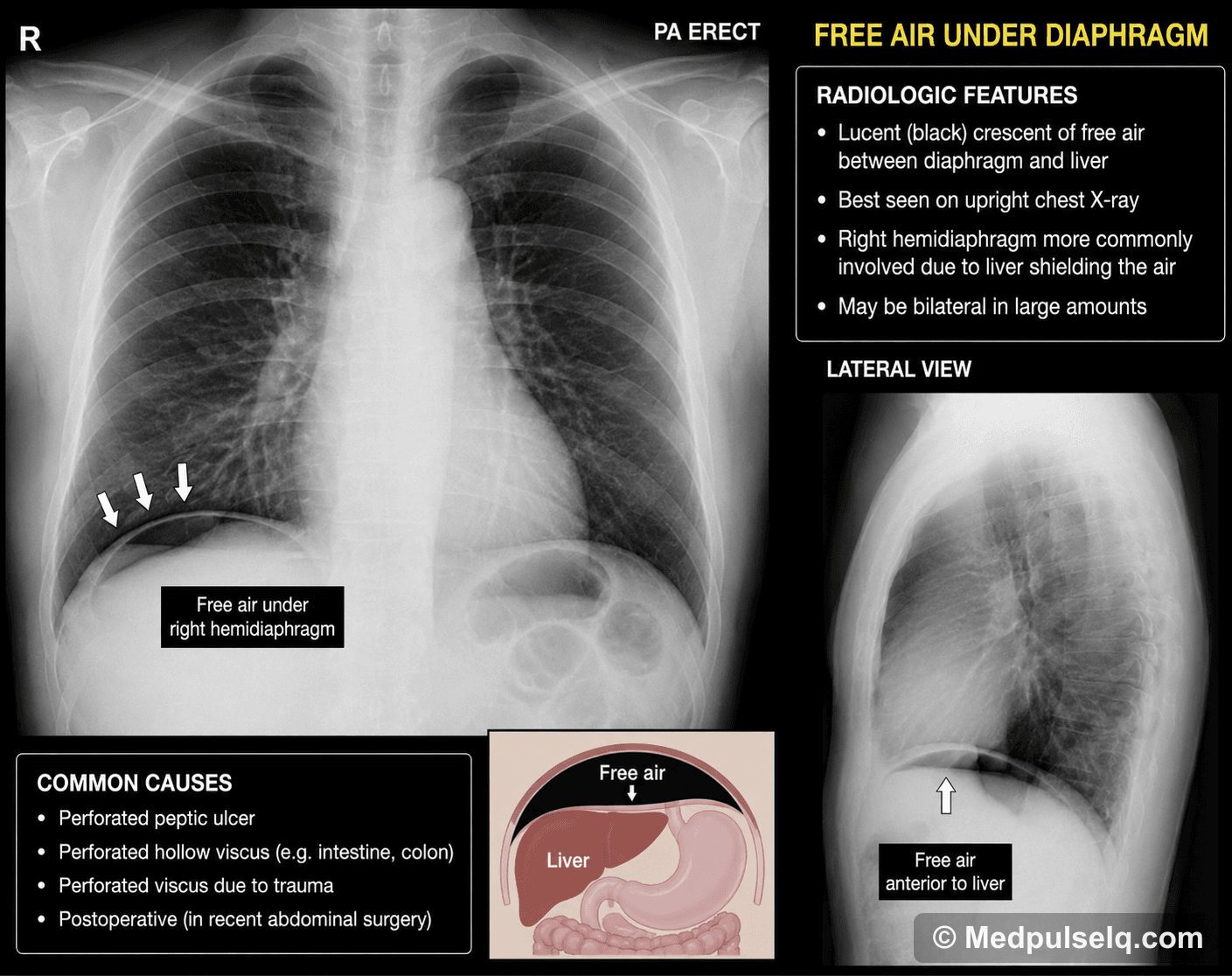
Plain radiograph · Erect, including both domes of the diaphragm · © MedpulseIq.com
Read it in order
0 of 5
Work down the list. The answer unlocks when you have been through all of it.
Landmarks to name
Right hemidiaphragm
The dome above the liver
Normally the liver lies in direct contact with it, so no gas should separate the two.
Liver shadow
The homogeneous soft-tissue density under the right dome
It provides the contrast that makes a crescent of gas obvious.
Gastric bubble
Beneath the left hemidiaphragm
A normal finding, and the commonest reason a student wrongly reports free gas on the left.
Costophrenic angles
Laterally at each lung base
Confirm the translucency is subdiaphragmatic rather than basal lung.
Viva voce
1 of 5 · 0 answeredSay your answer out loud before you open it. That is the exam skill.
Why is an erect film needed to demonstrate free peritoneal gas?
Senior’s 30-second takeaway
Erect chest radiograph — gas beneath the diaphragm — the whole bench in four lines. Read this on the way in.
- If you see this
- An erect film including both domes · A black crescent under the right dome · Clear lung bases above it
- If asked to identify it
- There is a translucent crescent between the right hemidiaphragm and the liver on this erect film.
- If asked one more
- Gas rises to the highest point of the peritoneal cavity, which is subphrenic when erect.
- If asked why it matters
- This means perforation of a hollow viscus until proved otherwise.
Then stop. Let the examiner ask the next question.