Loading…
🩺 Medicine · Part 5 revision hub
Neurology II — Spinal Cord, Movement, Cognition and Stroke
Everything you need to revise this Part in one place — the one‑page note for every concept, a rapid‑revision sheet, exam‑style questions that point you back to the right concept, flashcards, staged cases and viva practice.
20 concepts20 MCQs20 flashcards5 cases15 viva questions
📝 The plate wall
Every concept in this Part as a one‑page handwritten note. Open one to read it in full and zoom.
Concept 72
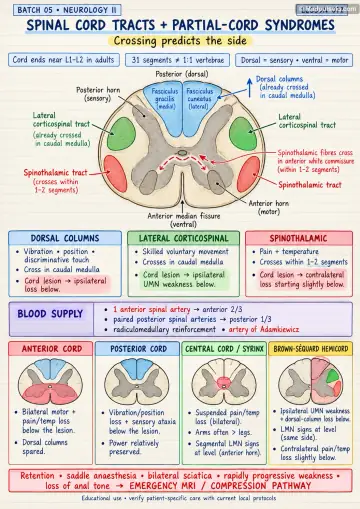
Spinal Cord Tracts: crossing predicts the side
Concept 73
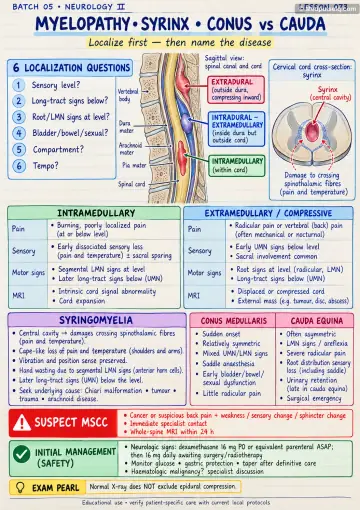
Myelopathy, Syrinx, Conus and Cauda
Concept 74
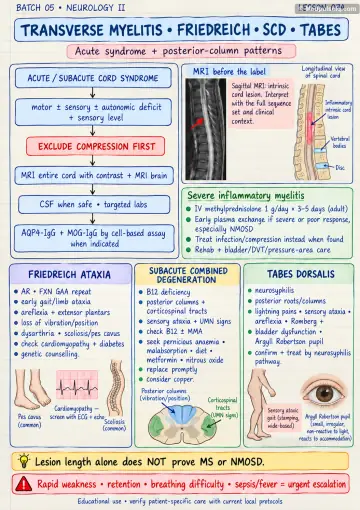
Transverse Myelitis, Friedreich Ataxia, SCD and Tabes
Concept 75
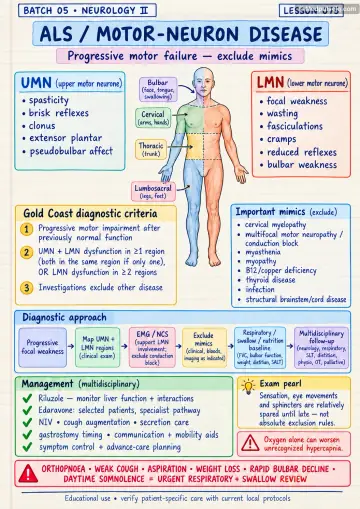
ALS and Motor-Neuron Disease
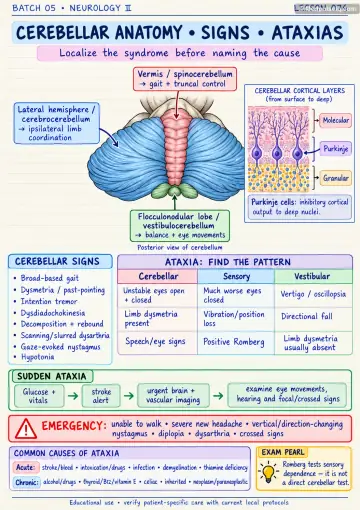
Concept 76
Cerebellar Ataxia: finding the pattern
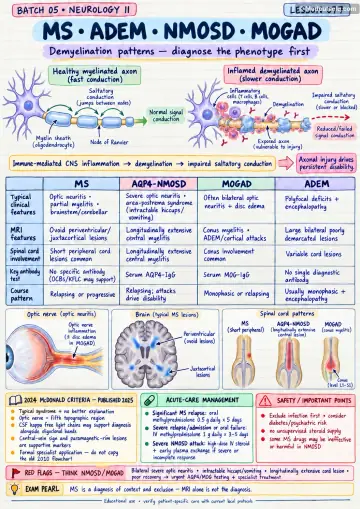
Concept 77
MS, NMOSD, MOGAD and ADEM
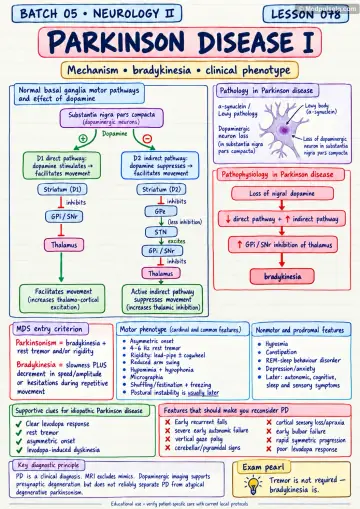
Concept 78
Parkinson Disease I: bradykinesia and phenotype
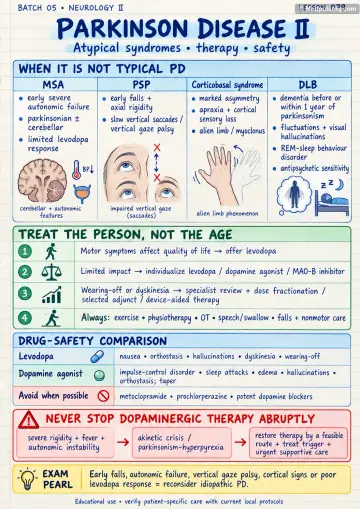
Concept 79
Parkinson Disease II: atypical clues and treatment safety
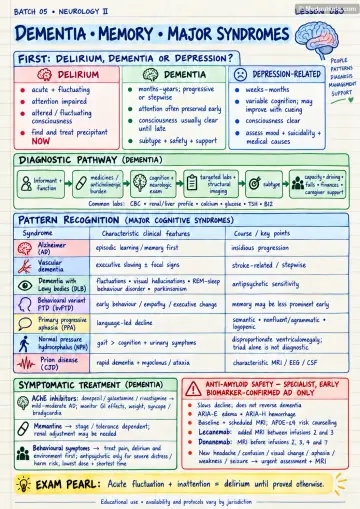
Concept 80
Dementia, Delirium and Major Cognitive Syndromes
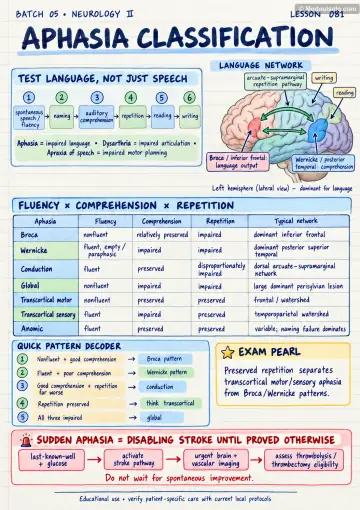
Concept 81
Aphasia Classification: language, not just speech
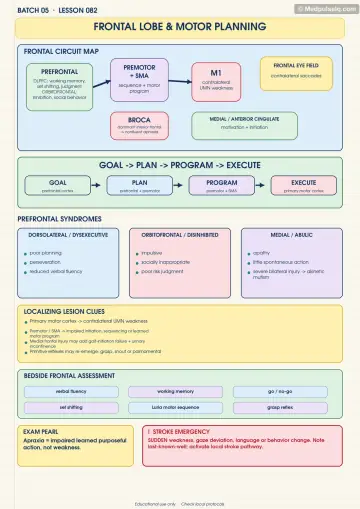
Concept 82
Frontal Lobe: planning, personality and movement
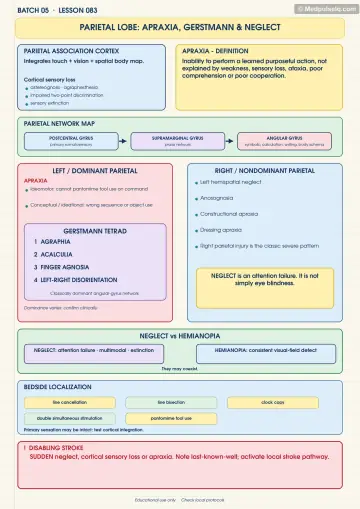
Concept 83
Parietal Lobe: body map, apraxia and neglect
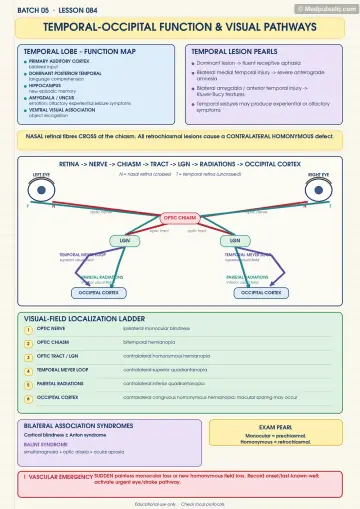
Concept 84
Temporal and Occipital Lobes: memory, meaning and visual fields
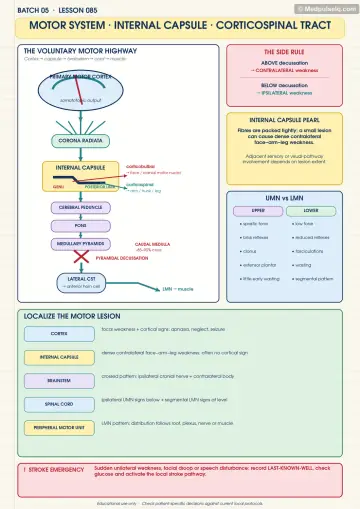
Concept 85
Motor Pathway: cortex, capsule, cord and nerve
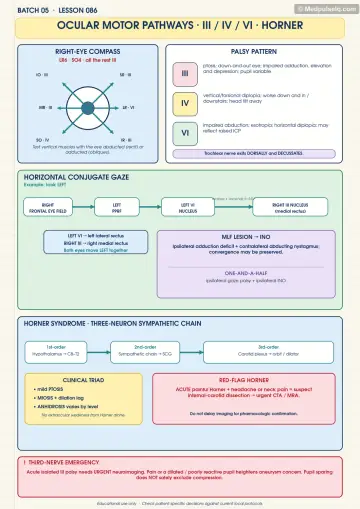
Concept 86
Eye Movements and Horner Syndrome
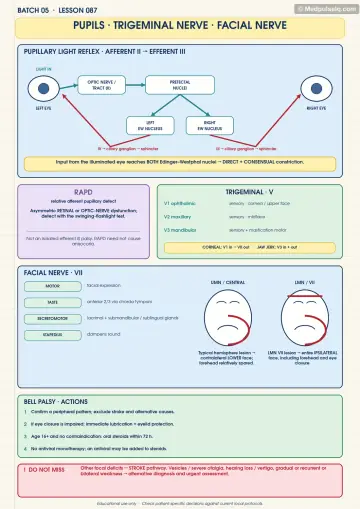
Concept 87
Pupils, Trigeminal Nerve and Facial Nerve
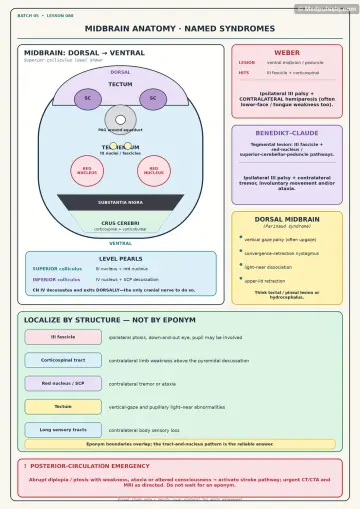
Concept 88
Midbrain: anatomy and named syndromes
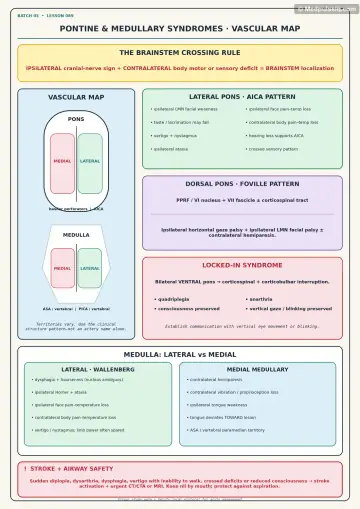
Concept 89
Pontine and Medullary Syndromes
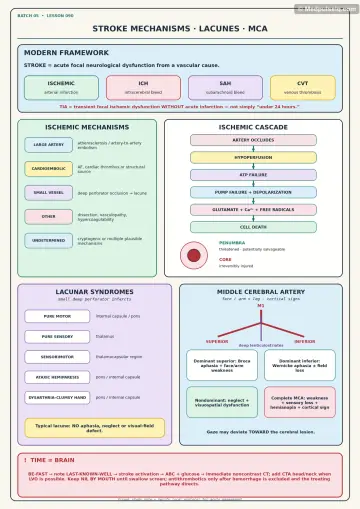
Concept 90
Stroke Mechanisms, Lacunes and MCA Stroke
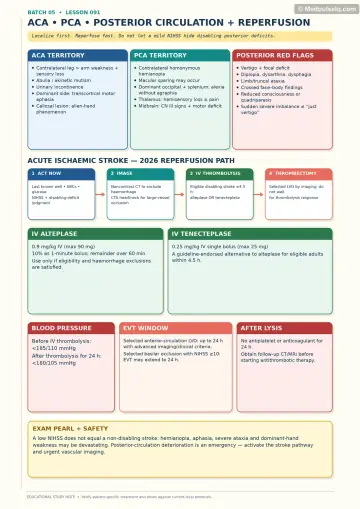
Concept 91
ACA, PCA, Posterior Circulation and Reperfusion
⚡ Rapid revision
The whole Part on one screen — read it the night before.
Cord and spinal emergencies
- Cord localization = tract, level, side, symmetry, sphincters and tempo.
- Dorsal columns and corticospinal tracts have crossed before the cord; spinothalamic fibres cross within 1–2 segments.
- Brown-Séquard: ipsilateral motor/proprioception loss and contralateral pain-temperature loss.
- Compression first: back or radicular pain plus neurologic change → urgent MRI; suspected malignant cord compression with neurologic signs → dexamethasone and definitive pathway.
- Conus: early symmetric saddle/sphincter signs; cauda: asymmetric painful LMN roots and urinary retention.
- Transverse myelitis is a syndrome; exclude compression, then test brain/cord/CSF/AQP4/MOG.
Motor, ataxia and demyelination
- ALS: progressive mixed UMN/LMN signs without a sensory level; search treatable mimics.
- ALS red flags: orthopnoea, weak cough, aspiration, weight loss, rapid bulbar decline and daytime somnolence.
- Cerebellar ataxia is unstable even eyes open; sensory ataxia becomes much worse with eye closure.
- Acute inability to walk, severe headache, vertical or direction-changing nystagmus, diplopia or crossed signs may be posterior-circulation stroke.
- MS diagnosis needs typical context and no better explanation; 2024 criteria add optic nerve region and CSF kappa free light chains.
- NMOSD clues: area-postrema syndrome, longitudinal myelitis, severe bilateral optic neuritis and poor recovery; treat attacks urgently.
Movement, cognition and localization
- Parkinsonism = bradykinesia plus rest tremor and/or rigidity; tremor is not required.
- Early falls, severe autonomic failure, vertical gaze palsy, cortical signs, early dementia/hallucinations or poor levodopa response suggest atypical parkinsonism.
- Never stop dopaminergic drugs abruptly; avoid metoclopramide, prochlorperazine and potent dopamine blockers when possible.
- Cognitive decline starts with time course: acute inattention is delirium until proved otherwise.
- Anti-amyloid therapy is only for selected biomarker-confirmed early Alzheimer disease with MRI/ARIA safeguards.
- Aphasia is language, dysarthria is articulation; test fluency, comprehension, repetition, naming, reading and writing.
- Crossed cranial-nerve/body findings localize to brainstem.
- Painful pupil-involving III palsy and painful Horner syndrome are vascular emergencies.
- Stroke pathway: last-known-well, glucose, CT/CTA, IV thrombolysis and thrombectomy decisions in parallel; low NIHSS can still be disabling.
- Acute stroke care includes swallow, temperature, glucose, BP, DVT/skin/nutrition, mechanism, prevention and rehabilitation.
🎯 Single‑best‑answer MCQs
Pick an answer to see the explanation — and the concept to revisit if you missed it. Your answers are saved on this device.
Score 0 / 00 of 20 answered
Question 1
A hemicord lesion causes which below-level pattern?
Question 2
The most urgent test for new saddle anaesthesia and urinary retention is:
Question 3
The initial steroid approach for malignant spinal cord compression with neurologic signs is:
Question 4
Cape-like loss of pain and temperature with preserved vibration suggests:
Question 5
Which finding argues against classic ALS?
Question 6
Ataxia markedly worsened only after eye closure suggests:
Question 7
A key change in the 2024 McDonald revisions is:
Question 8
Area-postrema syndrome plus longitudinal myelitis suggests:
Question 9
Parkinsonism requires bradykinesia plus:
Question 10
Early falls and vertical gaze palsy suggest:
Question 11
Abrupt levodopa withdrawal may cause:
Question 12
Fluctuation, visual hallucinations and REM-sleep behaviour disorder suggest:
Question 13
Fluent speech with poor comprehension and poor repetition is:
Question 14
Gerstmann syndrome localizes mainly to:
Question 15
Acute painful Horner syndrome should prompt evaluation for:
Question 16
Ipsilateral III palsy with contralateral hemiparesis is:
Question 17
A modern TIA definition requires:
Question 18
A disabling deficit with low NIHSS at 2 hours:
Question 19
Current 4.5-hour IV thrombolysis guidance permits:
Question 20
Stable post-stroke rehabilitation should:
🃏 Flashcards
Say the answer out loud before you flip. Shuffle once you know the order.
Card 1 of 20
🩺 Staged clinical cases
Read the presentation, decide what is going on and what you would do — then reveal the reasoning.
Case 1 — Cancer, back pain and weak legs
Stage A: A patient with prostate cancer develops severe night back pain, new bilateral leg weakness and urinary hesitancy.
Case 2 — Optic neuritis plus a long cord lesion
Stage A: A 30-year-old woman has severe bilateral visual loss, vomiting and hiccups, and a cervical-thoracic cord lesion spanning five vertebral segments.
Case 3 — Parkinson disease with sudden fever and rigidity
Stage A: A hospitalised patient with Parkinson disease is kept nil-by-mouth and misses levodopa for 36 hours. He develops fever, severe rigidity, confusion and raised CK.
Case 4 — Fluctuating cognition and hallucinations
Stage A: An older adult has cognitive fluctuations, formed visual hallucinations, REM-sleep behaviour disorder and spontaneous parkinsonism.
Case 5 — Low NIHSS but disabling aphasia
Stage A: A teacher presents 90 minutes after abrupt isolated expressive aphasia. NIHSS is low; CT shows no haemorrhage and CTA shows an M2 occlusion.
🎤 Viva practice
Answer aloud as if an examiner asked you — then check the model points.
Viva 1
Explain Brown-Séquard syndrome by tract crossing.
Viva 2
Differentiate conus medullaris from cauda equina syndrome.
Viva 3
Give the first-hour pathway for suspected malignant cord compression.
Viva 4
How do you investigate acute transverse myelitis?
Viva 5
List five treatable mimics of ALS.
Viva 6
Differentiate cerebellar, sensory and vestibular ataxia.
Viva 7
Compare MS, AQP4-NMOSD, MOGAD and ADEM.
Viva 8
State important 2024 McDonald-criteria changes.
Viva 9
Define parkinsonism and list red flags for atypical disease.
Viva 10
How do you prevent and recognize parkinsonism-hyperpyrexia syndrome?
Viva 11
Differentiate delirium, dementia and depression-related cognitive symptoms.
Viva 12
Classify aphasia by fluency, comprehension and repetition.
Viva 13
Localize III, IV, VI and MLF lesions.
Viva 14
Outline the adult acute ischaemic stroke pathway, including IVT and EVT.
Viva 15
What changed in current acute-stroke and rehabilitation guidance?
Keep going
Educational only — not a substitute for clinical judgement, supervision, or local guidelines.