Loading…
🩺 Medicine · Part 6 revision hub
Endocrinology I — Pituitary, Water, Sodium and Adrenal
Everything you need to revise this Part in one place — the one‑page note for every concept, a rapid‑revision sheet, exam‑style questions that point you back to the right concept, flashcards, staged cases and viva practice.
15 concepts20 MCQs20 flashcards6 cases15 viva questions
📝 The plate wall
Every concept in this Part as a one‑page handwritten note. Open one to read it in full and zoom.
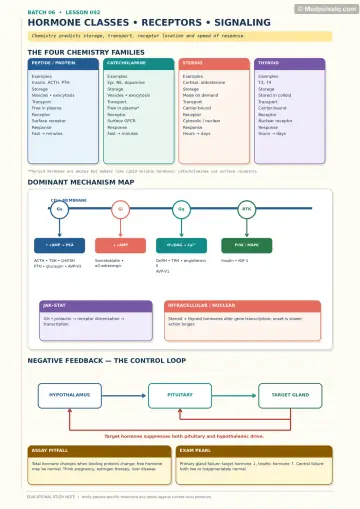
Concept 92
Hormone Classes, Receptors and Feedback
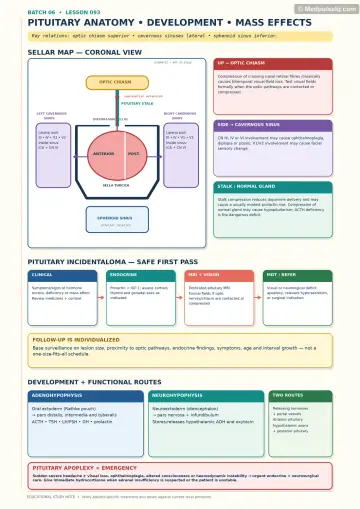
Concept 93
Pituitary Anatomy and Mass Effects
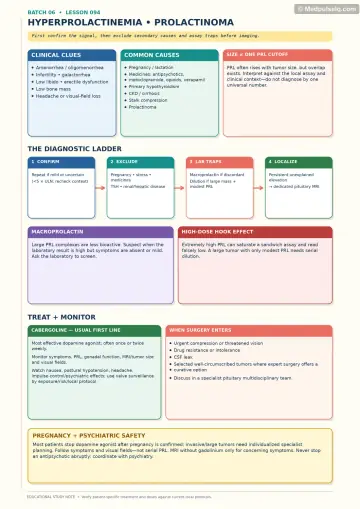
Concept 94
Hyperprolactinaemia and Prolactinoma
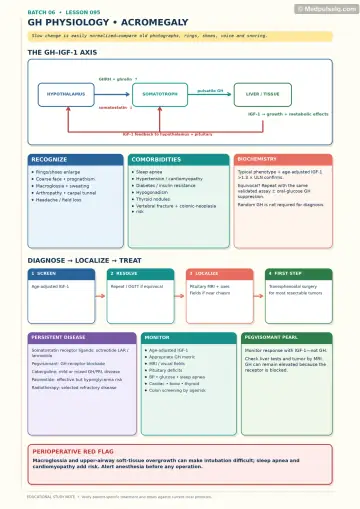
Concept 95
GH Physiology and Acromegaly
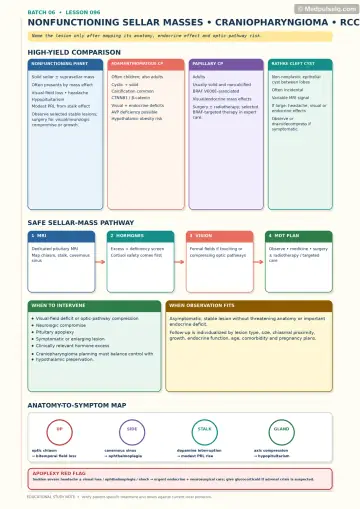
Concept 96
Sellar Masses, Craniopharyngioma and Rathke Cyst
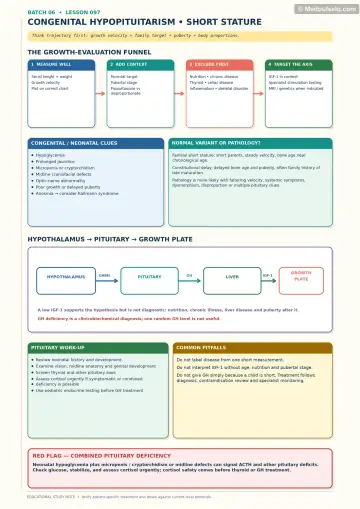
Concept 97
Congenital Hypopituitarism and Short Stature
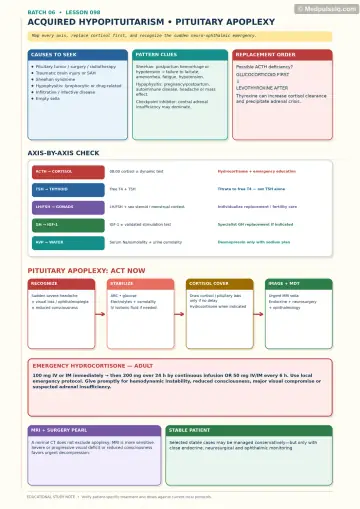
Concept 98
Acquired Hypopituitarism and Pituitary Apoplexy
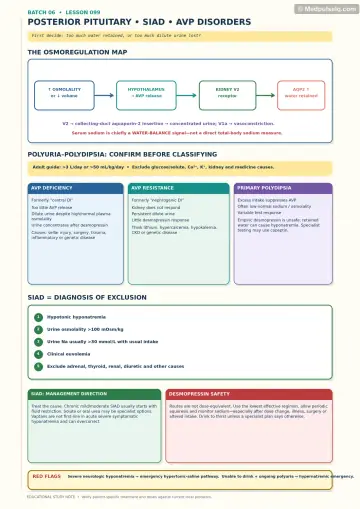
Concept 99
Posterior Pituitary, SIAD and AVP Disorders
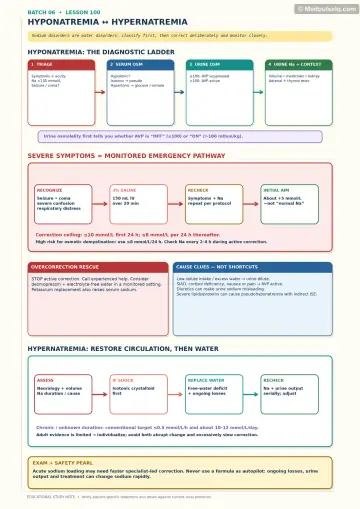
Concept 100
Hyponatraemia and Hypernatraemia
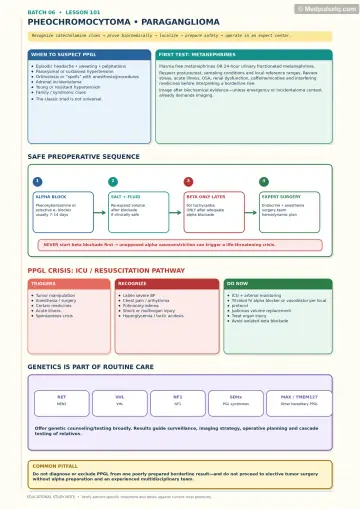
Concept 101
Pheochromocytoma and Paraganglioma
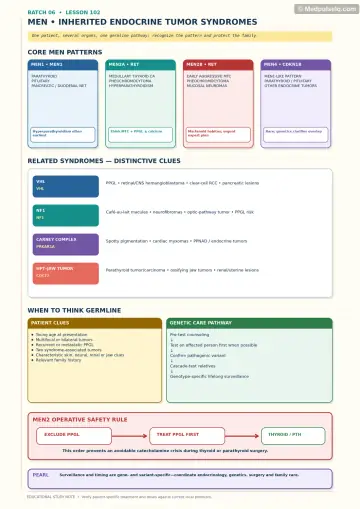
Concept 102
MEN and Inherited Endocrine Tumour Syndromes
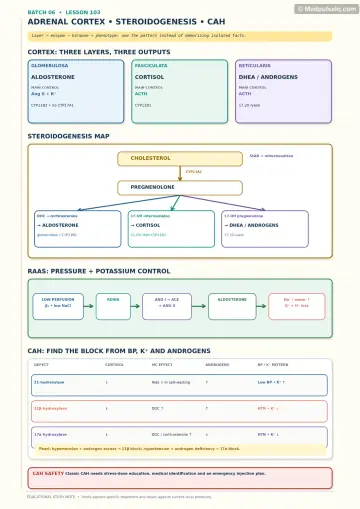
Concept 103
Adrenal Cortex, Steroidogenesis and CAH
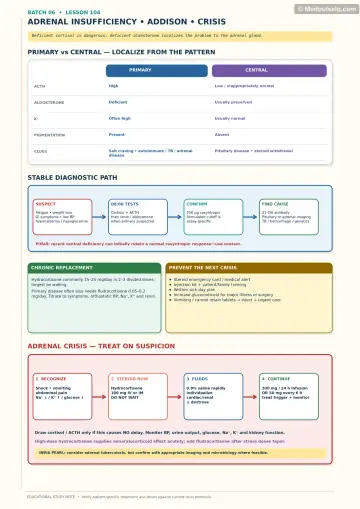
Concept 104
Adrenal Insufficiency and Crisis
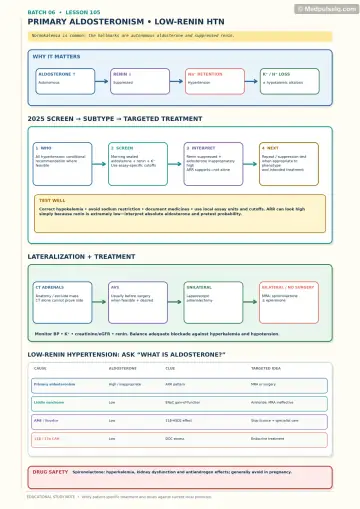
Concept 105
Primary Aldosteronism and Low-Renin Hypertension
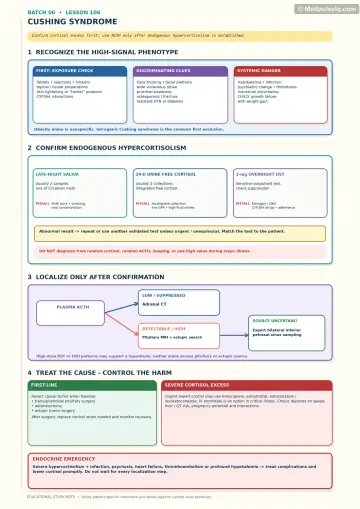
Concept 106
Cushing Syndrome
⚡ Rapid revision
The whole Part on one screen — read it the night before.
Pituitary and water
- Endocrine habit: stabilize if ill, confirm biochemistry, then localize or subtype.
- Sellar disease asks three questions: hormone excess, hormone deficiency and mass effect.
- Prolactin needs secondary-cause review plus macroprolactin and hook-effect awareness.
- Acromegaly is screened with age-adjusted IGF-1; random GH is unreliable.
- In hypopituitarism, glucocorticoid comes before levothyroxine when ACTH deficiency is possible.
- SIAD is hypotonic euvolaemic hyponatraemia with inappropriately concentrated urine after excluding mimics.
- Severe symptomatic hyponatraemia needs controlled 3 percent saline boluses and overcorrection prevention.
Adrenal and inherited tumours
- PPGL: metanephrines first; alpha blockade before beta blockade.
- MEN2: RET; control PPGL before thyroid or parathyroid surgery.
- Cortex layers: glomerulosa aldosterone, fasciculata cortisol, reticularis androgens.
- Adrenal crisis: hydrocortisone now plus isotonic saline with monitoring.
- Primary aldosteronism: normal potassium does not exclude it; AVS usually lateralizes before surgery.
- Cushing: exclude exogenous steroid, confirm cortisol excess, then use ACTH to localize.
🎯 Single‑best‑answer MCQs
Pick an answer to see the explanation — and the concept to revisit if you missed it. Your answers are saved on this device.
Score 0 / 00 of 20 answered
Question 1
Large pituitary mass with modest prolactin: next test?
Question 2
Combined ACTH and TSH deficiency: safest sequence?
Question 3
Preferred acromegaly screen?
Question 4
High urine osmolality in hypotonic hyponatraemia means:
Question 5
Initial severe hyponatraemia target is:
Question 6
Modern term for central diabetes insipidus:
Question 7
Before beta blockade in PPGL:
Question 8
MEN2 gene:
Question 9
Primary adrenal insufficiency clue:
Question 10
Suspected adrenal crisis immediate steroid:
Question 11
Normal potassium in resistant hypertension:
Question 12
Usual lateralization before PA surgery:
Question 13
Liddle pattern:
Question 14
Not a first-line Cushing screen:
Question 15
Suppressed ACTH in confirmed Cushing points to:
Question 16
Pegvisomant monitoring uses:
Question 17
SIAD must exclude especially:
Question 18
Homogeneous adrenal mass ≤10 HU is generally:
Question 19
MEN2 surgery principle:
Question 20
Desmopressin plus confusion and low sodium suggests:
🃏 Flashcards
Say the answer out loud before you flip. Shuffle once you know the order.
Card 1 of 20
🩺 Staged clinical cases
Read the presentation, decide what is going on and what you would do — then reveal the reasoning.
Case 1 — Large sellar mass with modest prolactin
Stage A: A 34-year-old man has headache, low libido and bitemporal field loss. MRI shows a 3.5-cm sellar mass; prolactin is only mildly raised.
Case 2 — Postpartum collapse
Stage A: After major postpartum haemorrhage, a woman remains hypotensive, hypoglycaemic and hyponatraemic and cannot lactate.
Case 3 — Seizure with sodium 108 mmol/L
Stage A: An older adult taking an SSRI has seizure, low serum osmolality and concentrated urine.
Case 4 — Adrenal mass and spells
Stage A: A 29-year-old has episodic headache, sweating, palpitations and BP 210/120; propranolol was prescribed.
Case 5 — Resistant hypertension without hypokalaemia
Stage A: BP is 168/100 on three drugs; potassium is 4.2 mmol/L.
Linked concepts: 105. Primary Aldosteronism and Low-Renin Hypertension
Case 6 — Infection with Cushing phenotype
Stage A: A patient with proximal weakness, bruising, diabetes and hypokalaemia presents with pneumonia and delirium.
Linked concepts: 106. Cushing Syndrome
🎤 Viva practice
Answer aloud as if an examiner asked you — then check the model points.
Viva 1
Why can TSH be normal in central hypothyroidism?
Viva 2
What is the hook effect?
Viva 3
How do you screen for acromegaly?
Viva 4
Name pituitary-apoplexy priorities.
Viva 5
Define SIAD.
Viva 6
Why correct chronic hyponatraemia slowly?
Viva 7
AVP deficiency versus resistance?
Viva 8
Why alpha before beta in PPGL?
Viva 9
Three Ps of MEN1?
Viva 10
Why hyperkalaemia in Addison disease?
Viva 11
Cosyntropin caveat?
Viva 12
Who gets PA screening in 2025 guidance?
Viva 13
Why CT is insufficient in PA?
Viva 14
Three Cushing screens?
Viva 15
What makes Cushing urgent?
Keep going
Educational only — not a substitute for clinical judgement, supervision, or local guidelines.