Loading…
❤️ Physiology · Part 8 revision hub
Endocrine Physiology
Everything you need to revise this Part in one place — the one‑page note for every concept, a rapid‑revision sheet, exam‑style questions that point you back to the right concept, flashcards, staged cases and viva practice.
11 concepts20 MCQs20 flashcards5 cases15 viva questions
📝 The plate wall
Every concept in this Part as a one‑page handwritten note. Open one to read it in full and zoom.
Concept 84
How Hormones Talk
Concept 85
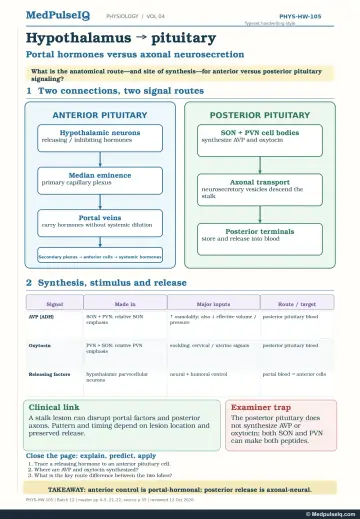
The Hypothalamus and the Pituitary
Concept 86
Prolactin, ADH and Oxytocin
Concept 87
Growth Hormone and Growing Up
Concept 88
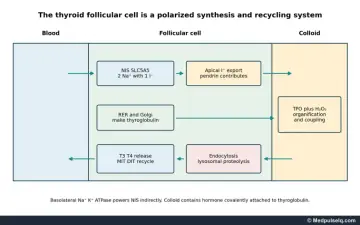
Making Thyroid Hormone
Concept 89
Thyroid Hormone in Action
Concept 90
Insulin: the fuel key
Concept 91
Fed, Fasting and the Rescue Hormones
Concept 92
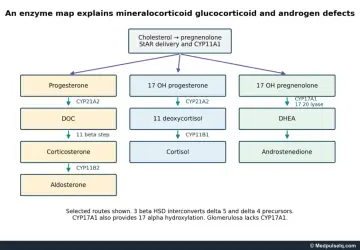
The Adrenal Cortex and Cortisol
Concept 93
Aldosterone and Adrenaline
Concept 94
Calcium, PTH and Vitamin D
⚡ Rapid revision
The whole Part on one screen — read it the night before.
Signalling and the pituitary
- Peptides: stored, free, short t½, surface receptors. Steroids/thyroid: bound, long t½, nuclear receptors.
- Gs → cAMP (glucagon, ACTH, TSH, LH/FSH, PTH, V2, β); Gi ↓ cAMP (somatostatin, α₂, D2); Gq → IP₃/DAG (TRH, GnRH, V1, oxytocin, α₁, AT₁, CaSR).
- Tyrosine kinase: insulin, IGF‑1. JAK–STAT: GH, prolactin, EPO, leptin. cGMP: ANP/BNP, NO.
- Hormone pairs localise: low target + high trophic = primary; low + low/normal = central.
- Portal system carries releasing hormones; posterior pituitary releases AVP/oxytocin made in SON/PVN.
- Prolactin is under dopamine inhibition → rises with stalk compression, antipsychotics, hypothyroidism.
- Pulsatile GnRH stimulates; continuous GnRH agonist suppresses LH/FSH.
- Compressive loss order: GH → LH/FSH → TSH → ACTH. Replace cortisol before thyroxine.
Growth, thyroid and pancreas
- GH pulses in slow‑wave sleep; IGF‑1 is the stable marker. Acromegaly: IGF‑1 ↑, GH not suppressed by glucose.
- Fasting: GH ↑, IGF‑1 ↓. Laron: GH ↑, IGF‑1 ↓ (receptor).
- Thyroid steps: NIS (2Na⁺:1I⁻) → pendrin → TPO organification + coupling → colloid → endocytosis → T4 ~90%, T3 ~10%.
- Free T4 0.02–0.03%, free T3 0.2–0.3%; T4 t½ ~7 d, T3 ~1 d; ~80% of T3 from peripheral D1/D2.
- TSH ~0.4–4.0 mU/L; trimester‑specific in pregnancy (hCG lowers TSH).
- Beta cell: glucose → glucokinase → ATP → KATP closure → depolarisation → Ca²⁺ → exocytosis; incretins amplify via cAMP.
- C‑peptide distinguishes endogenous (↑) from exogenous (↓) insulin.
- Counter‑regulation: glucagon + adrenaline (minutes) → cortisol + GH (hours). Hypoglycaemia level 1 < 3.9, level 2 < 3.0 mmol/L.
Adrenal and calcium
- Zones: glomerulosa (aldosterone, CYP11B2, no CYP17), fasciculata (cortisol), reticularis (DHEA).
- 21‑OH deficiency: ↓ cortisol, ↓ aldosterone, ↑ androgens, ↑ 17‑OHP. 11β‑OH: virilisation + hypertension. 17α‑OH: hypertension + no sex steroids.
- Cushing: confirm (salivary cortisol, UFC, 1 mg dex) then localise with ACTH.
- Primary adrenal insufficiency: ↑ ACTH, pigmentation, hyperkalaemia; secondary spares aldosterone.
- Medulla: tyrosine hydroxylase rate‑limiting; PNMT induced by cortisol; ~80% adrenaline. Test metanephrines; α‑block before β‑block.
- Calcium ~50% ionised, 40% bound, 10% complexed; alkalosis ↓ ionised Ca²⁺.
- PTH: ↑ Ca²⁺ reabsorption (distal), ↓ phosphate reabsorption, ↑ 1α‑hydroxylase, bone resorption via RANKL.
- 25(OH)D = vitamin D status; FGF23 ↓ phosphate and ↓ calcitriol; Mg²⁺ needed for PTH.
🎯 Single‑best‑answer MCQs
Pick an answer to see the explanation — and the concept to revisit if you missed it. Your answers are saved on this device.
Score 0 / 00 of 20 answered
Question 1
Which hormone acts primarily through a receptor tyrosine kinase?
Question 2
A loss‑of‑function mutation in Gsα would most likely cause resistance to:
Question 3
Low FT4 with a low‑normal TSH most likely indicates:
Question 4
Continuous administration of a GnRH agonist:
Question 5
Which anterior pituitary hormone increases when the pituitary stalk is transected?
Question 6
The Ferguson reflex refers to:
Question 7
A child has high GH but low IGF‑1 with normal nutrition and liver function. The likely defect is:
Question 8
The confirmatory test for acromegaly is:
Question 9
Perchlorate inhibits thyroid hormone synthesis by blocking:
Question 10
The Wolff–Chaikoff effect describes:
Question 11
In pregnancy, total T4 rises but free T4 is normal because:
Question 12
Which deiodinase mainly inactivates T4 and T3 in the placenta?
Question 13
Glucose‑stimulated insulin secretion is triggered by:
Question 14
Hypoglycaemia with high insulin and low C‑peptide suggests:
Question 15
Which tissue takes up glucose without needing insulin‑stimulated GLUT4?
Question 16
The first counter‑regulatory hormonal defence as glucose falls is:
Question 17
A newborn girl has ambiguous genitalia and later develops hypotension with hyperkalaemia. The likely enzyme defect is:
Question 18
Hyperkalaemia and skin pigmentation with low cortisol indicate:
Question 19
The enzyme converting noradrenaline to adrenaline, induced by cortisol, is:
Question 20
Hypocalcaemia that fails to correct with IV calcium despite adequate dosing should prompt checking:
🃏 Flashcards
Say the answer out loud before you flip. Shuffle once you know the order.
Card 1 of 20
🩺 Staged clinical cases
Read the presentation, decide what is going on and what you would do — then reveal the reasoning.
Case 1 — Headache, missed periods and milky discharge
Stage A: A 27‑year‑old woman has 8 months of amenorrhoea, galactorrhoea and headaches. She bumps into door frames on both sides. Pregnancy test is negative; she takes no medicines.
Linked concepts: 85. The Hypothalamus and the Pituitary, 86. Prolactin, ADH and Oxytocin
Case 2 — Weight loss, tremor and a racing heart
Stage A: A 31‑year‑old woman has weight loss, heat intolerance, palpitations and a diffuse goitre with a bruit. Her eyes appear prominent.
Linked concepts: 88. Making Thyroid Hormone, 89. Thyroid Hormone in Action
Case 3 — A teenager found drowsy and breathing deeply
Stage A: A 15‑year‑old has 2 weeks of thirst and polyuria, then vomiting and abdominal pain. He is drowsy with Kussmaul breathing and dry mucosa.
Linked concepts: 90. Insulin: the fuel key, 91. Fed, Fasting and the Rescue Hormones
Case 4 — Collapse after stopping steroids
Stage A: A 58‑year‑old who took prednisolone 20 mg daily for 9 months for polymyalgia stopped it abruptly a week ago. She now has vomiting, dizziness and BP 82/50; glucose 3.1 mmol/L.
Linked concepts: 92. The Adrenal Cortex and Cortisol, 93. Aldosterone and Adrenaline
Case 5 — Stones, bones and fatigue
Stage A: A 55‑year‑old woman has recurrent renal stones, constipation, low mood and osteoporosis on DXA.
Linked concepts: 94. Calcium, PTH and Vitamin D
🎤 Viva practice
Answer aloud as if an examiner asked you — then check the model points.
Viva 1
Compare peptide and steroid hormones.
Viva 2
Name the second messengers of Gs, Gi and Gq.
Viva 3
How does the hypothalamus control the anterior and posterior pituitary?
Viva 4
Why does prolactin rise with stalk lesions?
Viva 5
What is the stalk effect versus the hook effect?
Viva 6
List the factors that increase GH secretion.
Viva 7
Why is GH diabetogenic?
Viva 8
Outline thyroid hormone synthesis.
Viva 9
Describe the actions of thyroid hormone on the heart.
Viva 10
Explain sick euthyroid syndrome.
Viva 11
Describe glucose‑stimulated insulin secretion.
Viva 12
Why does DKA cause ketosis but HHS usually does not?
Viva 13
Classify CAH by enzyme and blood pressure.
Viva 14
Differentiate primary and secondary adrenal insufficiency.
Viva 15
Explain the actions of PTH.
Keep going
Educational only — not a substitute for clinical judgement, supervision, or local guidelines.