Loading…
🩻 Radiology · Part 1 revision hub
Imaging Physics and Radiation Safety
Everything you need to revise this Part in one place — the one‑page note for every concept, a rapid‑revision sheet, exam‑style questions that point you back to the right concept, flashcards, staged cases and viva practice.
14 concepts20 MCQs20 flashcards4 cases15 viva questions
📝 The plate wall
Every concept in this Part as a one‑page handwritten note. Open one to read it in full and zoom.
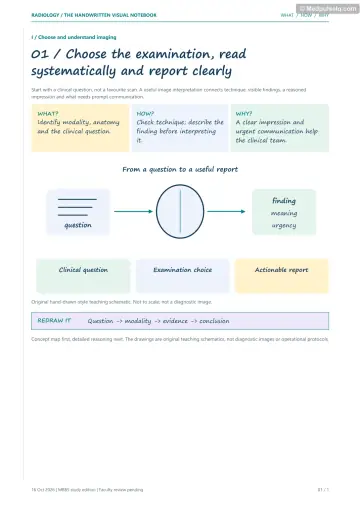
Concept 1
Reading a Medical Picture the 4S Way
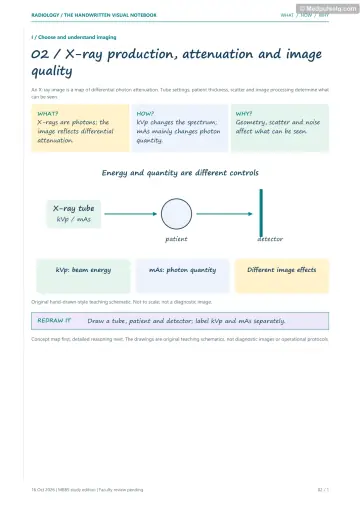
Concept 2
How X-rays Are Made
Concept 3
When X-rays Meet the Body
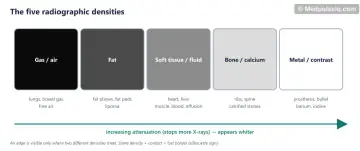
Concept 4
Five Shades and a Sharp Picture
Concept 5
Measuring Radiation
Concept 6
What Radiation Does to Cells
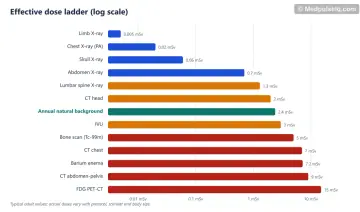
Concept 7
Keeping Patients and Staff Safe
Concept 8
CT: Slicing the Body with X-rays
Concept 9
Seeing CT Clearly
Concept 10
Ultrasound: Seeing with Echoes
Concept 11
Doppler: Watching Blood Move
Concept 12
MRI: Pictures from Spinning Protons
Concept 13
The MRI Menu
Concept 14
Safety in the Magnet Room
⚡ Rapid revision
The whole Part on one screen — read it the night before.
X-rays and their interactions
- Röntgen, 8 Nov 1895. Radio → microwave → IR → visible → UV increases photon energy. X-rays and gamma rays occupy overlapping energy ranges and are usually distinguished by production mechanism; all photons travel at c in vacuum.
- Tube: tungsten filament cathode → thermionic emission; tungsten–rhenium rotating anode (molybdenum/rhodium for mammography). ~99% heat, ~1% X‑rays.
- Bremsstrahlung (continuous) usually supplies most diagnostic X-rays; characteristic (discrete K lines) a variable component exploited in mammography.
- Photoelectric (inner shell, total absorption, ∝ Z³/E³) = contrast. Compton (outer shell, scatter) = most common, fog and staff dose. Pair production ≥ 1.02 MeV.
- Five densities: gas < fat < soft tissue/fluid < bone < metal. An edge exists only where different densities meet (silhouette sign).
- kVp = penetration, inversely related to contrast. mAs = photon number, noise and dose.
Radiation dose and protection
- Units: activity Bq (Ci), absorbed Gy (rad), equivalent/effective Sv (rem), exposure C/kg (R).
- Bergonié–Tribondeau: dividing + undifferentiated = sensitive. G2/M most sensitive, late S least.
- Deterministic (threshold, severity ↑): ARS, skin, cataract (~0.5 Gy). Stochastic (no threshold, probability ↑): cancer, heritable effects.
- ARS thresholds: haematopoietic 1–2 Gy, GI 6–10 Gy, CNS ≥ 20 Gy.
- ICRP principles: justification, optimisation (ALARA), limitation (not for patients). Staff: time, distance (inverse square), shielding.
- Limits: public 1 mSv/yr; occupational 20 mSv/yr (5‑yr average; AERB max 30 in one year); ICRP lens 20 mSv/yr.
- Doses: CXR 0.02, abdomen XR 0.7, CT head ~2, CT chest ~7, CT abdomen ~8–10, Ba enema ~7, PET‑CT 10–25 mSv.
- Pregnancy: enquire/test according to examination risk and local policy; justify and optimise essential imaging. Fetal risk depends on absorbed dose and developmental stage. A dose below 100 mGy alone does not justify termination on radiation grounds; this is not a zero-risk threshold. Cycle-based screening policies vary.
CT, ultrasound and MRI
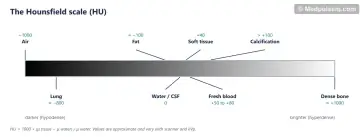
- HU = 1000 × (μ − μwater)/μwater. Air −1000, lung ~ −800, fat ~ −100, water 0, fresh blood +50 to +80, bone ~ +1000.
- Generations: 1st pencil beam (EMI, Hounsfield); 3rd rotate–rotate (modern basis); 4th fixed ring; 5th electron beam (historical cardiac design). Helical MDCT standard.
- Windows: brain 40/80, lung −600/1500, bone ~500/2000. Phases: arterial (HCC), portal venous (routine), delayed (washout), excretory (urography). Stones and blood: non‑contrast.
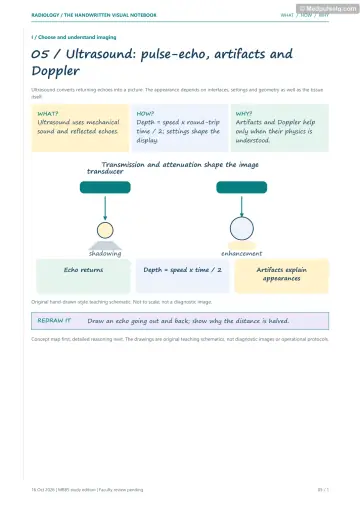
- US: > 20 kHz; diagnostic 2–18 MHz; PZT crystal; c = 1540 m/s; B‑mode most common; A‑mode ophthalmic; M‑mode cardiac. Shadowing = calculus/bone; enhancement = fluid.
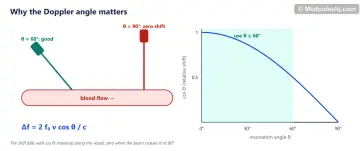
- Doppler Δf = 2f₀v cosθ/c; angle ≤ 60°; 90° = zero axial Doppler frequency shift; power Doppler most sensitive; BART colour map. TI (thermal), MI (mechanical, limit 1.9).
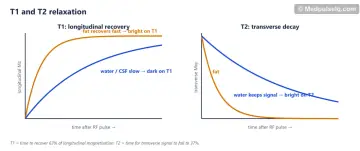
- MRI: T1 spin–lattice (63% recovery); T2 spin–spin (37% left). Water white on T2; fat bright on T1. FLAIR nulls CSF, STIR nulls fat, DWI restricts in acute infarct/abscess (ADC dark), SWI blooms with blood.
- MRI: check the exact device and conditions. MR Unsafe implants and ferromagnetic intraocular foreign bodies/aneurysm clips prevent scanning while unsafe. Selected non-MR-conditional CIED patients may be scanned under specialist protocols. Cochlear implants are model-specific; non-contrast MRI can be justified in pregnancy.
🎯 Single‑best‑answer MCQs
Pick an answer to see the explanation — and the concept to revisit if you missed it. Your answers are saved on this device.
Score 0 / 00 of 20 answered
Question 1
The predominant mechanism of X‑ray production in a diagnostic tube is:
Question 2
The anode target material used in conventional mammography is:
Question 3
The interaction primarily responsible for image contrast between bone and soft tissue is:
Question 4
The most common interaction of X‑rays with tissue at diagnostic energies is:
Question 5
Increasing kVp while keeping other factors constant will:
Question 6
The SI unit of absorbed dose is the:
Question 7
Which of the following is a stochastic effect of radiation?
Question 8
According to the law of Bergonié and Tribondeau, the most radiosensitive tissue among these is:
Question 9
In acute radiation syndrome, the gastrointestinal syndrome typically appears after whole‑body doses of about:
Question 10
The annual effective dose limit for members of the public is:
Question 11
A radiographer doubles her distance from a scattering patient. Her dose rate becomes approximately:
Question 12
Which statement about imaging a woman who may be pregnant is current practice?
Question 13
The Hounsfield unit value of water is:
Question 14
Which historical CT design used an electronically swept beam and stationary target rings for rapid cardiac imaging?
Question 15
The ideal phase to detect a hypervascular hepatocellular carcinoma is:
Question 16
The probe of choice for scrotal and thyroid ultrasound is a:
Question 17
At a Doppler insonation angle of 90°, the measured frequency shift is:
Question 18
On a T2‑weighted image, which appears bright?
Question 19
A bright lesion on DWI is also bright on the ADC map. This indicates:
Question 20
Which is an absolute contraindication to MRI?
🃏 Flashcards
Say the answer out loud before you flip. Shuffle once you know the order.
Card 1 of 20
🩺 Staged clinical cases
Read the presentation, decide what is going on and what you would do — then reveal the reasoning.
Case 1 — The pregnant woman with flank pain
Stage A: A 27‑year‑old at 14 weeks' gestation has severe right loin pain and microscopic haematuria. The intern requests "CT KUB".
Linked concepts: 7. Keeping Patients and Staff Safe, 10. Ultrasound: Seeing with Echoes
Case 2 — The welder for an MRI brain
Stage A: A 45‑year‑old welder with new seizures is booked for MRI brain. On the screening form he mentions "something flew into my eye years ago".
Linked concepts: 14. Safety in the Magnet Room, 13. The MRI Menu
Case 3 — The grainy portable chest film
Stage A: An ICU portable chest film looks "noisy" and grey, and the heart looks large.
Linked concepts: 4. Five Shades and a Sharp Picture, 3. When X-rays Meet the Body
Case 4 — The nervous radiographer
Stage A: A newly pregnant radiographer asks whether she must stop working in fluoroscopy.
Linked concepts: 7. Keeping Patients and Staff Safe, 6. What Radiation Does to Cells
🎤 Viva practice
Answer aloud as if an examiner asked you — then check the model points.
Viva 1
Why does bone look white on a radiograph?
Viva 2
What is the difference between kVp and mAs?
Viva 3
Define the gray and the sievert.
Viva 4
Distinguish deterministic and stochastic effects with examples.
Viva 5
State the three principles of radiation protection.
Viva 6
What is the inverse square law and why does it matter?
Viva 7
How would you image suspected appendicitis in pregnancy?
Viva 8
Explain the Hounsfield scale.
Viva 9
What is T2 shine‑through?
Viva 10
How do you assess four common MRI implant concerns?
Viva 11
Why does a portable AP chest film exaggerate heart size?
Viva 12
What is Bremsstrahlung?
Viva 13
Which windows must you review on a trauma CT head, and why?
Viva 14
Why is power Doppler useful in suspected testicular torsion?
Viva 15
Name three things that are bright on T1.
Keep going
Educational only — not a substitute for clinical judgement, supervision, or local guidelines.