Loading…
Elastic cartilage
Spotter answer: Elastic cartilage section
Workable field
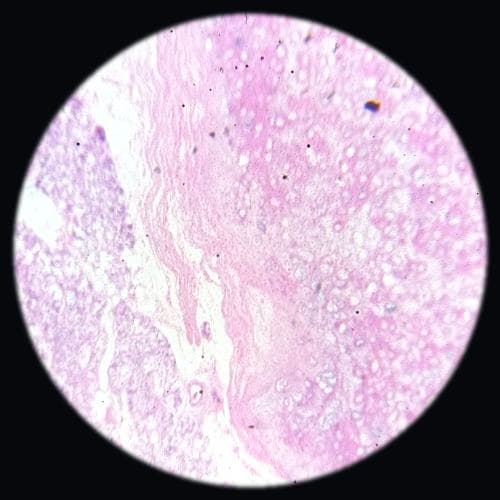
Field showing chondrocytes in lacunae mainly toward one side at medium power. Adjust the focus1.0×
- 1Chondrocytes — These are the cells within lacunae.
- 2Matrix — The surrounding area where fibres would be embedded, though not visible here.
Before you name anything
Take a deep breath and let's start by looking at the overall shape of the specimen at low power. Notice how it's not a solid mass but has a more open, spongy appearance. This is a clue that you're looking at cartilage. Now, focus on the chondrocytes in lacunae. These are the small, rounded spaces that house the cells. The key feature here is the presence of elastic fibres, which might be challenging to see with H&E staining, but look for a fine, branching network. Students often rush to high power and miss these broader patterns. Stay calm, and remember, identifying the lacunae and the elastic fibre network is what sets this apart from other types of cartilage. Once you spot these, you're on the right track. Let's move on to identifying the perichondrium, which is the dense layer surrounding the cartilage, confirming it's elastic cartilage.
Work it out, one rung at a time
Answer each question in your head first. Then open it.
- 1
low-power architecture
Is it a solid mass or more open?
- 2
epithelium or covering
Is there a surrounding layer?
- 3
the signature feature
Can you see the network of fibres?
- 4
confirm and exclude the look-alike
How do you know it's not hyaline cartilage?
Viva voce
1 of 5 · 0 answeredSay your answer out loud before you open it. That is the exam skill.
What type of cartilage is this?