Loading…
🌏 Community Medicine · Part 11 revision hub
Nutrition and Health
Everything you need to revise this Part in one place — the one‑page note for every concept, a rapid‑revision sheet, exam‑style questions that point you back to the right concept, flashcards, staged cases and viva practice.
9 concepts20 MCQs20 flashcards4 cases15 viva questions
📝 The plate wall
Every concept in this Part as a one‑page handwritten note. Open one to read it in full and zoom.
Concept 102
Energy and the Big Nutrients
Concept 103
Vitamins — Small Amounts, Big Effects
Concept 104
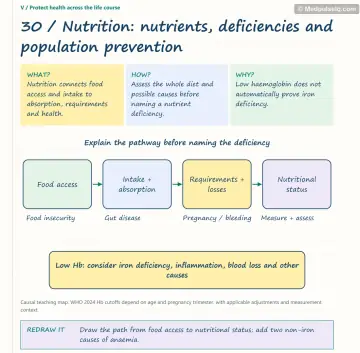
Iron and Anaemia
Concept 105
Iodine and Fluoride
Concept 106
When Children Don't Get Enough Food
Concept 107
Measuring Nutrition
Concept 108
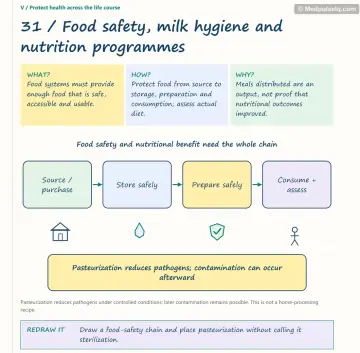
Safe Food and Safe Milk
Concept 109
Poisons in Food
Concept 110
India's Nutrition Programmes
⚡ Rapid revision
The whole Part on one screen — read it the night before.
Macronutrients and requirements
- Atwater: carbohydrate 4, protein 4, fat 9, alcohol 7 kcal/g.
- ICMR‑NIN 2020: reference man 65 kg, woman 55 kg; EAR vs RDA (EAR + 2 SD); energy as EER. Protein ≈ 0.83 g/kg/day. Pregnancy +350 kcal (2nd/3rd trimester); lactation +600 (0–6 months).
- Protein complementation: cereals lack lysine, pulses lack methionine. Egg = reference protein (BV ≈ 94).
- Dietary Guidelines for Indians 2024: "My Plate" (half vegetables/fruits), cereals ≤ 45% energy, salt < 5 g, added sugar < 5% energy, trans fat ≤ 2% in oils (FSSAI).
Micronutrients
- Vitamin A: XN, X1A, X1B (Bitot's), X2, X3A, X3B, XS, XF. Public‑health problem: XN > 1%, X1B > 0.5%. 9 doses (1 lakh IU at 9 months, then 2 lakh IU 6‑monthly to 5 years). Treatment: days 1, 2, 14.
- B1 beriberi (polished rice, alcohol); B2 angular stomatitis; B3 pellagra (maize, jowar: leucine); B6 with INH; folate NTDs; B12 vegetarians; C scurvy; D rickets.
- Anaemia (WHO 2024, g/dL): 6–23 months < 10.5; 24–59 months < 11; 5–11 years < 11.5; 12–14 years < 12; women < 12; men < 13; pregnancy < 11 (1st/3rd), < 10.5 (2nd). NFHS‑5: children 67.1%, women 57%, men 25%.
- Anaemia Mukt Bharat (2018), 6 × 6 × 6: syrup 20 mg + 100 µg biweekly (6–59 months); pink 45 mg + 400 µg weekly (5–9 years); blue 60 mg + 500 µg weekly (10–19); red 60 mg + 500 µg weekly (WRA), daily × 180 days (pregnant, lactating).
- Iodine: 150 µg/day (250 in pregnancy). TGR ≥ 5% = problem; median UIC < 100 µg/L insufficient. Salt ≥ 30 ppm production, ≥ 15 ppm consumer; > 90% households adequate. NGCP 1962 → NIDDCP 1992. 21 October.
- Fluoride: 0.5–1 mg/L optimal; > 1.5 dental, > 3–4 skeletal fluorosis; BIS acceptable 1.0, permissible 1.5. Nalgonda technique. NPPCF 2008–09.
Undernutrition and assessment
- SAM: WHZ < −3, MUAC < 11.5 cm, or bilateral pitting oedema. MAM: WHZ −3 to −2 or MUAC 11.5–12.5.
- Complicated SAM → NRC: 10 steps; F‑75 (stabilisation) → F‑100 (rehabilitation); ReSoMal; antibiotics for all; no iron in stabilisation. Good weight gain > 10 g/kg/day; discharge at 15% gain. CMAM protocol 2023.
- Kwashiorkor: oedema, flaky‑paint skin, flag sign, fatty liver, apathy.
- ABCD assessment; 24‑h recall (group means), weighment (most accurate). Consumption unit: adult man sedentary work = 1 (moderate 1.2, heavy 1.6).
Food safety and programmes
- Pasteurisation: holder 63 °C × 30 min; HTST 72 °C × 15 s; UHT 135–150 °C. Phosphatase test = adequacy; methylene blue = bacterial load.
- FSS Act 2006 (replaced PFA 1954); FSSAI 2008; Schedule 4; FoSTaC; Eat Right India.
- Adulterants: metanil yellow (turmeric, dal; HCl pink), argemone (mustard oil; nitric acid test), starch/water in milk.
- Toxins: lathyrism (BOAA/ODAP, khesari dal, spastic paraplegia, steeping/parboiling); aflatoxin (A. flavus, groundnut, HCC); epidemic dropsy (sanguinarine, argemone, Delhi 1998); ergotism (Claviceps, bajra); pyrrolizidine (veno‑occlusive disease).
- ICDS (2 October 1975; 6 services); Poshan 2.0 norms: children 500 kcal + 12–15 g; SAM 800 kcal + 20–25 g; P&L 600 kcal + 18–20 g. POSHAN Abhiyaan (8 March 2018, Jhunjhunu; Poshan Maah September). PM POSHAN: primary 450 kcal + 12 g; upper primary 700 kcal + 20 g. NFSA 2013: 5 kg/person/month; AAY 35 kg. Fortified rice universal (2024).
🎯 Single‑best‑answer MCQs
Pick an answer to see the explanation — and the concept to revisit if you missed it. Your answers are saved on this device.
Score 0 / 00 of 20 answered
Question 1
The reference Indian adult man in ICMR‑NIN 2020 weighs:
Question 2
The limiting amino acid in cereals is:
Question 3
Bitot's spots are classified as:
Question 4
Pellagra in jowar‑eating populations is attributed to:
Question 5
The number of vitamin A doses a child receives under UIP by age 5 is:
Question 6
Under WHO 2024 guidance, anaemia in a pregnant woman in the second trimester is Hb below:
Question 7
Under Anaemia Mukt Bharat, adolescents (10–19 years) receive:
Question 8
Iodine deficiency is a public‑health problem when the total goitre rate among school‑age children is:
Question 9
The minimum iodine content of salt at the consumer level in India is:
Question 10
The Nalgonda technique is used for:
Question 11
Which is NOT a criterion for SAM in a child aged 6–59 months?
Question 12
The therapeutic milk used in the stabilisation phase of SAM is:
Question 13
In the stabilisation phase of SAM, which should be withheld?
Question 14
The most accurate method of dietary assessment is:
Question 15
HTST pasteurisation of milk is done at:
Question 16
The test for adequacy of pasteurisation is the:
Question 17
Epidemic dropsy is caused by:
Question 18
Neurolathyrism presents as:
Question 19
POSHAN Abhiyaan was launched in:
Question 20
Under PM POSHAN, a primary school child's meal should provide:
🃏 Flashcards
Say the answer out loud before you flip. Shuffle once you know the order.
Card 1 of 20
🩺 Staged clinical cases
Read the presentation, decide what is going on and what you would do — then reveal the reasoning.
Case 1 — The anaemic schoolgirls
Stage A: In a block, WIFS registers show 95% "coverage", but a school survey finds 62% of girls anaemic.
Linked concepts: 104. Iron and Anaemia, 100. Concept 100
Case 2 — The swollen toddler
Stage A: A 20‑month‑old has bilateral pitting oedema up to the knees, flaky skin, sparse reddish hair, and is apathetic. MUAC 12.2 cm. Temperature 35.2 °C.
Linked concepts: 106. When Children Don't Get Enough Food
Case 3 — Mottled teeth in a village
Stage A: School screening in a Rajasthan village finds brown mottling of teeth in 70% of children; some adults complain of back stiffness.
Linked concepts: 105. Iodine and Fluoride
Case 4 — Paralysis after the drought
Stage A: After two drought years, 14 young men in a district develop spastic weakness of the legs. Most have eaten khesari dal as their main food for months.
Linked concepts: 109. Poisons in Food, 110. India's Nutrition Programmes
🎤 Viva practice
Answer aloud as if an examiner asked you — then check the model points.
Viva 1
What is a balanced diet?
Viva 2
Define RDA and EAR.
Viva 3
What is protein complementation?
Viva 4
WHO classification of xerophthalmia?
Viva 5
Vitamin A prophylaxis schedule?
Viva 6
What are the 6 × 6 × 6 elements of Anaemia Mukt Bharat?
Viva 7
WHO 2024 Hb cut‑offs for women and pregnancy?
Viva 8
Indicators of IDD?
Viva 9
Effects of fluoride at different levels?
Viva 10
Define SAM.
Viva 11
WHO 10 steps in SAM management?
Viva 12
Methods of nutritional assessment?
Viva 13
Methods of pasteurisation and tests?
Viva 14
Name food‑borne toxins in India.
Viva 15
Services of ICDS?
Keep going
Educational only — not a substitute for clinical judgement, supervision, or local guidelines.