Loading…
🌏 Community Medicine · Part 2 revision hub
Epidemiology I — Measures and Observational Designs
Everything you need to revise this Part in one place — the one‑page note for every concept, a rapid‑revision sheet, exam‑style questions that point you back to the right concept, flashcards, staged cases and viva practice.
9 concepts20 MCQs20 flashcards4 cases15 viva questions
📝 The plate wall
Every concept in this Part as a one‑page handwritten note. Open one to read it in full and zoom.
Concept 10
Epidemiology — Detective Work for Populations
Concept 11
Rates, Ratios and Proportions
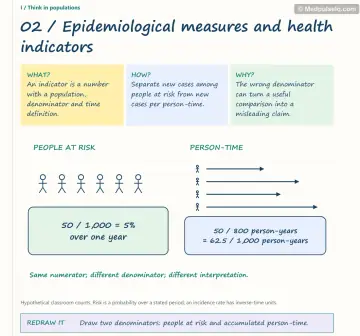
Concept 12
New Cases and Existing Cases — Incidence and Prevalence
Concept 13
Counting Deaths Fairly
Concept 14
Who, Where and When — Describing Disease
Concept 15
A Snapshot Study — Cross-Sectional and Ecological
Concept 16
Looking Back — Case-Control Studies
Concept 17
Looking Forward — Cohort Studies

Concept 18
How Strongly Are Two Things Linked?
⚡ Rapid revision
The whole Part on one screen — read it the night before.
Foundations
- Epidemiology (Last): distribution + determinants of health‑related states in specified populations + application to control.
- Descriptive (who, where, when) → analytical (why: case‑control, cohort) → experimental (trials).
- Causal models: triad (infectious), web (chronic), wheel (genetic vs environment), sufficient‑component pies (necessary vs component causes).
- Ratio (x/y), proportion (part/whole, 0–1), rate (events/person‑time). CFR, attack rate and prevalence are proportions; MMR is a ratio.
Occurrence
- Risk = new cases / at‑risk at start (over a stated period). Incidence rate = new cases / person‑time.
- Point prevalence = existing cases / population at a time. Period prevalence = existing + new / mid‑period population.
- P ≈ I × D (steady state, rare condition); exactly P/(1 − P) = I × D.
- Longer survival without cure (ART, insulin) raises prevalence.
- Secondary attack rate excludes the primary case and counts susceptible contacts.
Mortality and standardisation
- CDR is confounded by age structure → standardise.
- Direct: study rates × standard population → age‑standardised rate. Indirect: standard rates × study population → SMR = O/E × 100.
- Healthy worker effect lowers occupational SMRs.
Descriptive
- Time: short‑term (epidemic), periodic (seasonal, cyclic), secular.
- Point source: single peak within one incubation period. Propagated: successive waves one serial interval apart.
- Epi curve x‑axis interval ≈ ¼–⅓ of the incubation period; plot by date of onset.
Designs and measures
- Cross‑sectional: prevalence, temporal ambiguity, Neyman bias. Ecological: group units, ecological fallacy.
- Case‑control: outcome → past exposure; OR = ad/bc; recall and selection bias; rare diseases.
- Cohort: exposure → future outcome; RR = Iₑ/Iᵤ; loss to follow‑up; rare exposures, many outcomes.
- AR = Iₑ − Iᵤ; AF(exposed) = (RR − 1)/RR; PAF (Levin) = Pe(RR − 1)/[1 + Pe(RR − 1)].
- Vaccine efficacy = (1 − RR) × 100. NNT = 1/ARR.
🎯 Single‑best‑answer MCQs
Pick an answer to see the explanation — and the concept to revisit if you missed it. Your answers are saved on this device.
Score 0 / 00 of 20 answered
Question 1
Mycobacterium tuberculosis in relation to tuberculosis disease is best described as:
Question 2
The web of causation model is most suited to explain:
Question 3
Which of the following is a true rate?
Question 4
In a household of six, one child develops measles. Of the five other members, two are already immune. Later, two of the remaining develop measles within the incubation period. The secondary attack rate is:
Question 5
Introduction of a drug that prolongs life without curing a chronic disease will:
Question 6
In 2,000 person‑years of follow‑up, 40 new cases occur. The incidence rate is:
Question 7
The standardised mortality ratio is calculated as:
Question 8
Indirect standardisation is preferred over direct standardisation when:
Question 9
An epidemic curve showing successive peaks separated by roughly one incubation period suggests:
Question 10
The long‑term rise in diabetes prevalence in India over three decades is an example of:
Question 11
The main limitation of a cross‑sectional study in establishing causation is:
Question 12
Concluding that individuals who eat more salt get strokes because states with high salt sales have high stroke rates is an example of:
Question 13
In a case‑control study, 60 of 100 cases and 30 of 100 controls were exposed. The odds ratio is:
Question 14
The bias most characteristic of case‑control studies is:
Question 15
The odds ratio from a case‑control study approximates the relative risk when:
Question 16
A historical (retrospective) cohort study:
Question 17
The healthy worker effect leads to:
Question 18
Incidence in the exposed is 40 per 1,000 and in the unexposed 10 per 1,000. The attributable fraction among the exposed is:
Question 19
Attack rate is 5% in the vaccinated and 20% in the unvaccinated. Vaccine efficacy is:
Question 20
The measure most useful to a policy‑maker deciding how much disease would be prevented by removing an exposure from the whole population is:
🃏 Flashcards
Say the answer out loud before you flip. Shuffle once you know the order.
Card 1 of 20
🩺 Staged clinical cases
Read the presentation, decide what is going on and what you would do — then reveal the reasoning.
Case 1 — The wedding feast
Stage A: Of 200 guests at a wedding lunch, 64 develop vomiting and diarrhoea 2–6 hours later. All cases occur within an 8‑hour window.
Case 2 — Rising HIV prevalence after ART scale‑up
Stage A: A district's HIV prevalence among adults rose from 0.30% to 0.36% over five years after ART coverage expanded from 50% to 85%.
Linked concepts: 12. New Cases and Existing Cases — Incidence and Prevalence
Case 3 — Two states and their death rates
Stage A: State A (CDR 7.2) is criticised as having "worse health" than State B (CDR 5.6). A has 12% of its population over 60; B has 7%.
Linked concepts: 13. Counting Deaths Fairly
Case 4 — A rare cancer near a factory
Stage A: Residents report several cases of a rare childhood leukaemia near a chemical plant.
Linked concepts: 16. Looking Back — Case-Control Studies, 17. Looking Forward — Cohort Studies
🎤 Viva practice
Answer aloud as if an examiner asked you — then check the model points.
Viva 1
Define epidemiology.
Viva 2
What is the epidemiological triad?
Viva 3
Differentiate necessary and sufficient cause.
Viva 4
Differentiate rate, ratio and proportion.
Viva 5
Differentiate incidence and prevalence.
Viva 6
What factors increase prevalence?
Viva 7
Why standardise rates?
Viva 8
What is SMR?
Viva 9
What are the types of epidemics by time?
Viva 10
What is the ecological fallacy?
Viva 11
Steps of a case‑control study?
Viva 12
When does OR approximate RR?
Viva 13
Advantages of cohort studies?
Viva 14
Define attributable risk and PAR.
Viva 15
Formula for vaccine efficacy?
Keep going
Educational only — not a substitute for clinical judgement, supervision, or local guidelines.