Loading…
🩺 Medicine · Part 7 revision hub
Endocrinology II — Diabetes, Calcium, Potassium and Thyroid
Everything you need to revise this Part in one place — the one‑page note for every concept, a rapid‑revision sheet, exam‑style questions that point you back to the right concept, flashcards, staged cases and viva practice.
15 concepts20 MCQs20 flashcards8 cases15 viva questions
📝 The plate wall
Every concept in this Part as a one‑page handwritten note. Open one to read it in full and zoom.
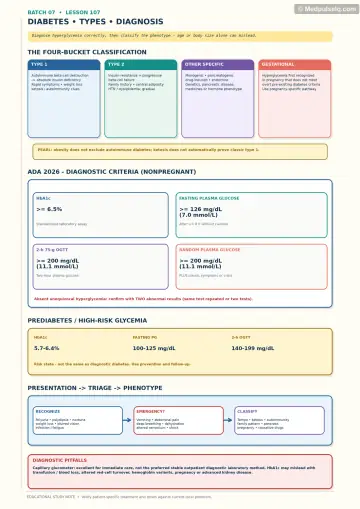
Concept 107
Diabetes: Types and Diagnosis
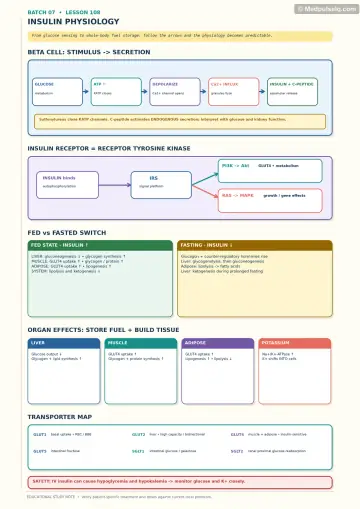
Concept 108
Insulin: The Body's Fuel Key
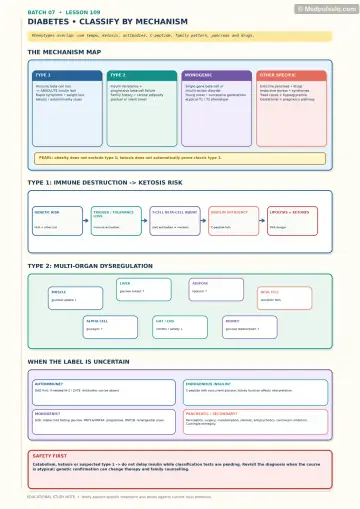
Concept 109
Classifying Diabetes by Mechanism
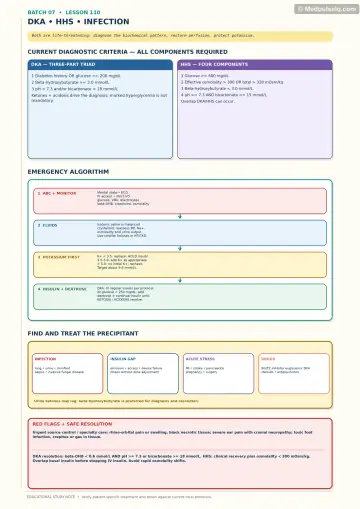
Concept 110
DKA and HHS: Diabetic Emergencies
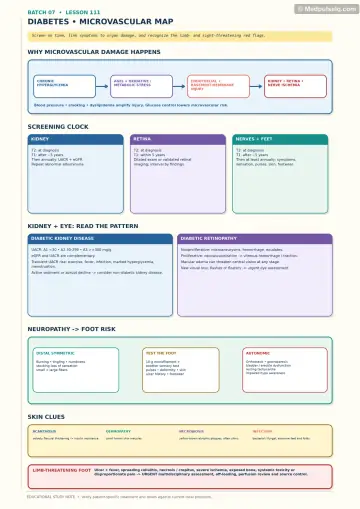
Concept 111
Diabetes Damage: Kidneys, Eyes, Nerves and Skin
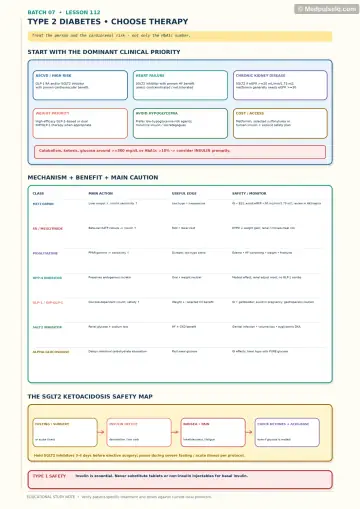
Concept 112
Choosing Type 2 Diabetes Treatment
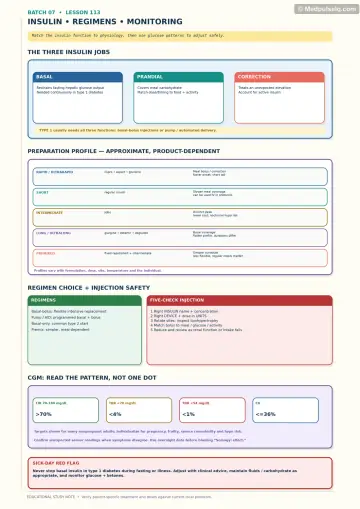
Concept 113
Insulin Regimens and Glucose Monitoring
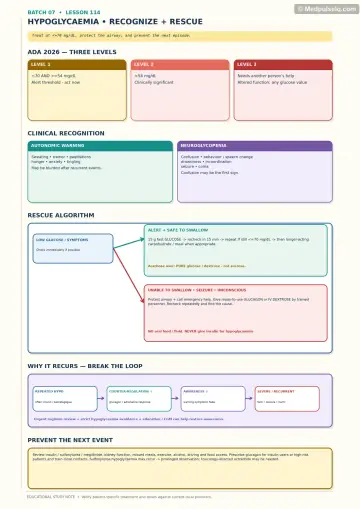
Concept 114
Hypoglycaemia: Recognize and Rescue
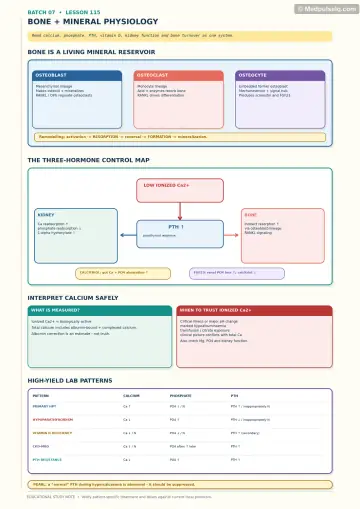
Concept 115
Calcium, Phosphate, PTH and Vitamin D
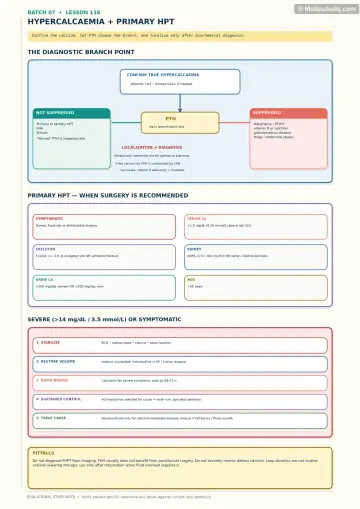
Concept 116
Hypercalcaemia and Primary Hyperparathyroidism
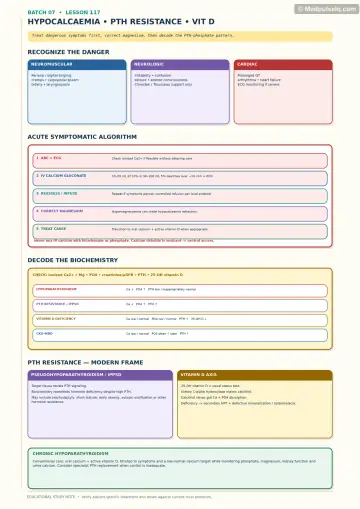
Concept 117
Hypocalcaemia, PTH Resistance and Vitamin D
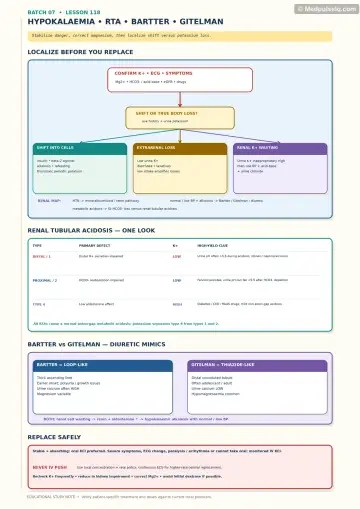
Concept 118
Hypokalaemia: Finding the Loss
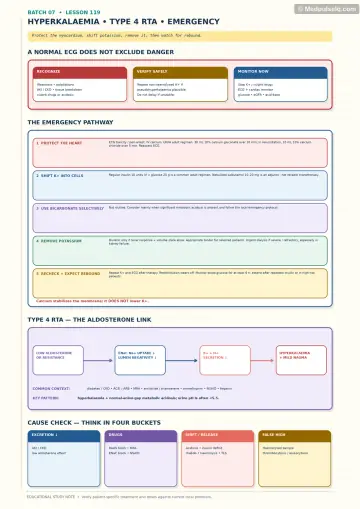
Concept 119
Hyperkalaemia: Protect the Heart
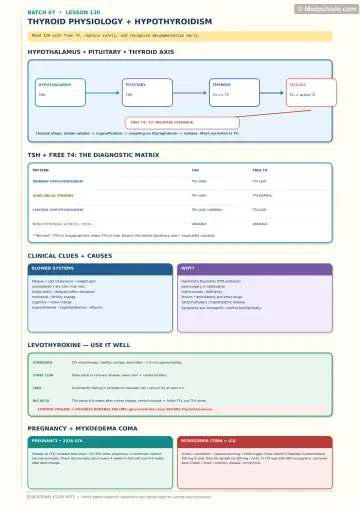
Concept 120
Thyroid Tests and Hypothyroidism
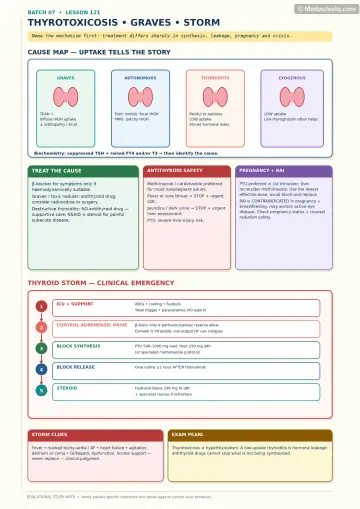
Concept 121
Hyperthyroidism, Graves Disease and Thyroid Storm
⚡ Rapid revision
The whole Part on one screen — read it the night before.
Diabetes diagnosis and phenotype
- Diagnose diabetes in nonpregnant adults with HbA1c ≥6.5%, fasting glucose ≥126 mg/dL, 2-hour OGTT ≥200 mg/dL, or symptomatic random glucose ≥200 mg/dL; confirm if asymptomatic.
- HbA1c may mislead with altered red-cell lifespan, transfusion or blood loss, haemoglobin variants, pregnancy, advanced CKD and assay interference.
- Atypical adult diabetes: revisit phenotype with tempo, ketosis, islet antibodies, contextual C-peptide, family pattern, pancreatic disease and drug history.
- Type 1 diabetes always needs basal insulin. Never stop it completely during illness or fasting.
- Asian ancestry lowers risk-based screening BMI threshold to 23 kg/m².
Diabetes treatment and emergencies
- Type 2 therapy is comorbidity-led: SGLT2 inhibitor for HF/CKD when appropriate; GLP-1-based therapy for ASCVD or weight priorities; metformin is useful but not a gatekeeper.
- DKA = diabetes or hyperglycaemia + beta-hydroxybutyrate ≥3 mmol/L or urine ketones ≥2+ + pH <7.3 and/or bicarbonate <18.
- HHS = glucose ≥600 mg/dL + hyperosmolality + beta-hydroxybutyrate <3 + pH ≥7.3 and bicarbonate ≥15.
- DKA with K <3.5 mmol/L: replace potassium first and delay insulin. Add dextrose when glucose <250 while continuing insulin until ketones and acidosis resolve.
- Hypoglycaemia: <70 alert, <54 clinically significant, severe = assistance required. Treat conscious patients with 15 g glucose and recheck in 15 minutes.
Mineral and potassium anchors
- Hypercalcaemia: confirm, then PTH. Non-suppressed PTH during hypercalcaemia is abnormal.
- PHPT surgery: symptoms or Ca >1 mg/dL above ULN, skeletal criterion, renal criterion, sex-specific hypercalciuria or age <50.
- Symptomatic hypocalcaemia: IV calcium gluconate with ECG monitoring, correct magnesium and cause.
- Hypokalaemia: determine shift versus loss; blood pressure plus acid-base state localizes. Never IV-push potassium.
- Hyperkalaemia: ECG calcium → insulin/glucose ± beta-agonist → remove potassium → repeat K, ECG and glucose.
Thyroid anchors
- Primary hypothyroidism: high TSH with low FT4. Central hypothyroidism: low FT4 with inappropriate low/normal TSH; assess cortisol first.
- Graves disease has TRAb/high uptake; thyroiditis has low uptake and does not benefit from thionamide.
- Methimazole/carbimazole is usually preferred in nonpregnant adults; PTU is preferred in first trimester and thyroid storm.
- Fever or sore throat on antithyroid drugs means stop and urgent CBC.
- Thyroid storm: ICU, cooling, safe beta blockade, thionamide, iodine at least 1 hour later, steroid and trigger control.
- Myxoedema coma: ventilation/support, hydrocortisone before or with IV thyroid hormone, cautious passive rewarming and trigger treatment.
High-yield comparison tables
| Feature | DKA | Starvation ketosis | Lactic acidosis |
|---|---|---|---|
| Glucose | often high; can be near normal with SGLT2 use or pregnancy | low/normal | variable |
| Beta-hydroxybutyrate | ≥3 mmol/L in diagnostic framework | usually less severe, overlap possible | may coexist; lactate dominant |
| Acidosis | high-gap metabolic acidosis | usually mild | high-gap with raised lactate |
| Key context | diabetes, insulin deficiency, illness | prolonged low intake | shock, hypoxia, sepsis, drugs, liver dysfunction |
| Treatment anchor | fluids, potassium-led insulin, trigger | carbohydrate/fluids; refeeding monitoring | restore perfusion/oxygenation and treat cause |
| Pattern | Think of |
|---|---|
| Hypertension + hypokalaemic metabolic alkalosis + suppressed renin | primary mineralocorticoid excess |
| Hypotension + hyperkalaemia + hyponatraemia | adrenal insufficiency, especially primary |
| Hyperkalaemia + mild normal-gap acidosis in diabetic CKD | type 4 RTA |
| Hypercalcaemia + non-suppressed PTH | primary/tertiary hyperparathyroidism or FHH |
| Hypocalcaemia + high phosphate + low PTH | hypoparathyroidism |
| Hypocalcaemia + high phosphate + high PTH | PTH resistance or advanced CKD context |
Pharmacology safety round-up
| Drug/problem | Preventable harm | Safety action |
|---|---|---|
| Insulin | wrong product/dose, hypoglycaemia, lipohypertrophy | verify label/concentration, teach units/sites, match meals, review renal function |
| Sulfonylurea | prolonged hypoglycaemia | use cautiously in older/renal patients; observe recurrence; consider octreotide in overdose/recurrent severe events |
| Metformin | accumulation during severe AKI/hypoxia | hold during severe acute illness/AKI; use with appropriate eGFR; monitor B12 |
| SGLT2 inhibitor | euglycaemic DKA, genital infection, volume depletion | sick-day/surgery pause, ketone education, hygiene and volume assessment |
| GLP-1-based therapy | GI intolerance, dehydration, gallbladder events | titrate; review severe abdominal symptoms/hydration; avoid in pregnancy |
| IV potassium | fatal rapid infusion/extravasation | never IV push; use pump, line/rate policy, ECG and repeat levels |
| Insulin for hyperkalaemia | delayed hypoglycaemia | baseline and serial glucose with rescue plan |
| IV calcium | extravasation/arrhythmia | correct salt/route, ECG, secure access; do not mix with bicarbonate/phosphate |
| Antithyroid drug | agranulocytosis/hepatotoxicity | symptom-triggered stop and CBC/LFT assessment |
| Levothyroxine | overtreatment, interaction, precipitated adrenal crisis | start appropriately; separate iron/calcium; treat possible adrenal insufficiency first |
Emergency one-page sequence
- Altered diabetic patient: bedside glucose → airway/circulation → if low, treat immediately → if high, check ketones, gas, electrolytes and osmolality → classify DKA/HHS/other → fluids plus potassium-directed insulin → find trigger → biochemical resolution plus safe transition.
- Weak or paralysed patient with abnormal potassium: ECG and repeat sample → if hyperkalaemic ECG toxicity, calcium first → insulin/glucose plus adjunct → remove potassium → repeat K/glucose/ECG. If hypokalaemic, correct magnesium and potassium with monitoring → determine shift versus renal/GI loss.
- Confused patient with thyroid disease: temperature, heart rate, ventilation, sodium/glucose/cortisol and trigger → storm phenotype: beta blockade only if haemodynamically safe, thionamide, delayed iodine, steroid → myxoedema phenotype: ventilation, steroid first, IV thyroid hormone, passive rewarming.
🎯 Single‑best‑answer MCQs
Pick an answer to see the explanation — and the concept to revisit if you missed it. Your answers are saved on this device.
Score 0 / 00 of 20 answered
Question 1
A stable asymptomatic adult has HbA1c 6.7% once. The best next step is:
Question 2
Which patient most strongly requires continued basal insulin while fasting?
Question 3
A patient with type 2 diabetes and symptomatic heart failure has HbA1c 6.8% on metformin. The most disease-modifying addition is:
Question 4
Which finding completes DKA diagnosis in a patient with prior diabetes, beta-hydroxybutyrate 4 mmol/L and glucose 190 mg/dL?
Question 5
In DKA, potassium is 3.1 mmol/L. The next priority is:
Question 6
Which best defines level 3 hypoglycaemia?
Question 7
A patient taking acarbose develops insulin-associated hypoglycaemia. Preferred oral treatment is:
Question 8
Hypercalcaemia with a “normal” PTH most strongly indicates:
Question 9
Which asymptomatic primary hyperparathyroidism finding is a surgical criterion?
Question 10
The most important coexisting deficiency to correct in refractory hypocalcaemia is:
Question 11
Hypokalaemic metabolic alkalosis, high renin/aldosterone, hypomagnesaemia and hypocalciuria suggest:
Question 12
The first drug for hyperkalaemia with QRS widening is:
Question 13
After insulin/glucose for hyperkalaemia, the essential monitoring is:
Question 14
Hyperkalaemia with mild normal-anion-gap acidosis in diabetic CKD suggests:
Question 15
Low free T4 with a non-elevated TSH should raise concern for:
Question 16
A patient on carbimazole develops fever and sore throat. The best action is:
Question 17
Preferred antithyroid drug in the first trimester is generally:
Question 18
In thyroid storm, iodine should be administered:
Question 19
Which treatment is ineffective for the thyrotoxic phase of uncomplicated destructive thyroiditis?
Question 20
In suspected myxoedema coma with possible adrenal insufficiency, the correct sequence includes:
🃏 Flashcards
Say the answer out loud before you flip. Shuffle once you know the order.
Card 1 of 20
🩺 Staged clinical cases
Read the presentation, decide what is going on and what you would do — then reveal the reasoning.
Case 1 — Euglycaemic DKA
Stage A: A 26-year-old with type 1 diabetes taking an SGLT2 inhibitor has vomiting after fasting. Glucose is 184 mg/dL, beta-hydroxybutyrate 5.2 mmol/L, pH 7.21 and bicarbonate 13 mmol/L.
Case 2 — Type 2 diabetes with HF and CKD
Stage A: A 62-year-old on metformin has HbA1c 7.1%, eGFR 38, albuminuria and heart failure.
Linked concepts: 112. Choosing Type 2 Diabetes Treatment
Case 3 — Recurrent nocturnal hypoglycaemia
Stage A: A 74-year-old with CKD uses NPH and a sulfonylurea. Morning headaches and CGM lows occur at 03:00.
Case 4 — PTH-dependent hypercalcaemia
Stage A: A 46-year-old has calcium 11.4 mg/dL with a laboratory upper limit of 10.2, non-suppressed PTH, a renal stone and T-score −2.1.
Case 5 — Hypokalaemia with hypertension
Stage A: A 39-year-old with resistant hypertension has potassium 2.8 mmol/L and metabolic alkalosis while not taking a diuretic.
Linked concepts: 118. Hypokalaemia: Finding the Loss
Case 6 — Hyperkalaemia with a broad QRS
Stage A: A patient with AKI has potassium 7.1 mmol/L, bradycardia and QRS widening.
Linked concepts: 119. Hyperkalaemia: Protect the Heart
Case 7 — Graves disease in early pregnancy
Stage A: A woman at 8 weeks' gestation has symptomatic Graves disease requiring medication.
Linked concepts: 121. Hyperthyroidism, Graves Disease and Thyroid Storm
Case 8 — Thyroid storm with heart failure
Stage A: A thyrotoxic patient has fever, delirium, atrial fibrillation and pulmonary oedema.
Linked concepts: 121. Hyperthyroidism, Graves Disease and Thyroid Storm
🎤 Viva practice
Answer aloud as if an examiner asked you — then check the model points.
Viva 1
Why can HbA1c be misleading?
Viva 2
How do you distinguish type 1 from type 2 in an adult?
Viva 3
Why use an SGLT2 inhibitor when HbA1c is already controlled?
Viva 4
State the three components of DKA diagnosis.
Viva 5
Why must potassium precede insulin when K is below 3.5?
Viva 6
What are the three hypoglycaemia levels?
Viva 7
How do you approach hypercalcaemia?
Viva 8
Name four parathyroidectomy criteria in asymptomatic PHPT.
Viva 9
Why correct magnesium in hypocalcaemia or hypokalaemia?
Viva 10
How do Bartter and Gitelman differ?
Viva 11
What are the three aims in hyperkalaemia?
Viva 12
Why is a normal ECG not reassuring in hyperkalaemia?
Viva 13
How is central hypothyroidism monitored?
Viva 14
Why is PTU used in thyroid storm?
Viva 15
Differentiate Graves disease from thyroiditis.
Keep going
Educational only — not a substitute for clinical judgement, supervision, or local guidelines.