Loading…
❤️ Physiology · Part 10 revision hub
Neurophysiology I — Sensory Systems and Special Senses
Everything you need to revise this Part in one place — the one‑page note for every concept, a rapid‑revision sheet, exam‑style questions that point you back to the right concept, flashcards, staged cases and viva practice.
13 concepts20 MCQs20 flashcards5 cases15 viva questions
📝 The plate wall
Every concept in this Part as a one‑page handwritten note. Open one to read it in full and zoom.
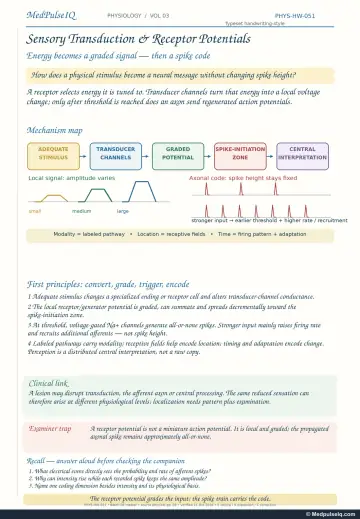
Concept 103
Sensory Receptors: from stimulus to signal
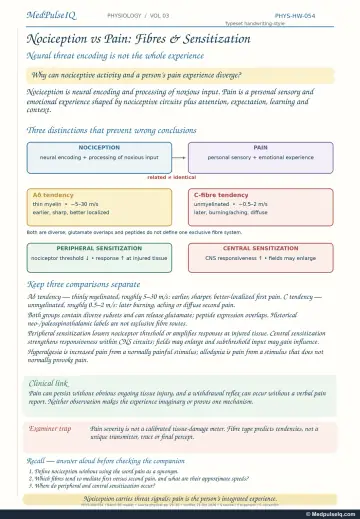
Concept 104
Pain
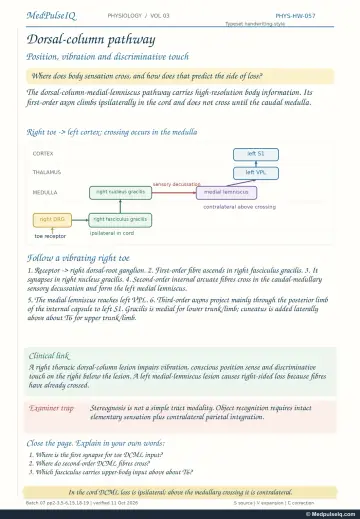
Concept 105
The Highways of Sensation
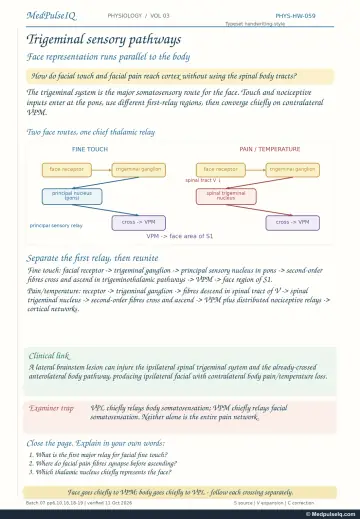
Concept 106
Face, Thalamus and Sensory Cortex
Concept 107
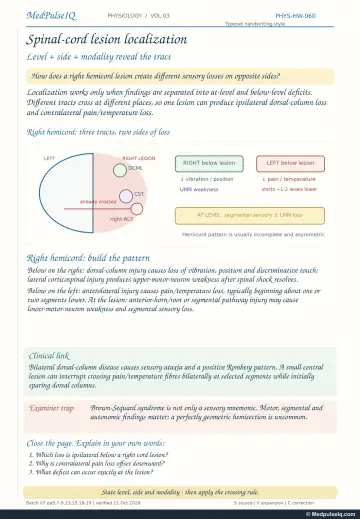
Finding the Lesion in the Spinal Cord
Concept 108
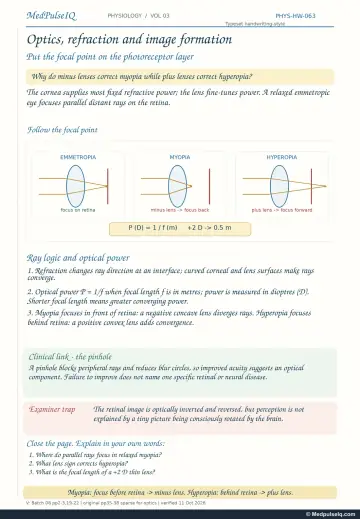
Optics of the Eye
Concept 109
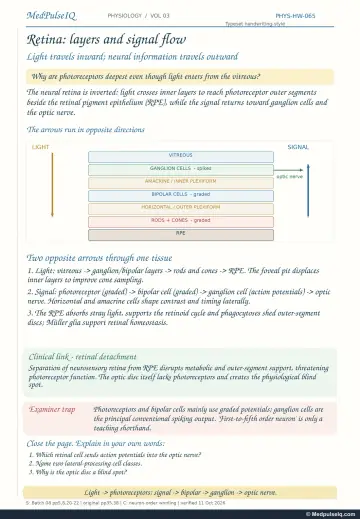
The Retina and Phototransduction
Concept 110
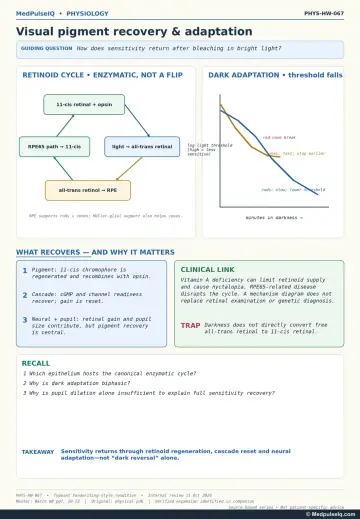
Seeing in the Dark and in Colour
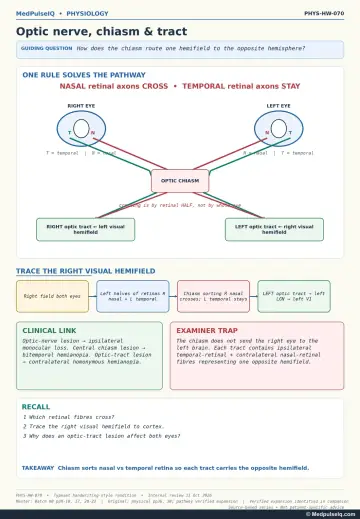
Concept 111
The Visual Pathway
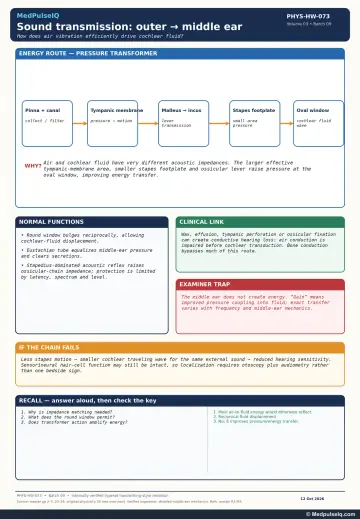
Concept 112
How We Hear
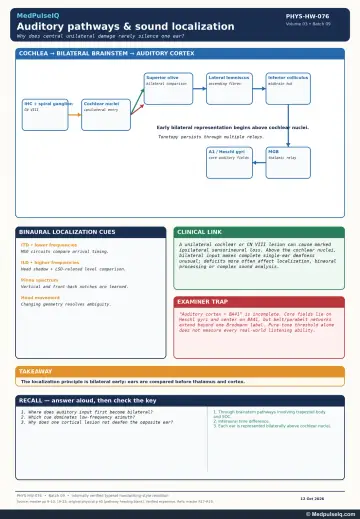
Concept 113
Auditory Pathways and Hearing Tests
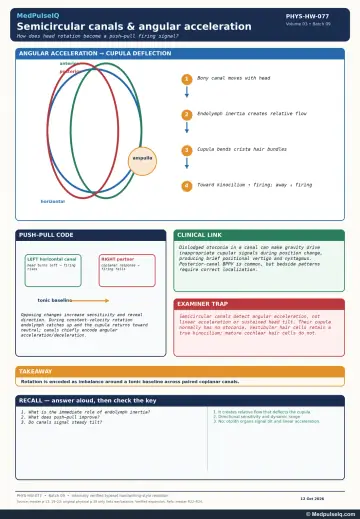
Concept 114
Balance
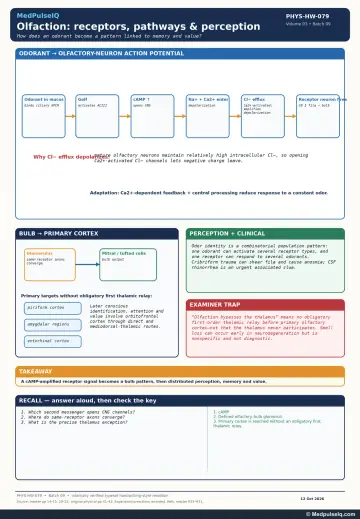
Concept 115
Smell and Taste
⚡ Rapid revision
The whole Part on one screen — read it the night before.
Receptors, pain and pathways
- Receptor potential: graded, local; spikes all‑or‑none. Intensity = rate + recruitment; location = receptive field; modality = labelled line.
- Merkel (SA1, form), Meissner (FA1, flutter/slip), Pacinian (FA2, vibration ~250 Hz), Ruffini (SA2, stretch).
- Fibres: Ia/Ib (Aα), II (Aβ), III (Aδ, 5–30 m/s, first pain), IV (C, 0.5–2 m/s, second pain).
- Pain channels: TRPV1 (heat, capsaicin), ASIC (H⁺), P2X3 (ATP); NaV1.7 initiation, NaV1.8 upstroke. PGE₂/bradykinin sensitise.
- Gate control: Aβ → lamina II inhibitory interneurons. Descending: PAG → RVM (5‑HT) + locus coeruleus (NA) → dorsal horn. Opioids: ↓ presynaptic Ca²⁺, ↑ postsynaptic K⁺.
- DCML: ipsilateral in cord, crosses in caudal medulla → VPL. Gracilis (leg) medial; cuneatus above T6.
- ALS: synapse in dorsal horn, crosses in anterior white commissure (1–2 segments), contralateral; sacral fibres lateral.
- Face: principal V (touch, pons), spinal V (pain/temp, medulla) → VPM. Lateral medullary: ipsilateral face + contralateral body pain/temp loss.
Cord and vision
- Brown‑Séquard: ipsilateral UMN + DCML; contralateral pain/temp (1–2 below). Anterior cord: spares DCML. Central cord: cape loss, arms > legs.
- Conus: early sphincter, symmetrical; cauda equina: LMN, asymmetric, radicular pain.
- Cornea ~43 D, lens ~20 D. Myopia → minus; hypermetropia → plus; presbyopia = lens stiffening.
- Near triad: accommodation (ciliary contraction, zonules slacken), convergence, miosis (CN III).
- Light reflex: CN II → pretectal → bilateral EW → CN III. RAPD = asymmetric afferent defect.
- Horner: miosis, ptosis, anhidrosis; anisocoria worse in dark. CN III palsy: dilated, down and out.
- Phototransduction: light → transducin → PDE6 → ↓ cGMP → CNG close → hyperpolarisation → ↓ glutamate. ON bipolars use mGluR6.
- Rods: sensitive, convergent, no colour, absent at foveola; cones: S 420, M 530, L 560 nm.
- Dark adaptation: cones (5–10 min) then rods; rod–cone break; needs RPE65/vitamin A.
- Red–green defects X‑linked (~8% males); deutan commonest.
- Nasal fibres cross. Chiasm → bitemporal; tract → incongruous homonymous; Meyer loop → superior quadrant; parietal → inferior; V1 → congruous with macular sparing.
Hearing, balance, chemical senses
- Middle ear gain ~22× (area 17:1 × lever 1.3). Base = high frequency, apex = low.
- Endolymph K⁺‑rich, +80 mV; K⁺ entry depolarises hair cells. IHC → 95% afferents; OHC → prestin amplifier, OAEs.
- Noise → 4 kHz notch; Ménière's → low‑frequency fluctuating loss; otosclerosis → Carhart notch.
- Bilateral from superior olive. ITD (MSO, low f); ILD (LSO, high f).
- Conductive: Rinne negative, Weber to bad ear. SNHL: Rinne positive, Weber to good ear.
- Canals: angular acceleration; utricle/saccule: linear + tilt. VOR: left head turn → eyes right (L canal → R VI → MLF → L III).
- Nystagmus named by fast phase. COWS. HINTS: normal head impulse + direction‑changing nystagmus + skew = central.
- BPPV: posterior canal, Dix–Hallpike, Epley.
- Olfaction: Golf → cAMP → CNG → Cl⁻ efflux; no obligatory thalamic relay; Kallmann = anosmia + hypogonadism.
- Taste: sweet/umami/bitter (T1R/T2R, type II, ATP), sour (OTOP1, type III), salt (ENaC). VII anterior ⅔, IX posterior ⅓, X epiglottis → NTS → VPMpc → insula.
🎯 Single‑best‑answer MCQs
Pick an answer to see the explanation — and the concept to revisit if you missed it. Your answers are saved on this device.
Score 0 / 00 of 20 answered
Question 1
Stimulus intensity is mainly encoded in a sensory nerve by:
Question 2
The receptor best suited to detect a 256 Hz tuning fork is the:
Question 3
"Second pain" — slow, burning and poorly localised — is carried by:
Question 4
Gate control of pain is mediated by:
Question 5
Second‑order neurons of the dorsal column–medial lemniscus pathway cross in the:
Question 6
A patient sways with eyes closed but not open. The lesion most likely involves:
Question 7
A lateral medullary infarct causes pain/temperature loss on the:
Question 8
Anterior spinal artery occlusion characteristically spares:
Question 9
Loss of pain and temperature in a "cape" distribution with preserved light touch suggests:
Question 10
During accommodation for near vision:
Question 11
On swinging a light from the right to the left eye, both pupils dilate. The lesion is in the:
Question 12
In response to light, a rod photoreceptor:
Question 13
The only retinal neurons that routinely fire conventional action potentials are:
Question 14
The rod–cone break on a dark‑adaptation curve marks:
Question 15
The most common inherited colour‑vision defect is:
Question 16
A left temporal lobe lesion affecting Meyer's loop produces:
Question 17
High‑frequency sounds produce maximal basilar membrane displacement at the:
Question 18
Right‑sided conductive hearing loss gives:
Question 19
When the head rotates to the left, the vestibulo‑ocular reflex moves the eyes:
Question 20
A patient who cannot smell after a head injury reports that food has "no taste". Basic taste testing will most likely show:
🃏 Flashcards
Say the answer out loud before you flip. Shuffle once you know the order.
Card 1 of 20
🩺 Staged clinical cases
Read the presentation, decide what is going on and what you would do — then reveal the reasoning.
Case 1 — Burning feet that can't feel the floor
Stage A: A 58‑year‑old with 15 years of type 2 diabetes has burning feet at night and feels unsteady in the dark. Vibration is absent at the toes and ankles; pinprick reduced to mid‑shin; ankle jerks absent; Romberg positive.
Case 2 — Stabbed in the back
Stage A: A 25‑year‑old has a stab wound to the right side of the back at the level of T8. He cannot move his right leg. He cannot feel a tuning fork on the right foot, and he cannot feel pinprick or temperature on the left leg up to about T10.
Linked concepts: 105. The Highways of Sensation, 107. Finding the Lesion in the Spinal Cord
Case 3 — Bumping into door frames
Stage A: A 45‑year‑old man has bumped into door frames on both sides for 6 months and has had headaches. His wife notes his hands and jaw have grown. Acuity is normal.
Linked concepts: 111. The Visual Pathway, 108. Optics of the Eye
Case 4 — Spinning when rolling over in bed
Stage A: A 62‑year‑old woman has 30‑second episodes of violent spinning when she lies down or rolls to the right. Between episodes she is well; hearing is normal; neurological examination is normal.
Linked concepts: 114. Balance
Case 5 — Sudden vertigo and unable to walk
Stage A: A 67‑year‑old hypertensive smoker has sudden continuous vertigo, vomiting and cannot stand unaided. He has hiccups and hoarseness.
Linked concepts: 114. Balance, 106. Face, Thalamus and Sensory Cortex
🎤 Viva practice
Answer aloud as if an examiner asked you — then check the model points.
Viva 1
Define a receptor potential and contrast it with an action potential.
Viva 2
How is intensity encoded?
Viva 3
Classify sensory nerve fibres.
Viva 4
Explain peripheral and central sensitisation.
Viva 5
Describe the descending pain‑modulating pathway.
Viva 6
Trace vibration sense from the right foot to cortex.
Viva 7
Trace pain from the left hand.
Viva 8
What is Brown‑Séquard syndrome?
Viva 9
Explain the near triad.
Viva 10
Describe the pupillary light reflex pathway.
Viva 11
Explain phototransduction.
Viva 12
Why does a pituitary tumour cause bitemporal hemianopia?
Viva 13
How does the middle ear match impedance?
Viva 14
Differentiate conductive from sensorineural loss with tuning forks.
Viva 15
What is HINTS?
Keep going
Educational only — not a substitute for clinical judgement, supervision, or local guidelines.