Loading…
❤️ Physiology · Part 11 revision hub
Neurophysiology II — Motor Control, Autonomic and Higher Functions
Everything you need to revise this Part in one place — the one‑page note for every concept, a rapid‑revision sheet, exam‑style questions that point you back to the right concept, flashcards, staged cases and viva practice.
11 concepts20 MCQs20 flashcards5 cases15 viva questions
📝 The plate wall
Every concept in this Part as a one‑page handwritten note. Open one to read it in full and zoom.
Concept 116
Movement Is a Hierarchy: upper versus lower motor neuron
Concept 117
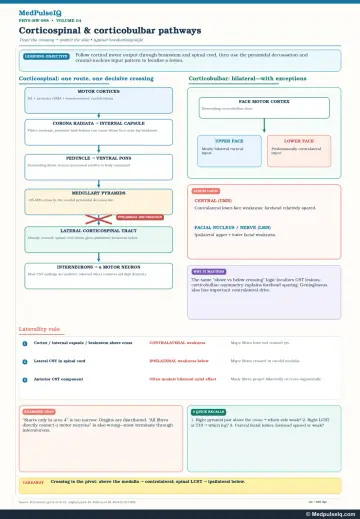
The Descending Highways
Concept 118
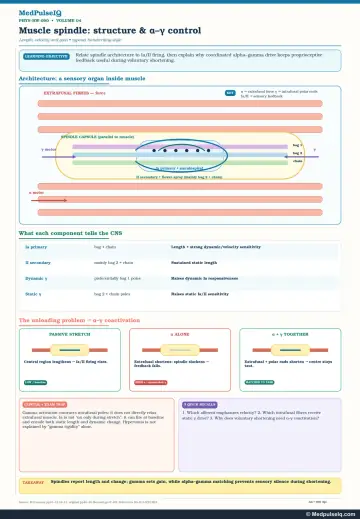
The Muscle Spindle and the Knee Jerk
Concept 119
Other Reflexes and Spinal Shock
Concept 120
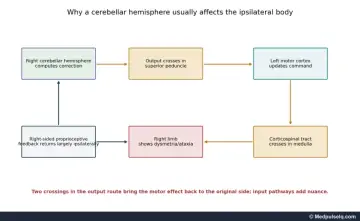
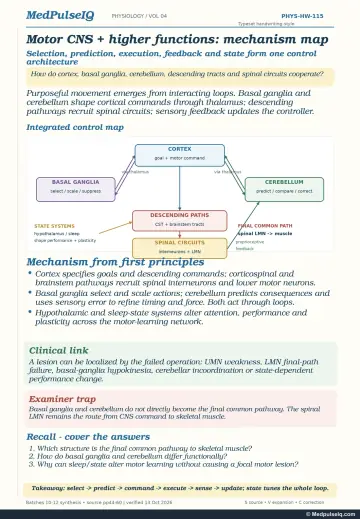
The Cerebellum: the error-corrector
Concept 121
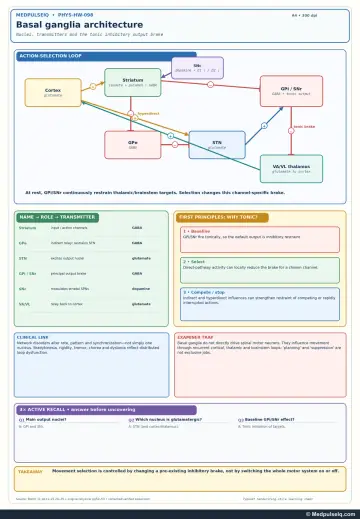
The Basal Ganglia: choosing the movement
Concept 122
The Autonomic Nervous System
Concept 123
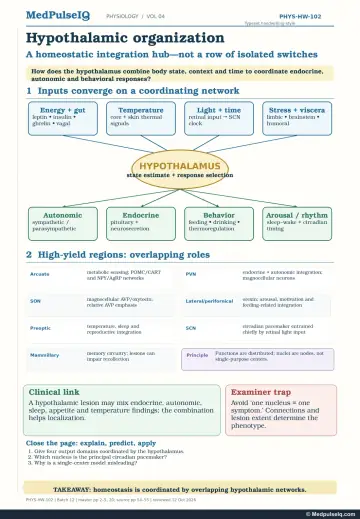
The Hypothalamus: the body's thermostat and appetite centre
Concept 124
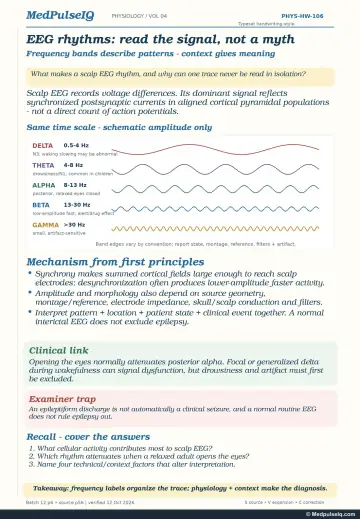
Brain Waves and Sleep
Concept 125
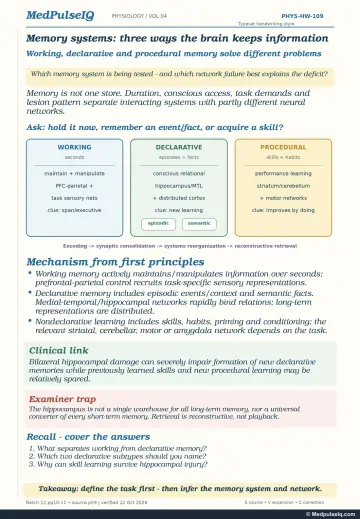
Learning and Memory
Concept 126
Speech, the Thinking Cortex and the Brain's Fluid
⚡ Rapid revision
The whole Part on one screen — read it the night before.
Motor pathways and reflexes
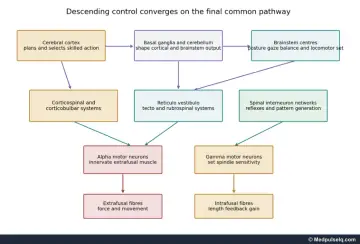
- Hierarchy: strategy (prefrontal/parietal) → planning (premotor, SMA) → M1 → CST → α motor neuron (final common pathway). BG and cerebellum act via thalamic loops.
- UMN: spastic, brisk, clonus, extensor plantar, little wasting. LMN: flaccid, areflexic, wasting, fasciculations. Acute UMN can be flaccid (shock).
- CST: ~85–90% cross at pyramidal decussation. Above → contralateral weakness; cord → ipsilateral.
- Lower face and genioglossus get mainly contralateral cortical input; UMN facial palsy spares the forehead.
- Crossed brainstem syndromes: Weber (III + contralateral hemiparesis), Millard–Gubler (VI/VII), medial medullary (XII).
- Decorticate (above red nucleus): arms flexed; decerebrate (below red nucleus): all extended — worse.
- Spindle: parallel; Ia (velocity + length), II (static). γ sets gain; α–γ coactivation.
- Stretch reflex monosynaptic; reciprocal inhibition disynaptic. Biceps C5–6, triceps C7, knee L3–4, ankle S1.
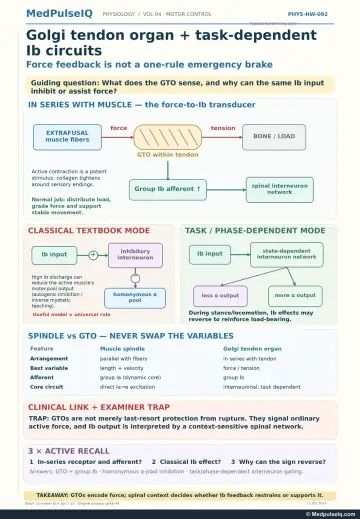
- GTO: series, force, Ib, autogenic inhibition (task‑dependent). Withdrawal + crossed extension: polysynaptic.
- Renshaw: recurrent glycinergic inhibition. Tetanus (VAMP, ↓ glycine/GABA) → spasms; strychnine (glycine R); botulinum (SNAREs at NMJ) → flaccid.
- Spinal shock → bulbocavernosus reflex returns first → spasticity; autonomic dysreflexia ≥ T6.
Cerebellum, basal ganglia, autonomic
- Purkinje = sole cortical output, GABAergic. Mossy → granule → parallel fibres; climbing fibres from inferior olive.
- Vestibulocerebellum → nystagmus, truncal; vermis → gait (alcohol); hemispheres → limb dysmetria, intention tremor. Signs ipsilateral.
- Peduncles: superior mainly out; middle in only; inferior mainly in.
- BG: GPi/SNr tonic brake on thalamus. Direct (D1) releases; indirect (D2) and hyperdirect tighten. STN is glutamatergic.
- PD: SNc loss → ↑ GPi output → bradykinesia, rigidity, rest tremor. HD: indirect SPN loss → chorea. STN lesion → contralateral hemiballismus.
- Sympathetic T1–L2, NA (sweat glands ACh); parasympathetic III, VII, IX, X, S2–4, ACh muscarinic. All ganglia nicotinic.
- M2 heart (↓ HR), M3 glands/smooth muscle; α₁ vasoconstriction; β₁ heart, renin; β₂ bronchi, muscle vessels; β₃ lipolysis, detrusor.
- Organophosphate: DUMBELS + fasciculations → atropine to dry chest, pralidoxime.
Hypothalamus, sleep, memory, cortex
- Arcuate POMC (α‑MSH → MC4R, stop) vs NPY/AgRP (eat). Ghrelin ↑ before meals; leptin ∝ fat. MC4R = commonest monogenic obesity.
- OVLT/SFO sense osmolality and Ang II (no BBB). SCN = clock (ipRGC → RHT).
- EEG: beta > 13, alpha 8–13 (eyes closed), theta 4–8, delta < 4. 3 Hz spike–wave = absence.
- N2 spindles + K‑complexes; N3 ≥ 20% slow waves; REM: rapid eyes, atonia, dreams; N3 early, REM late.
- Process S (adenosine) + Process C (SCN, melatonin). VLPO ⟷ arousal flip‑flop stabilised by orexin; narcolepsy = orexin loss.
- Memory: working (DLPFC), episodic (hippocampus, Papez), semantic (anterior temporal), procedural (striatum, cerebellum), fear (amygdala).
- LTP: AMPA depolarisation → NMDA Mg²⁺ unblock → Ca²⁺ → CaMKII → more AMPA. Cooperativity, associativity, specificity.
- Broca: non‑fluent, comprehension OK; Wernicke: fluent, poor comprehension; conduction: poor repetition; transcortical: repetition spared.
- CSF ~500 mL/day, ~150 mL; choroid plexus → arachnoid granulations. CPP = MAP − ICP. BBB tight junctions; absent at circumventricular organs.
🎯 Single‑best‑answer MCQs
Pick an answer to see the explanation — and the concept to revisit if you missed it. Your answers are saved on this device.
Score 0 / 00 of 20 answered
Question 1
Which finding most strongly indicates a lower motor neuron lesion?
Question 2
Immediately after an acute stroke, the hemiplegic limb is often:
Question 3
A lacunar infarct in the posterior limb of the left internal capsule causes:
Question 4
Weakness of the lower face only, with forehead sparing, indicates a lesion of the:
Question 5
Group Ia afferents from muscle spindles are most sensitive to:
Question 6
The function of α–γ coactivation is to:
Question 7
An absent ankle jerk on one side suggests compression of the:
Question 8
Tetanus toxin causes spasms by:
Question 9
In the crossed extensor reflex, a painful stimulus to the right foot produces:
Question 10
The only output neurons of the cerebellar cortex are:
Question 11
A lesion of the right cerebellar hemisphere causes intention tremor in the:
Question 12
In the basal ganglia, the only major excitatory (glutamatergic) nucleus is the:
Question 13
Dopamine increases movement because it:
Question 14
Hemiballismus most classically follows a lesion of the:
Question 15
Sympathetic postganglionic fibres to eccrine sweat glands release:
Question 16
Bradycardia from vagal stimulation is mediated by:
Question 17
Which hormone rises before meals and stimulates appetite?
Question 18
Sleep spindles and K‑complexes are the defining features of:
Question 19
NMDA receptors contribute to LTP induction because they:
Question 20
A patient speaks fluently and understands well but cannot repeat phrases. The lesion is most likely in the:
🃏 Flashcards
Say the answer out loud before you flip. Shuffle once you know the order.
Card 1 of 20
🩺 Staged clinical cases
Read the presentation, decide what is going on and what you would do — then reveal the reasoning.
Case 1 — Wasting hands and brisk knees
Stage A: A 58‑year‑old man has 8 months of progressive hand weakness and cramps, then slurred speech. Small hand muscles are wasted with visible fasciculations, yet the arm and knee reflexes are brisk, with extensor plantars. Sensation is normal.
Case 2 — A shaky right hand in a teacher
Stage A: A 64‑year‑old teacher has a 4–5 Hz tremor of the right hand at rest that settles when she writes; her handwriting has become small. Her husband says she has acted out dreams for years. She has lost her sense of smell.
Linked concepts: 121. The Basal Ganglia: choosing the movement, 124. Brain Waves and Sleep
Case 3 — Farmer found vomiting with pinpoint pupils
Stage A: A 32‑year‑old farmer is brought in after ingesting a pesticide. He is drowsy, sweating, salivating, has pinpoint pupils, wheeze with copious secretions, HR 48/min and muscle twitching.
Linked concepts: 122. The Autonomic Nervous System
Case 4 — Can't recall breakfast but plays the sitar
Stage A: A 45‑year‑old musician recovered from herpes simplex encephalitis 6 months ago. He cannot remember conversations from an hour earlier and repeats questions, yet plays the sitar well and learns new finger exercises. Digit span is normal. His family notes he puts objects in his mouth.
Case 5 — Clumsy right arm and a staggering walk
Stage A: A 30‑year‑old woman has 2 weeks of a clumsy right arm and unsteady walking. Power and reflexes are normal. Finger–nose test shows right‑sided past‑pointing and intention tremor; rapid alternating movements are slow and irregular on the right; she walks broad‑based and veers right. Romberg: unsteady with eyes open and closed.
🎤 Viva practice
Answer aloud as if an examiner asked you — then check the model points.
Viva 1
Differentiate UMN and LMN lesions.
Viva 2
Trace the corticospinal tract.
Viva 3
Why is the forehead spared in a central facial palsy?
Viva 4
Describe the structure of a muscle spindle.
Viva 5
Explain the stretch reflex and reciprocal inhibition.
Viva 6
Compare the muscle spindle and Golgi tendon organ.
Viva 7
What is spinal shock?
Viva 8
Explain the Babinski sign.
Viva 9
Describe the cerebellar microcircuit.
Viva 10
List cerebellar signs and explain intention tremor.
Viva 11
Explain direct and indirect pathways.
Viva 12
Why does Parkinson's disease cause bradykinesia?
Viva 13
Compare sympathetic and parasympathetic systems.
Viva 14
Explain sleep regulation.
Viva 15
What are the properties of LTP?
Keep going
Educational only — not a substitute for clinical judgement, supervision, or local guidelines.