Loading…
❤️ Physiology · Part 2 revision hub
Haematology and Immunity
Everything you need to revise this Part in one place — the one‑page note for every concept, a rapid‑revision sheet, exam‑style questions that point you back to the right concept, flashcards, staged cases and viva practice.
9 concepts20 MCQs20 flashcards4 cases15 viva questions
📝 The plate wall
Every concept in this Part as a one‑page handwritten note. Open one to read it in full and zoom.
Concept 12
Blood and Plasma: what flows in the tubes
Concept 13
Making Red Cells
Concept 14
Haemoglobin and the Life of a Red Cell
Concept 15
Anaemia: when oxygen carriage falls
Concept 16
White Cells: the defence force
Concept 17
Immunity: born-with and learned defences
Concept 18
Platelets and the First Plug
Concept 19
Clotting: the fibrin net and its brakes
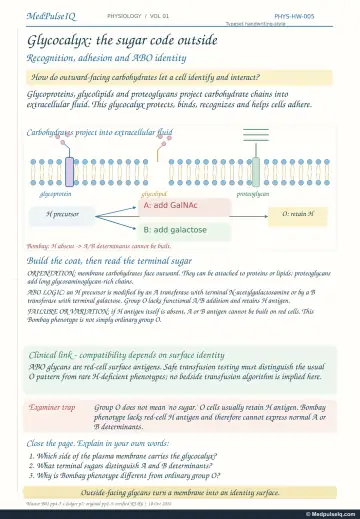
Concept 20
Blood Groups and Safe Transfusion
⚡ Rapid revision
The whole Part on one screen — read it the night before.
Plasma and red cells
- Blood ≈ 70 mL/kg; plasma protein 6–8 g/dL; albumin 3.5–5 g/dL (≈ 80% of oncotic pressure, t½ ≈ 20 days); fibrinogen 200–400 mg/dL.
- Serum = plasma − fibrinogen and consumed factors.
- ESR ↑ with fibrinogen, globulins, anaemia; ↓ with polycythaemia, sickle cells, spherocytes.
- EPO: renal peritubular fibroblasts, HIF‑2α; targets CFU‑E; reticulocytosis in 3–5 days.
- Hepcidin degrades ferroportin: ↑ in inflammation/overload, ↓ in hypoxia/erythropoiesis.
- B12 → ↑ MMA + ↑ homocysteine + neurology; folate → ↑ homocysteine only.
- RBC: 120 days, no mitochondria, glycolysis (ATP, NADH, 2,3‑BPG), HMP shunt (NADPH via G6PD).
- Haemolysis: ↑ retics, ↑ LDH, ↑ unconjugated bilirubin, ↓ haptoglobin.
Indices and anaemia
- MCV = Hct × 10 / RBC; MCH = Hb × 10 / RBC; MCHC = Hb / Hct × 100.
- Iron deficiency: ↓ ferritin, ↑ TIBC, ↓ TSAT, ↑ RDW; inflammation: ferritin normal/↑, ↓ TIBC.
- RPI < 2 = hypoproliferative; > 2 = loss or haemolysis.
- PV: JAK2 V617F, low EPO; secondary polycythaemia: high EPO.
White cells and immunity
- Steroids: neutrophilia (demargination), lymphopenia, eosinopenia.
- LAD‑1 (CD18): delayed cord separation, no pus; CGD (NADPH oxidase): catalase‑positive organisms.
- IgG crosses placenta; IgM first and best complement fixer; IgA mucosal; IgE mast cells.
- MAC (C5–C9) deficiency → Neisseria; C1‑INH deficiency → hereditary angioedema.
Haemostasis and transfusion
- Adhesion GP Ib–vWF; aggregation GP IIb/IIIa–fibrinogen; ADP–P2Y12; TXA₂ via COX‑1.
- Bernard–Soulier = GP Ib (giant platelets); Glanzmann = GP IIb/IIIa.
- PT: VII + common; aPTT: XII, XI, IX, VIII + common; vitamin K: II, VII, IX, X, C, S.
- Antithrombin (heparin), protein C/S (inactivate Va, VIIIa), TFPI; plasmin → D‑dimer.
- ABO antibodies natural (IgM); anti‑D immune (IgG); Bombay makes anti‑H.
- O red cells universal donor; AB plasma universal donor.
🎯 Single‑best‑answer MCQs
Pick an answer to see the explanation — and the concept to revisit if you missed it. Your answers are saved on this device.
Score 0 / 00 of 20 answered
Question 1
Which plasma protein contributes most to plasma oncotic pressure?
Question 2
The ESR is typically decreased in:
Question 3
Erythropoietin acts mainly on which progenitor?
Question 4
Hepcidin reduces iron absorption by:
Question 5
Raised methylmalonic acid with raised homocysteine indicates deficiency of:
Question 6
Red cells generate NADPH via:
Question 7
Which finding is most specific for intravascular haemolysis?
Question 8
MCV 64 fL, RBC 6.1 × 10¹²/L, normal RDW, normal ferritin. Most likely:
Question 9
Which compensation improves tissue O₂ unloading in chronic anaemia?
Question 10
Polycythaemia with a low serum EPO suggests:
Question 11
Glucocorticoids cause:
Question 12
Delayed separation of the umbilical cord and leucocytosis without pus suggests a defect in:
Question 13
Which antibody class is the first produced in a primary response?
Question 14
Recurrent meningococcal infections suggest deficiency of:
Question 15
Absent platelet aggregation with ADP, collagen and adrenaline but normal ristocetin agglutination indicates:
Question 16
Aspirin inhibits platelet function for the platelet's lifespan because:
Question 17
Warfarin first prolongs the PT because:
Question 18
Prolonged aPTT that does not correct with normal plasma, in a woman with recurrent miscarriage, suggests:
Question 19
A patient with Bombay phenotype can safely receive red cells from:
Question 20
Which transfusion reaction typically presents with hypoxaemia and bilateral infiltrates within 6 hours without fluid overload?
🃏 Flashcards
Say the answer out loud before you flip. Shuffle once you know the order.
Card 1 of 20
🩺 Staged clinical cases
Read the presentation, decide what is going on and what you would do — then reveal the reasoning.
Case 1 — Tired, pale and craving ice
Stage A: A 24‑year‑old woman with heavy menstrual periods has fatigue and exertional breathlessness. Hb 8.6 g/dL, MCV 68 fL, RDW high, platelets 480 × 10⁹/L.
Linked concepts: 13. Making Red Cells, 15. Anaemia: when oxygen carriage falls
Case 2 — Dark urine after an antimalarial
Stage A: A 30‑year‑old man treated with primaquine develops dark urine, jaundice and fatigue on day 3. Hb falls from 14 to 9 g/dL.
Linked concepts: 14. Haemoglobin and the Life of a Red Cell, 16. White Cells: the defence force
Case 3 — Bleeding after dental extraction
Stage A: A 16‑year‑old girl has prolonged bleeding after tooth extraction, frequent nosebleeds and heavy periods since menarche. Platelets normal, PT normal, aPTT mildly prolonged.
Linked concepts: 18. Platelets and the First Plug, 19. Clotting: the fibrin net and its brakes
Case 4 — Fever and loin pain ten minutes into a transfusion
Stage A: A post‑operative patient becomes febrile and hypotensive with loin pain ten minutes after a red‑cell unit is started. Urine turns red‑brown.
🎤 Viva practice
Answer aloud as if an examiner asked you — then check the model points.
Viva 1
Differentiate plasma and serum.
Viva 2
List the functions of plasma proteins.
Viva 3
What factors increase ESR?
Viva 4
How is erythropoiesis regulated?
Viva 5
Describe iron absorption.
Viva 6
Why does B12 deficiency cause neurological damage but folate deficiency does not?
Viva 7
What is the fate of haemoglobin after RBC destruction?
Viva 8
Define MCV, MCH and MCHC with normal values.
Viva 9
How does the body compensate for anaemia?
Viva 10
Describe the steps of neutrophil recruitment.
Viva 11
What are the differences between innate and adaptive immunity?
Viva 12
Describe the steps of primary haemostasis.
Viva 13
Which factors are vitamin K dependent and why?
Viva 14
What is Rh isoimmunisation and how is it prevented?
Viva 15
What is the Bombay blood group?
Keep going
Educational only — not a substitute for clinical judgement, supervision, or local guidelines.