Loading…
❤️ Physiology · Part 5 revision hub
Cardiovascular Physiology
Everything you need to revise this Part in one place — the one‑page note for every concept, a rapid‑revision sheet, exam‑style questions that point you back to the right concept, flashcards, staged cases and viva practice.
15 concepts20 MCQs20 flashcards4 cases15 viva questions
📝 The plate wall
Every concept in this Part as a one‑page handwritten note. Open one to read it in full and zoom.
Concept 42
Heart Muscle and the Heart's Wiring
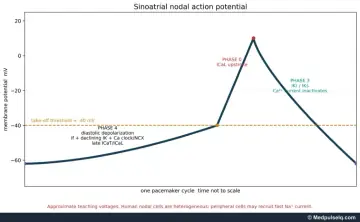
Concept 43
Pacemaker and Ventricular Action Potentials
Concept 44
Nerves That Speed and Slow the Heart
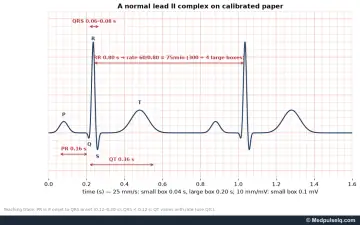
Concept 45
The ECG: waves and intervals
Concept 46
The ECG: axis, blocks and rhythms
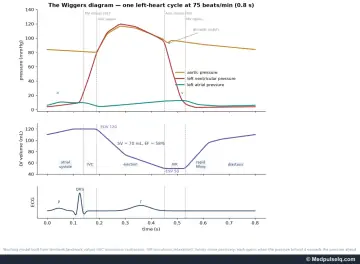
Concept 47
One Heartbeat in Slow Motion
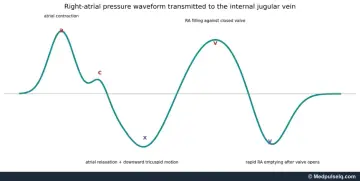
Concept 48
Heart Sounds and the Neck Veins
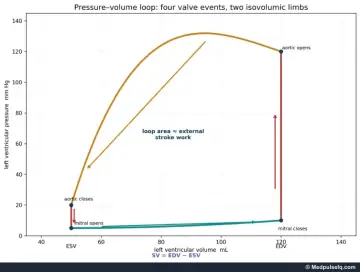
Concept 49
The Pressure–Volume Loop
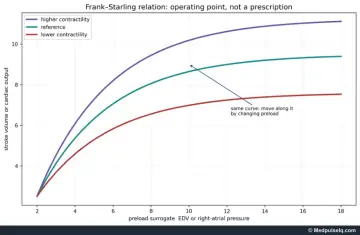
Concept 50
Cardiac Output and Venous Return
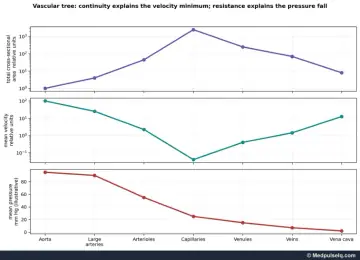
Concept 51
Pressure, Flow and Resistance
Concept 52
Capillaries, Starling Forces and Oedema
Concept 53
Who Controls Blood Flow?
Concept 54
Blood Pressure and How We Measure It
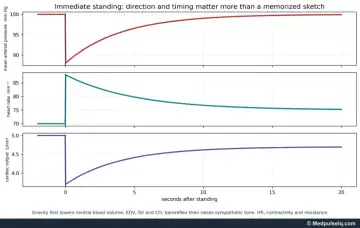
Concept 55
The Baroreflex and Standing Up
Concept 56
Long-term Pressure Control and Shock
⚡ Rapid revision
The whole Part on one screen — read it the night before.
Electricity
- Conduction: SA → atria → AV node (delay, decremental) → His → bundle branches → Purkinje; AV node slowest, Purkinje fastest.
- Escape rates: junctional 40–60 (narrow), ventricular 20–40 (wide). Escape is late; ectopy is early.
- Nodal AP: phases 4–0–3; If + Ca²⁺ clock; I_CaL upstroke. Ventricular AP: 0 I_Na, 1 I_to, 2 I_CaL vs I_K, 3 I_Kr/I_Ks/I_K1, 4 I_K1.
- β₁ ↑ cAMP (rate, conduction, force, relaxation); M₂ ↓ cAMP + GIRK (rate, AV conduction).
- ECG: PR 0.12–0.20 s, QRS < 0.12 s, QTc ≲ 440/460 ms; rate = 300 ÷ large boxes.
- Axis: I and aVF positive = normal. Mobitz I nodal; Mobitz II infranodal.
- Arrhythmia mechanisms: automaticity, triggered (EAD — long QT; DAD — Ca²⁺ overload), re‑entry (unidirectional block + slow conduction; wavelength = CV × ERP).
Mechanics
- Cycle 60/HR; tachycardia shortens diastole most. EDV ~120, ESV ~50, SV ~70, EF 55–70%.
- Valves move with pressure; S1 = AV closure, S2 = semilunar closure; S3 rapid filling, S4 atrial kick into stiff ventricle.
- Splitting: fixed ASD; paradoxical LBBB/severe AS; Valsalva/standing louder → HCM, MVP.
- JVP: absent a AF, cannon a AV dissociation, giant v TR, steep y constriction, absent y tamponade, Kussmaul constriction.
- Preload (stretch), afterload (wall stress σ = Pr/2h), contractility (ESPVR slope). EF is load‑dependent.
- CO = HR × SV ≈ 5 L/min; Fick CO = V̇O₂ ÷ (CaO₂ − CvO₂); VR = (Pmsf − RAP)/RVR; Pmsf ≈ 7.
Vessels and pressure
- Q = ΔP/R; R ∝ 1/r⁴; parallel R adds reciprocally; arterioles = resistance, veins = capacitance (~⅔ volume).
- Continuity: velocity lowest in capillaries. Doppler ΔP ≈ 4v².
- Revised Starling: small continuous filtration, lymph returns ~2–4 L/day; oedema = Pc↑, π↓, leak↑, lymph↓.
- Coronary flow diastolic, extraction ~70–75%; cerebral flow tracks PaCO₂; pulmonary vessels constrict to hypoxia.
- MAP ≈ DBP + ⅓PP = CO × SVR; small cuff overestimates.
- Baroreceptors: carotid (IX), aortic (X) → NTS → nucleus ambiguus, CVLM → RVLM; reset in chronic hypertension.
- Long‑term pressure = renal pressure natriuresis + RAAS. Shock: hypovolaemic, cardiogenic, distributive, obstructive.
🎯 Single‑best‑answer MCQs
Pick an answer to see the explanation — and the concept to revisit if you missed it. Your answers are saved on this device.
Score 0 / 00 of 20 answered
Question 1
A wide‑QRS escape rhythm at 32/min most likely originates in:
Question 2
Cardiac muscle cannot be tetanised because:
Question 3
The upstroke of the SA nodal action potential is carried mainly by:
Question 4
Blocking hERG (I_Kr) channels primarily prolongs:
Question 5
Vagal stimulation slows the SA node mainly by:
Question 6
A transplanted heart responds to exercise mainly through:
Question 7
On paper at 25 mm/s, the RR interval is 4 large boxes. Heart rate is:
Question 8
Peaked T waves and a widening QRS suggest:
Question 9
QRS positive in I and negative in aVF and II indicates:
Question 10
The minimum requirement for re‑entry is:
Question 11
During isovolumic contraction:
Question 12
EDV 140 mL, ESV 60 mL. Ejection fraction is:
Question 13
Fixed splitting of S2 is characteristic of:
Question 14
Cannon a waves in the JVP indicate:
Question 15
An acute rise in afterload with constant preload and contractility will:
Question 16
V̇O₂ 300 mL/min, CaO₂ 200 mL/L, mixed venous O₂ content 140 mL/L. CO is:
Question 17
If an arteriole's radius falls by half with constant pressure gradient, flow becomes:
Question 18
Oedema in nephrotic syndrome results mainly from:
Question 19
Coronary blood flow to the left ventricle is greatest during:
Question 20
Which response follows an acute rise in arterial pressure with an intact baroreflex?
🃏 Flashcards
Say the answer out loud before you flip. Shuffle once you know the order.
Card 1 of 20
🩺 Staged clinical cases
Read the presentation, decide what is going on and what you would do — then reveal the reasoning.
Case 1 — Syncope with a slow, wide pulse
Stage A: A 78‑year‑old has two blackouts without warning. Pulse 34/min, regular. ECG: regular P waves at 80/min marching through wide QRS complexes at 34/min with no fixed PR relationship.
Linked concepts: 42. Heart Muscle and the Heart's Wiring, 46. The ECG: axis, blocks and rhythms
Case 2 — Breathless with a new holosystolic murmur after MI
Stage A: Four days after an inferior MI, a 66‑year‑old develops sudden breathlessness and hypotension. A new apical systolic murmur is heard.
Case 3 — Dizzy every morning on standing
Stage A: A 70‑year‑old with long‑standing diabetes reports light‑headedness on standing. Lying BP 148/84, HR 72; after 3 minutes standing BP 112/70, HR 76.
Linked concepts: 55. The Baroreflex and Standing Up, 50. Cardiac Output and Venous Return
Case 4 — Warm, hypotensive and confused
Stage A: A 45‑year‑old with pyelonephritis has BP 82/40, HR 124, warm peripheries, bounding pulses, confusion and lactate 4.6 mmol/L.
🎤 Viva practice
Answer aloud as if an examiner asked you — then check the model points.
Viva 1
Why is AV nodal delay important?
Viva 2
Describe the SA nodal action potential.
Viva 3
What is the ionic basis of the ventricular plateau?
Viva 4
Define chronotropy, dromotropy, inotropy, lusitropy.
Viva 5
How is heart rate calculated from an ECG?
Viva 6
Classify AV blocks.
Viva 7
Describe the phases of the cardiac cycle.
Viva 8
What produces the heart sounds?
Viva 9
State Frank–Starling's law and its mechanism.
Viva 10
Define preload and afterload.
Viva 11
What is the Fick principle?
Viva 12
What is mean systemic filling pressure?
Viva 13
State Poiseuille's law.
Viva 14
Describe the baroreceptor reflex.
Viva 15
Classify shock.
Keep going
Educational only — not a substitute for clinical judgement, supervision, or local guidelines.