Loading…
Skeletal muscle
Spotter answer: Skeletal muscle with striations.
Clear field
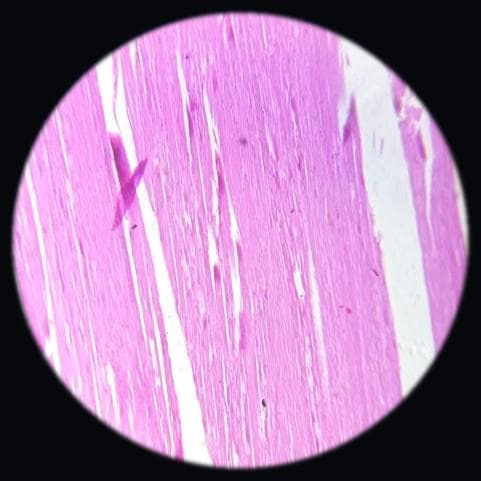
Skeletal muscle fibres at medium power showing longitudinal skeletal muscle fibres. Adjust the focus1.0×
Before you name anything
Alright, take a deep breath. Let's start by looking at the slide on low power. Notice the overall architecture: long, parallel fibres stretching across the field. This is a classic feature of skeletal muscle. Before you get into the details, just appreciate that pattern. Now, move to a higher power and look for the striations and peripheral nuclei. These are your key identifiers. Students often rush to identify individual cells and miss the bigger picture. Focus on the arrangement first. The striations are crucial; they confirm you're looking at skeletal muscle and not smooth muscle, which lacks these features. Remember, the peripheral nuclei are another giveaway. Keep calm and follow these steps, and you'll do just fine.
Work it out, one rung at a time
Answer each question in your head first. Then open it.
- 1
low-power architecture
What is the overall pattern?
- 2
epithelium or covering
Are there any coverings visible?
- 3
the signature feature
What confirms skeletal muscle?
- 4
confirm and exclude the look-alike
How do you know it's not smooth muscle?
Viva voce
1 of 5 · 0 answeredSay your answer out loud before you open it. That is the exam skill.
What are the key features of skeletal muscle?