Loading…
🌏 Community Medicine · Part 1 revision hub
Concepts of Health, Disease and Prevention
Everything you need to revise this Part in one place — the one‑page note for every concept, a rapid‑revision sheet, exam‑style questions that point you back to the right concept, flashcards, staged cases and viva practice.
9 concepts20 MCQs20 flashcards4 cases15 viva questions
📝 The plate wall
Every concept in this Part as a one‑page handwritten note. Open one to read it in full and zoom.
Concept 1
What Community Medicine Is — Seeing the Whole Population
Concept 2
What Health Really Means
Concept 3
Why Some People Stay Healthy — Determinants of Health
Concept 4
Measuring a Nation's Health
Concept 5
How a Disease Unfolds
Concept 6
Prevention at Every Stage
Concept 7
Control, Elimination and Eradication
Concept 8
Families, Culture and Health
Concept 9
Health for All — Primary Health Care
⚡ Rapid revision
The whole Part on one screen — read it the night before.
Health and its determinants
- WHO Constitution (in force 7 April 1948): "complete physical, mental and social well‑being and not merely the absence of disease or infirmity". It is positive, multidimensional and rights‑based.
- Critique: "complete" is unattainable and over‑medicalises. Huber (2011): health as the ability to adapt and self‑manage.
- Disease (doctor finds) ≠ illness (person feels) ≠ sickness (society recognises).
- Determinants: biological, behavioural, environmental, socio‑economic, health services. Dahlgren–Whitehead rainbow; WHO CSDH structural vs intermediary.
- Inequity = differences that are avoidable and unjust; social gradient = step‑wise at every level (Marmot).
Indicators
- Good indicator: valid, reliable, sensitive, specific, feasible, relevant, with defined numerator, denominator and time.
- IMR (per 1,000 live births) = most sensitive single indicator. India 25 (SRS 2023); U5MR 29 (SRS 2023); MMR 88 per 100,000 live births (SRS 2021–23).
- MMR is a ratio (denominator = live births). Proportional mortality denominator = all deaths.
- HDI = life expectancy + education (expected and mean schooling) + GNI per capita PPP. PQLI = IMR + LE at age 1 + literacy (no income).
- DALY = YLL + YLD; QALY used in cost‑utility analysis.
Natural history and prevention
- Pre‑pathogenesis → pathogenesis (biological onset → detectable pre‑clinical phase → clinical horizon → outcome).
- Iceberg: hidden base of sub‑clinical, undiagnosed and carrier states (HTN, DM, anaemia, polio, hepatitis B). No iceberg: rabies, tetanus.
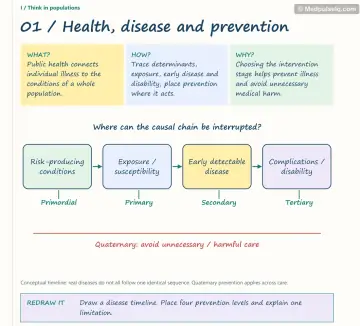
- Levels: primordial (stop risk emerging), primary (health promotion + specific protection), secondary (early diagnosis and treatment), tertiary (disability limitation + rehabilitation), quaternary (avoid over‑medicalisation).
- Rehabilitation: medical, vocational, social, psychological.
Endpoints and PHC
- Control → elimination as a public‑health problem (threshold) → elimination of transmission (zero, defined area) → eradication (zero, worldwide, permanent) → extinction.
- Smallpox eradicated 1980; WPV2 (2015) and WPV3 (2019) certified eradicated; India polio‑free 2014, MNT eliminated 2015, yaws‑free 2016, trachoma validated 2024, leprosy threshold 2005, kala‑azar threshold 2023.
- Alma‑Ata 1978: four principles (equitable distribution, community participation, intersectoral coordination, appropriate technology) + eight elements. Astana 2018 → UHC + SDGs.
- UHC: population × services × financial protection; SDG 3.8.1 and 3.8.2.
🎯 Single‑best‑answer MCQs
Pick an answer to see the explanation — and the concept to revisit if you missed it. Your answers are saved on this device.
Score 0 / 00 of 20 answered
Question 1
The WHO definition of health includes which three dimensions?
Question 2
A man with undetected hypertension feels completely well. This illustrates:
Question 3
Health differences that are avoidable and unjust are best described as:
Question 4
The denominator of the maternal mortality ratio is:
Question 5
Which component is NOT included in the Physical Quality of Life Index?
Question 6
A disability‑adjusted life year is the sum of:
Question 7
Which disease classically has NO iceberg phenomenon?
Question 8
The interval from when a disease first becomes detectable by a screening test to when it would be diagnosed clinically is the:
Question 9
Legislation restricting trans‑fat in packaged foods for the whole population is best classified as:
Question 10
Providing MCR footwear to a leprosy patient with an anaesthetic foot is:
Question 11
Deprescribing unnecessary drugs in a frail elderly patient is an example of:
Question 12
Permanent reduction to zero of the worldwide incidence of infection, so that interventions are no longer needed, defines:
Question 13
India's leprosy status since 2005 (prevalence below 1 per 10,000 nationally) is:
Question 14
Which feature made smallpox uniquely eradicable?
Question 15
The modified B.G. Prasad scale classifies socio‑economic status using:
Question 16
In the Health Belief Model, a mother's worry that the PHC is too far and costly to reach is a perceived:
Question 17
Which is NOT one of the four principles of primary health care at Alma‑Ata?
Question 18
The three dimensions of universal health coverage are population covered, services covered and:
Question 19
A small reduction in risk across a whole population preventing more cases than intensive treatment of a high‑risk few is called:
Question 20
In the Whitehall studies, mortality among civil servants:
🃏 Flashcards
Say the answer out loud before you flip. Shuffle once you know the order.
Card 1 of 20
🩺 Staged clinical cases
Read the presentation, decide what is going on and what you would do — then reveal the reasoning.
Case 1 — Diarrhoea in one lane
Stage A: In one week, three children from the same lane of a peri‑urban ward present to the PHC with acute watery diarrhoea. All have some dehydration. Mothers say they "already wash hands".
Case 2 — The "eradicated" headline
Stage A: A newspaper claims that a state has "eradicated kala‑azar" after two years with fewer than one case per 10,000 population in every block.
Linked concepts: 7. Control, Elimination and Eradication
Case 3 — The screening camp with no follow‑up
Stage A: An NGO screens 2,000 adults for diabetes and hypertension in one weekend and reports finding 340 "new patients".
Linked concepts: 6. Prevention at Every Stage, 9. Health for All — Primary Health Care
Case 4 — Family study and the delayed fever visit
Stage A: During a family study, you find a joint family of 11. The 8‑month‑old had three days of fever before being brought to the PHC. The mother says her mother‑in‑law decides when to "go to the hospital".
🎤 Viva practice
Answer aloud as if an examiner asked you — then check the model points.
Viva 1
Define health according to WHO, and give one criticism.
Viva 2
Differentiate disease, illness and sickness.
Viva 3
What are social determinants of health?
Viva 4
Why is IMR the best single indicator of community health?
Viva 5
Define DALY.
Viva 6
What is the iceberg phenomenon? Give two examples.
Viva 7
Name the levels of prevention with one example each.
Viva 8
What are the modes of intervention?
Viva 9
Differentiate elimination and eradication.
Viva 10
Why could smallpox be eradicated but not malaria?
Viva 11
What is a community diagnosis?
Viva 12
Name the socio‑economic scales used in India.
Viva 13
What are the principles of primary health care?
Viva 14
List the eight essential elements of PHC.
Viva 15
What is UHC?
Keep going
Educational only — not a substitute for clinical judgement, supervision, or local guidelines.