Loading…
🌏 Community Medicine · Part 13 revision hub
Health Systems, Management and Global Health
Everything you need to revise this Part in one place — the one‑page note for every concept, a rapid‑revision sheet, exam‑style questions that point you back to the right concept, flashcards, staged cases and viva practice.
10 concepts20 MCQs20 flashcards4 cases15 viva questions
📝 The plate wall
Every concept in this Part as a one‑page handwritten note. Open one to read it in full and zoom.
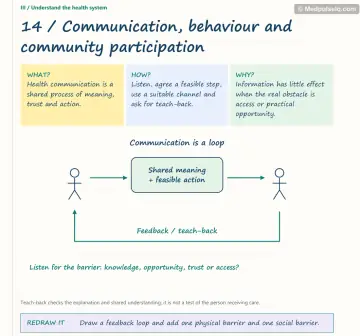
Concept 122
Talking About Health
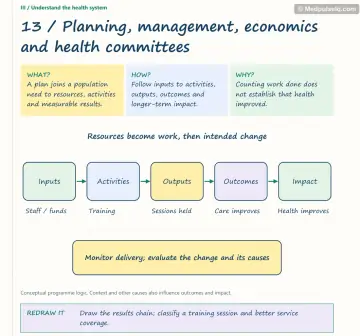
Concept 123
Planning and Managing Health
Concept 124
Who Pays for Health?
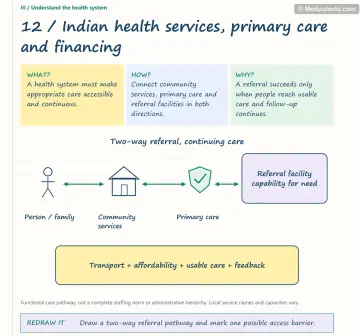
Concept 125
India's Health Care Ladder
Concept 126
The People Who Deliver Care
Concept 127
National Health Mission and Health Policy
Concept 128
Ayushman Bharat
Concept 129
Health Across Borders
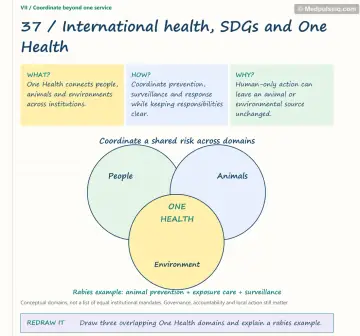
Concept 130
One World, One Health
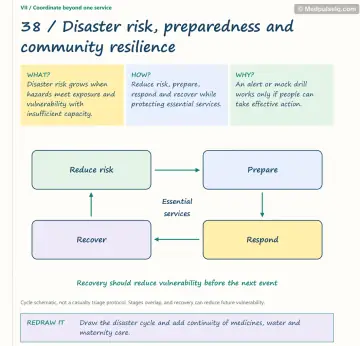
Concept 131
When Disaster Strikes
⚡ Rapid revision
The whole Part on one screen — read it the night before.
Communication and planning
- Communication: sender → message → channel → receiver → feedback; barriers (physiological, psychological, environmental, cultural).
- HE approaches: regulatory, service, educational, PHC. Models: medical, motivation (awareness → interest → evaluation → trial → adoption), social intervention.
- Methods: individual (counselling, GATHER), group (demonstration, group discussion 6–12, panel, symposium, workshop, role play), mass (media). Behaviour theories: HBM, Stages of Change, TPB, COM‑B. Measure observed behaviour, not awareness.
- Planning cycle: situation analysis → objectives (SMART) → resources → priorities → plan → implement → monitor → evaluate. Inputs → activities → outputs → outcomes → impact.
- PERT tₑ = (a + 4m + b)/6; CPM critical path (zero slack). ABC (value), VED (criticality), FSN, SDE, HML; FEFO.
- Committees: Bhore 1946 (PHC), Mudaliar 1962 (consolidation), Chadah 1963, Mukerji 1965, Jungalwalla 1967 (integration), Kartar Singh 1973 (MPW; PHC per 50,000), Shrivastava 1975 (village health guides), Bajaj 1986.
Financing
- NHA 2021–22: GHE ≈ 1.84% of GDP; OOPE ≈ 39.4% of THE (≈ 64% in 2013–14). NHP 2017 target 2.5% of GDP.
- Catastrophic expenditure: OOPE > 10% or > 25% of household budget (SDG 3.8.2). Medicines = largest OOPE share.
- Payment: fee‑for‑service, capitation, salary, case‑based/DRG (PM‑JAY packages), global budgets.
- Economic evaluation: CMA, CEA (natural units; ICER), CUA (QALY/DALY), CBA (money). HTAIn threshold ≈ 1 × GDP per capita per QALY.
Delivery and workforce
- Norms (plain/hilly‑tribal): SC 5,000/3,000; PHC 30,000/20,000; CHC 1,20,000/80,000. CHC: 30 beds, 4 specialists + anaesthetist. U‑PHC per 50,000. IPHS 2007 → 2012 → 2022.
- FRU: 24×7 EmOC with CS, blood storage, newborn care.
- ASHA: 1 per 1,000, woman 25–45, gram sabha selection, incentives + honorarium. AAM‑SHC team: CHO + 2 MPW (F) + 1 MPW (M). VHSNC (untied ₹10,000), VHSND, MAS, RKS/JAS.
- NRHM 12 April 2005; NUHM 1 May 2013; NHM: free drugs and diagnostics (2015), 108/102, MMUs, PIPs, NHSRC. RMNCH+A 2013.
- NHP 1983 (Health for All 2000), 2002 (2% GDP; elimination targets), 2017 (UHC; HWCs; 2.5% GDP; ⅔ to primary care; LE 70, TFR 2.1, U5MR 23, MMR 100, IMR 28).
- Ayushman Bharat: AAMs (14 April 2018; > 1.75 lakh; 12 packages + emergency), PM‑JAY (23 September 2018; ₹5 lakh/family/year; all 70+ from October 2024; NHA), ABDM (2021; ABHA 14‑digit), PM‑ABHIM (2021; critical care blocks, labs, NIOH Nagpur).
Global health, One Health, disasters
- WHO: 7 April 1948; Geneva; 194 members (before the US withdrawal took effect in January 2026); WHA, Executive Board (34), Secretariat; 6 regions (SEARO New Delhi). IHR amended 2024 (in force 2025); Pandemic Agreement (WHA 2025).
- UNICEF 1946; UNFPA 1969; UNAIDS 1996; World Bank 1944; FAO 1945; ILO 1919; Gavi 2000; Global Fund 2002; Red Cross 1863.
- SDGs: 17 goals, 169 targets, 2015–2030. SDG 3.1 MMR < 70; 3.2 NMR ≤ 12, U5MR ≤ 25; 3.4 NCD −⅓; 3.8 UHC.
- One Health: people–animals–environment; quadripartite (WHO, FAO, WOAH, UNEP). AMR: NAP‑AMR 2017; AWaRe (Access ≥ 60–70%); Schedule H1 (2014); Red Line (2016); colistin feed ban (2019); KARSAP (2018).
- Disaster cycle: mitigation → preparedness → response → recovery. DM Act 2005: NDMA (PM), SDMA (CM), DDMA (Collector); NDRF 2006; Sendai 2015–2030.
- Triage: red (immediate), yellow (delayed), green (minor), black (dead/expectant); START/JumpSTART.
- Sphere: water ≥ 15 L/person/day; 1 toilet/20 persons; shelter 3.5 m²/person; 2,100 kcal/day; measles vaccination 6 months–15 years + vitamin A; early‑warning surveillance; psychological first aid.
🎯 Single‑best‑answer MCQs
Pick an answer to see the explanation — and the concept to revisit if you missed it. Your answers are saved on this device.
Score 0 / 00 of 20 answered
Question 1
The most effective group method for teaching a practical skill such as preparing ORS is:
Question 2
In the GATHER approach to counselling, "R" stands for:
Question 3
In PERT, with optimistic time 2, most likely time 5 and pessimistic time 14 weeks, the expected time is:
Question 4
VED analysis classifies inventory by:
Question 5
The committee that recommended multipurpose health workers was:
Question 6
An economic evaluation expressing results as cost per QALY gained is:
Question 7
Out‑of‑pocket expenditure as a share of total health expenditure in India (NHA 2021–22) is approximately:
Question 8
A Primary Health Centre in plain areas serves a population of:
Question 9
Which is essential for a CHC to function as a First Referral Unit?
Question 10
One ASHA is generally recommended per:
Question 11
The team leader at an Ayushman Arogya Mandir sub‑centre is the:
Question 12
The National Rural Health Mission was launched in:
Question 13
The National Health Policy 2017 set a public health expenditure target of:
Question 14
PM‑JAY provides hospitalisation cover of up to:
Question 15
The digital health ID under the Ayushman Bharat Digital Mission is the:
Question 16
The WHO regional office for South‑East Asia is located in:
Question 17
SDG target 3.2 aims to reduce under‑5 mortality to at most:
Question 18
In the WHO AWaRe classification, colistin belongs to the:
Question 19
The National Disaster Management Authority is chaired by the:
Question 20
In mass casualty triage, a yellow tag indicates:
🃏 Flashcards
Say the answer out loud before you flip. Shuffle once you know the order.
Card 1 of 20
🩺 Staged clinical cases
Read the presentation, decide what is going on and what you would do — then reveal the reasoning.
Case 1 — Awareness without action
Stage A: In a block, 85% of mothers "know" that ORS treats diarrhoea, but only 40% of children with diarrhoea received ORS (NFHS).
Linked concepts: 122. Talking About Health
Case 2 — Stock‑outs at the PHC
Stage A: A PHC repeatedly runs out of anti‑snake venom, oxytocin and insulin, while cough syrups and vitamins expire.
Linked concepts: 123. Planning and Managing Health, 124. Who Pays for Health?
Case 3 — The PM‑JAY patient who stopped treatment
Stage A: A 58‑year‑old had a PM‑JAY‑funded angioplasty at a private hospital. Six months later he is readmitted with a repeat event; he stopped his medicines after 1 month because of cost and no follow‑up.
Linked concepts: 128. Ayushman Bharat, 125. India's Health Care Ladder
Case 4 — Cyclone in 72 hours
Stage A: IMD warns of a very severe cyclone due to make landfall on a coastal district in 72 hours.
Linked concepts: 131. When Disaster Strikes, 49. Concept 49
🎤 Viva practice
Answer aloud as if an examiner asked you — then check the model points.
Viva 1
What are the elements of communication?
Viva 2
Principles of health education?
Viva 3
Steps of the planning cycle?
Viva 4
What is PERT?
Viva 5
Differentiate ABC and VED analysis.
Viva 6
Recommendations of the Bhore Committee?
Viva 7
Types of economic evaluation?
Viva 8
Population norms for SC, PHC and CHC?
Viva 9
Who is an ASHA, and what are her roles?
Viva 10
Components of NHM?
Viva 11
Key targets of NHP 2017?
Viva 12
Components of Ayushman Bharat?
Viva 13
Structure and functions of WHO?
Viva 14
What is One Health and its role in AMR?
Viva 15
Describe the disaster management cycle and triage.
Keep going
Educational only — not a substitute for clinical judgement, supervision, or local guidelines.