Loading…
🌏 Community Medicine · Part 3 revision hub
Epidemiology II — Trials, Bias, Causation and Screening
Everything you need to revise this Part in one place — the one‑page note for every concept, a rapid‑revision sheet, exam‑style questions that point you back to the right concept, flashcards, staged cases and viva practice.
9 concepts20 MCQs20 flashcards4 cases15 viva questions
📝 The plate wall
Every concept in this Part as a one‑page handwritten note. Open one to read it in full and zoom.
Concept 19
The Fair Test — Randomised Controlled Trials
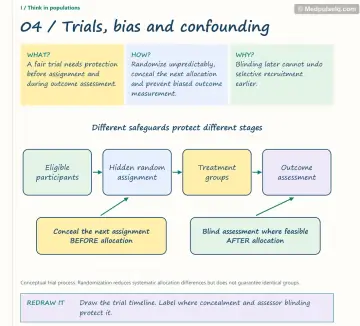
Concept 20
Bias, Confounding and Chance
Concept 21
Trials in the Real World
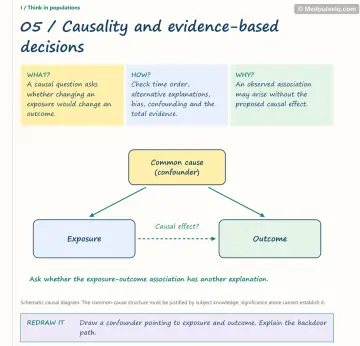
Concept 22
Is It Really the Cause?
Concept 23
Putting All the Evidence Together
Concept 24
Screening — Finding Disease Early
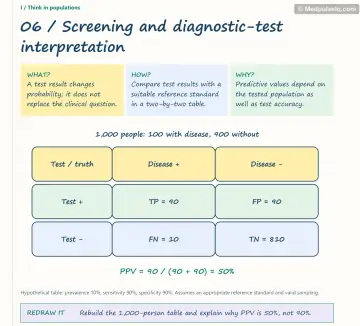
Concept 25
How Good Is a Test?
Concept 26
Updating Your Guess — Likelihood Ratios and ROC
Concept 27
Does Screening Actually Help?
⚡ Rapid revision
The whole Part on one screen — read it the night before.
Trials
- RCT: random sequence → allocation concealment (before assignment, prevents selection bias) → blinding (after assignment, prevents performance and detection bias) → ITT analysis.
- Only randomisation controls unknown confounders.
- ARR = CER − EER; RRR = ARR/CER; NNT = 1/ARR. Report absolute effects.
- Field trial = healthy individuals (Salk 1954). Cluster/community trial = groups; design effect = 1 + (m − 1)ICC.
- Crossover = own control with washout. Factorial = combinations. Stepped‑wedge = staggered cluster roll‑out.
- Phases: I (safety, dose), II (efficacy signal), III (confirmatory RCT), IV (post‑marketing; PvPI). CTRI registration; NDCT Rules 2019; CONSORT 2025.
Bias, confounding, causation
- Random error ↓ with sample size; bias does not.
- Selection biases: Berkson's, volunteer, non‑response, healthy worker, attrition, Neyman. Information: recall, interviewer, observer, misclassification. Hawthorne effect.
- Confounder: linked to exposure, causes outcome, not a mediator. Control: randomisation, restriction, matching / stratification, standardisation, regression.
- Effect modification is a finding to report, not a bias to remove.
- Bradford Hill: temporality (essential), strength, consistency, dose–response, plausibility, coherence, experiment, specificity (weakest), analogy.
Evidence synthesis
- EBM: evidence + expertise + patient values. Ask (PICO) → Acquire → Appraise → Apply → Assess.
- Forest plot: squares (weight), lines (CI), diamond (pooled); I² heterogeneity (25/50/75%). Funnel plot for publication bias.
- GRADE: RCTs start high, observational low; certainty ≠ strength of recommendation. PRISMA 2020; PROSPERO.
Screening
- Screening sorts apparently healthy people; diagnosis confirms. Types: mass, high‑risk, multiphasic, opportunistic.
- Wilson–Jungner (1968) + Andermann (2008): important problem, early stage, suitable test, effective treatment, facilities, agreed policy, cost balance, continuing process, equity, evaluation.
- Se = TP/(TP+FN); Sp = TN/(TN+FP); PPV = TP/(TP+FP); NPV = TN/(TN+FN). ↓ prevalence → ↓ PPV, ↑ NPV.
- LR+ = Se/(1 − Sp); LR− = (1 − Se)/Sp. Post‑test odds = pre‑test odds × LR.
- ROC: Se vs 1 − Sp; AUC 0.5–1; Youden J = Se + Sp − 1 (≠ AUC).
- Serial → ↑Sp, ↓Se; parallel → ↑Se, ↓Sp.
- Lead‑time, length, overdiagnosis, volunteer biases → judge by disease‑specific mortality in invited populations.
🎯 Single‑best‑answer MCQs
Pick an answer to see the explanation — and the concept to revisit if you missed it. Your answers are saved on this device.
Score 0 / 00 of 20 answered
Question 1
Allocation concealment primarily prevents:
Question 2
Analysing participants in the groups to which they were randomised, regardless of adherence, is:
Question 3
Event risk is 20% in controls and 15% with treatment. The NNT is:
Question 4
The only method that controls for unknown confounders is:
Question 5
Hospital‑based controls who were admitted for conditions related to the exposure under study produce:
Question 6
Increasing sample size will reduce:
Question 7
Randomising villages rather than individuals to a sanitation intervention is a:
Question 8
Post‑marketing surveillance of a drug corresponds to:
Question 9
Which Bradford Hill consideration is essential for causation?
Question 10
Risk of lung cancer rising with the number of cigarettes smoked per day illustrates:
Question 11
In a forest plot, the diamond represents:
Question 12
In GRADE, evidence from randomised trials begins at certainty level:
Question 13
Checking the blood pressure of every adult attending the OPD for any reason is:
Question 14
Which is NOT a Wilson–Jungner criterion?
Question 15
Sensitivity of a test is calculated as:
Question 16
If disease prevalence falls while sensitivity and specificity remain constant:
Question 17
A test has sensitivity 80% and specificity 90%. Its positive likelihood ratio is:
Question 18
Using two tests in parallel (positive if either is positive) will:
Question 19
Earlier diagnosis that increases survival time from diagnosis without delaying death is:
Question 20
The most appropriate outcome to evaluate a cancer screening programme is:
🃏 Flashcards
Say the answer out loud before you flip. Shuffle once you know the order.
Card 1 of 20
🩺 Staged clinical cases
Read the presentation, decide what is going on and what you would do — then reveal the reasoning.
Case 1 — The recruiter who knew
Stage A: In a trial of a community NCD follow‑up model, randomisation lists were pinned on the clinic notice board. Recruiters enrolled "motivated" patients when the next slot was the intervention arm.
Case 2 — Positive screen in a low‑risk group
Stage A: A screening test (sensitivity 95%, specificity 98%) is used in 10,000 college students where prevalence is 1%. A student with a positive result is distressed.
Linked concepts: 25. How Good Is a Test?, 26. Updating Your Guess — Likelihood Ratios and ROC
Case 3 — "Survival doubled" after screening
Stage A: A private chain claims its whole‑body imaging package "doubled 5‑year survival" for kidney cancer.
Linked concepts: 27. Does Screening Actually Help?
Case 4 — Is the cookstove programme worth it?
Stage A: A state considers subsidising clean cooking fuel to reduce childhood pneumonia. Observational meta‑analyses show OR ≈ 1.7 for solid‑fuel exposure. Two large RCTs of improved stoves showed no significant reduction in pneumonia.
Linked concepts: 22. Is It Really the Cause?, 23. Putting All the Evidence Together, 18. Concept 18
🎤 Viva practice
Answer aloud as if an examiner asked you — then check the model points.
Viva 1
Differentiate allocation concealment and blinding.
Viva 2
What is intention‑to‑treat analysis?
Viva 3
What are the types of randomised trials?
Viva 4
Phases of a clinical trial?
Viva 5
Define confounding with an example.
Viva 6
How is confounding controlled?
Viva 7
Name three selection biases.
Viva 8
List Bradford Hill's considerations.
Viva 9
What is a meta‑analysis?
Viva 10
What does GRADE assess?
Viva 11
Define screening and differentiate it from diagnosis.
Viva 12
Give the Wilson–Jungner criteria.
Viva 13
Define sensitivity, specificity, PPV and NPV.
Viva 14
Effect of prevalence on predictive values?
Viva 15
What is lead‑time bias?
Keep going
Educational only — not a substitute for clinical judgement, supervision, or local guidelines.