Loading…
🌏 Community Medicine · Part 7 revision hub
Respiratory, Contact and Sexually Transmitted Infections
Everything you need to revise this Part in one place — the one‑page note for every concept, a rapid‑revision sheet, exam‑style questions that point you back to the right concept, flashcards, staged cases and viva practice.
11 concepts20 MCQs20 flashcards4 cases15 viva questions
📝 The plate wall
Every concept in this Part as a one‑page handwritten note. Open one to read it in full and zoom.
Concept 57
Diphtheria, Whooping Cough and Tetanus
Concept 58
Chickenpox, Mumps and Influenza
Concept 59
COVID-19 and New Respiratory Threats
Concept 60
Pneumonia in Children
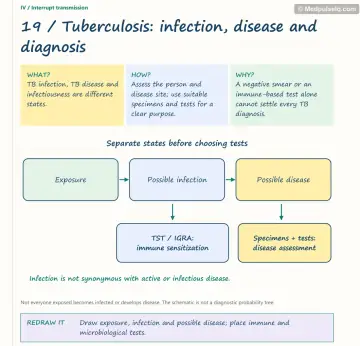
Concept 61
Tuberculosis — Infection and Disease
Concept 62
Finding Tuberculosis
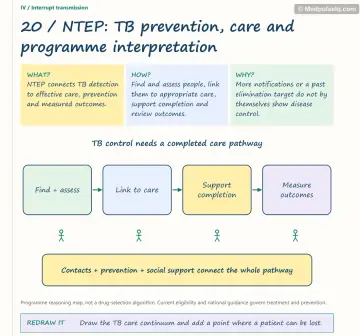
Concept 63
Treating TB and India's TB Programme
Concept 64
Leprosy — Early Signs and Types
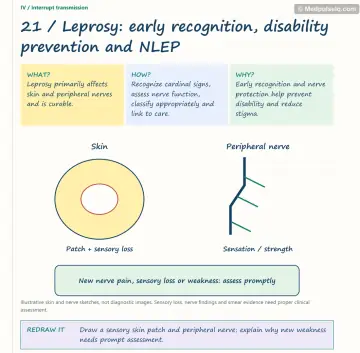
Concept 65
Curing Leprosy and Preventing Disability
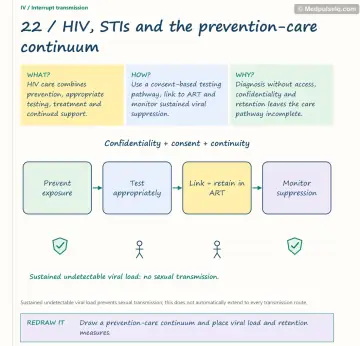
Concept 66
HIV — Prevention to Treatment
Concept 67
Sexually Transmitted Infections and Safe Births
⚡ Rapid revision
The whole Part on one screen — read it the night before.
Vaccine‑preventable respiratory infections
- Diphtheria: pseudomembrane, bull neck, myocarditis; DAT on suspicion + penicillin/erythromycin; contacts get prophylaxis + vaccination. Outbreaks in school‑age children = missed boosters.
- Pertussis: catarrhal → paroxysmal (whoop) → convalescent; azithromycin; adolescents and adults are sources for infants.
- Tetanus: soil spores, not communicable; MNT eliminated 2015 (< 1/1,000 live births per district); 5 cleans; Td in pregnancy; TIG 250 IU for tetanus‑prone wounds in the unimmunised.
- Varicella: centripetal, pleomorphic crops; VZIG for high‑risk exposed; no aspirin (Reye's). Mumps: parotitis; orchitis in post‑pubertal males.
- Influenza: drift (seasonal) vs shift (pandemic, A only); MoHFW categories A, B(i), B(ii), C; oseltamivir for B and C.
- COVID‑19 lessons: ventilation, genomic surveillance (INSACOG), oxygen, CoWIN (> 220 crore doses), continuity of essential services; PM‑ABHIM.
- IMNCI fast breathing: ≥ 60 (< 2 months), ≥ 50 (2–12 months), ≥ 40 (12–59 months). Danger signs/stridor → refer; chest indrawing or fast breathing → oral amoxicillin. SAANS 2019.
Tuberculosis
- India incidence 187/lakh (2024; −21% since 2015); mortality 21/lakh; ≈ 26 lakh notified; ≈ 25–27% of global burden.
- Undernutrition has the largest PAF; HIV the highest RR. RATIONS trial: nutrition cut TB in contacts.
- Presumptive TB → upfront NAAT (CBNAAT/Truenat: MTB + RIF resistance). Universal DST. Serological tests banned (2012). Mandatory notification (2012; penal provisions 2018) on Ni‑kshay.
- DS‑TB: 2HRZE/4HRE daily weight‑band FDCs. Hr‑TB: 6 months REZ + Lfx.
- MDR = H + R resistance; pre‑XDR = + FQ; XDR = + FQ + Bdq and/or Lzd. BPaLM 6 months (≥ 14 years, eligible).
- TPT: 3HP, 6H; 6Lfx for MDR contacts. Ni‑kshay Poshan ₹1,000/month (since November 2024); Ni‑kshay Mitra (PMTBMBA 2022); TB Mukt Bharat Abhiyan (7 December 2024).
- Outcomes: cured, completed, failed, died, LTFU (≥ 1 month), not evaluated. Success = cured + completed.
Leprosy
- Cardinal signs: anaesthetic patch, thickened nerve with sensory/motor loss, AFB in slit‑skin smear (any one).
- PB 1–5 lesions; MB > 5 lesions, nerve involvement or smear‑positive. When in doubt, MB.
- 🆕 Uniform 3‑drug MDT from 1 April 2025: rifampicin 600 mg + clofazimine 300 mg monthly; clofazimine 50 mg + dapsone 100 mg daily. PB 6 months, MB 12 months.
- Type 1 reaction (BT–BL; DTH) vs type 2 ENL (BL–LL; immune complex; fever, nodules). Continue MDT; prednisolone.
- G2D = visible deformity; high G2D among new cases = late detection. Child cases = recent transmission.
- NLEP: LCDC, Sparsh (30 January), SDR‑PEP, DPMR, RCS (₹12,000), zero transmission by 2027.
HIV and STIs
- India (2023): ≈ 25 lakh PLHIV; adult prevalence ≈ 0.2%; ≈ 68,000 new infections/year.
- Three‑test diagnostic strategy; EID by DNA PCR from 6 weeks.
- NACP‑V (2021–26): 95‑95‑95; Test and Treat (2017); TLD first‑line; viral load monitoring; U = U.
- PEP within 72 h for 28 days. HIV/AIDS Act 2017. Helpline 1097.
- Syndromic kits 1–7 (grey, green, white, blue, red, yellow, black). 4 C's. Suraksha Clinics.
- EMTCT: ANC‑1, testing and treatment ≥ 95%; ≤ 50 paediatric HIV and congenital syphilis cases/100,000 live births. BPG 2.4 MU for syphilis.
🎯 Single‑best‑answer MCQs
Pick an answer to see the explanation — and the concept to revisit if you missed it. Your answers are saved on this device.
Score 0 / 00 of 20 answered
Question 1
Diphtheria antitoxin should be given:
Question 2
Maternal and neonatal tetanus elimination is defined as fewer than:
Question 3
Pandemics of influenza are caused by:
Question 4
The chickenpox rash, compared with smallpox, is characteristically:
Question 5
India's genomic surveillance consortium for SARS‑CoV‑2 is:
Question 6
A 2‑year‑old with cough is classified as having fast breathing when the respiratory rate is at least:
Question 7
Under IMNCI, a child aged 2 months to 5 years with chest indrawing but no danger signs is treated with:
Question 8
The risk factor with the largest population attributable fraction for TB in India is:
Question 9
BCG vaccine provides the most reliable protection against:
Question 10
The upfront diagnostic test recommended for presumptive TB under NTEP is:
Question 11
A patient previously treated for TB for 3 weeks who now has TB is classified as:
Question 12
The intensive phase of treatment for drug‑sensitive TB consists of:
Question 13
XDR‑TB (current WHO definition) is MDR/RR‑TB plus resistance to:
Question 14
Ni‑kshay Poshan Yojana support since November 2024 is:
Question 15
Which is NOT a cardinal sign of leprosy?
Question 16
A high proportion of child cases among new leprosy cases indicates:
Question 17
Under India's revised regimen from April 2025, PB leprosy is treated with:
Question 18
WHO grade 2 disability in leprosy includes:
Question 19
The current preferred first‑line ART regimen in India is:
Question 20
The NACO STI kit for genital ulcer (non‑herpetic) is:
🃏 Flashcards
Say the answer out loud before you flip. Shuffle once you know the order.
Card 1 of 20
🩺 Staged clinical cases
Read the presentation, decide what is going on and what you would do — then reveal the reasoning.
Case 1 — The coughing household
Stage A: A 38‑year‑old construction worker (BMI 16.5, daily alcohol) has a 4‑week cough and weight loss. NAAT: MTB detected, rifampicin resistance not detected. He lives with his wife, mother and two children (3 and 9 years) in one room.
Case 2 — The painful nerve
Stage A: A 30‑year‑old woman with 8 patches and a positive skin smear is in month 5 of MDT. She develops fever, crops of tender red nodules on her forearms and face, and pain at the elbow.
Case 3 — Fast breathing at seven months
Stage A: An ASHA sees a 7‑month‑old with cough for 3 days. Respiratory rate is 54/min, with no chest indrawing. The child is breastfeeding well, with no danger signs.
Linked concepts: 60. Pneumonia in Children
Case 4 — A positive test at the first ANC visit
Stage A: A 22‑year‑old primigravida at 10 weeks has a reactive rapid HIV test and a reactive rapid syphilis test at her first ANC visit.
🎤 Viva practice
Answer aloud as if an examiner asked you — then check the model points.
Viva 1
Clinical features and treatment of diphtheria?
Viva 2
Define neonatal tetanus.
Viva 3
Antigenic drift vs shift?
Viva 4
IMNCI classification of cough or difficult breathing?
Viva 5
What is presumptive TB?
Viva 6
Which diagnostic tests are used under NTEP?
Viva 7
Drug‑sensitive TB regimen?
Viva 8
Define MDR, pre‑XDR and XDR‑TB.
Viva 9
What is BPaLM?
Viva 10
What patient supports exist under NTEP?
Viva 11
Cardinal signs of leprosy?
Viva 12
Differentiate type 1 and type 2 lepra reactions.
Viva 13
What are the 95‑95‑95 targets?
Viva 14
What is PEP for HIV?
Viva 15
What is syndromic management of STIs?
Keep going
Educational only — not a substitute for clinical judgement, supervision, or local guidelines.