Loading…
❤️ Physiology · Part 1 revision hub
General Physiology — Cell, Membrane and Body Fluids
Everything you need to revise this Part in one place — the one‑page note for every concept, a rapid‑revision sheet, exam‑style questions that point you back to the right concept, flashcards, staged cases and viva practice.
11 concepts20 MCQs20 flashcards4 cases15 viva questions
📝 The plate wall
Every concept in this Part as a one‑page handwritten note. Open one to read it in full and zoom.
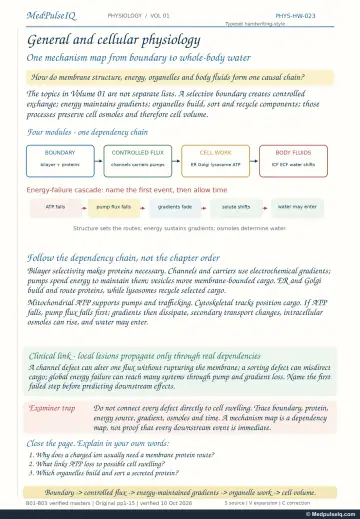
Concept 1
Homeostasis: the body's control loop
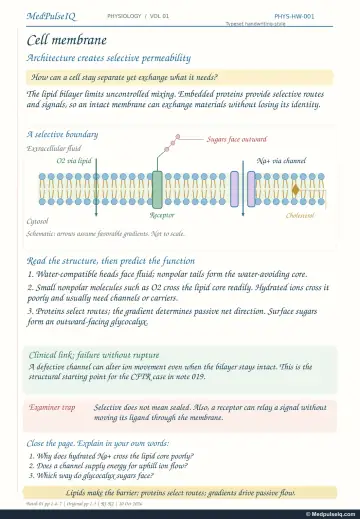
Concept 2
The Cell Membrane: a smart boundary
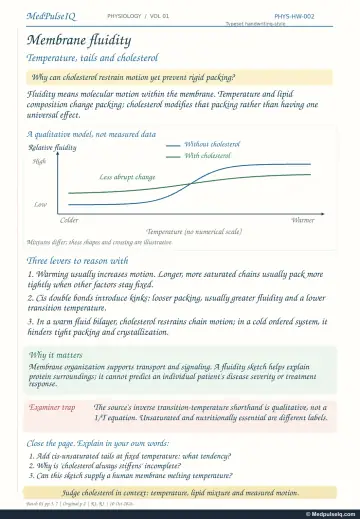
Concept 3
Membrane Lipids, Fluidity and Neighbourhoods
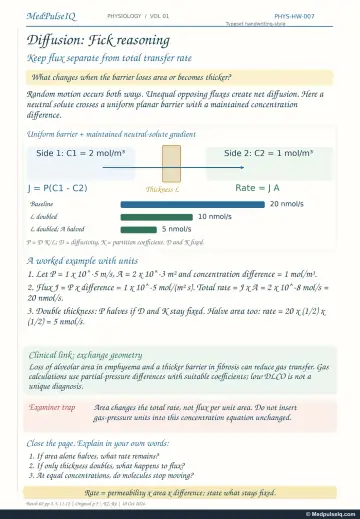
Concept 4
Diffusion: moving down the slope
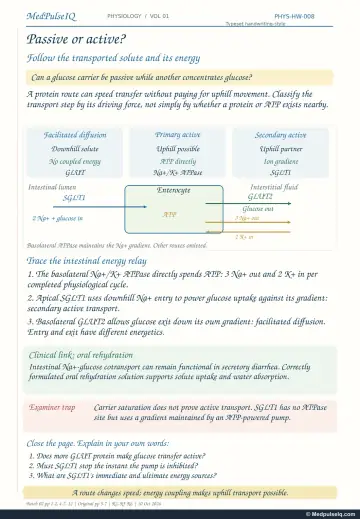
Concept 5
Carriers and Pumps: passive or active?
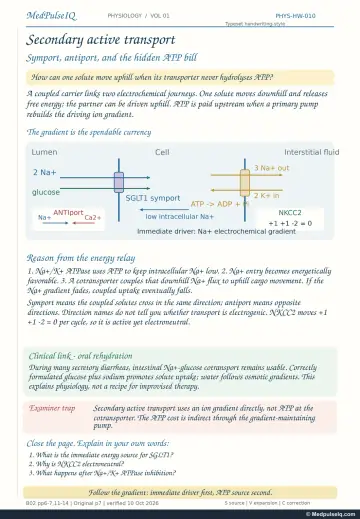
Concept 6
Borrowed Energy and Bubbles: secondary active and vesicular transport
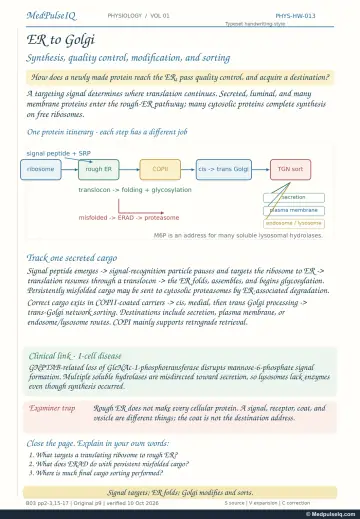
Concept 7
Inside the Cell: organelles and the cytoskeleton
Concept 8
How Cells Talk and How They Die
Concept 9
Body Water: compartments and how we measure them
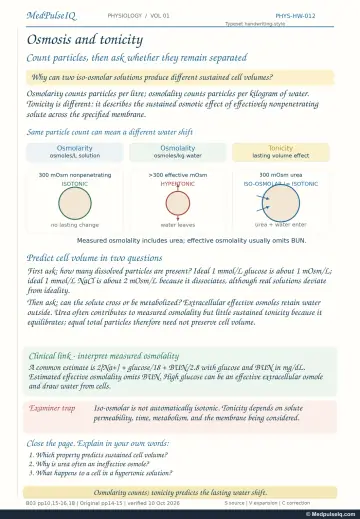
Concept 10
Osmosis, Tonicity and the Drip Bag
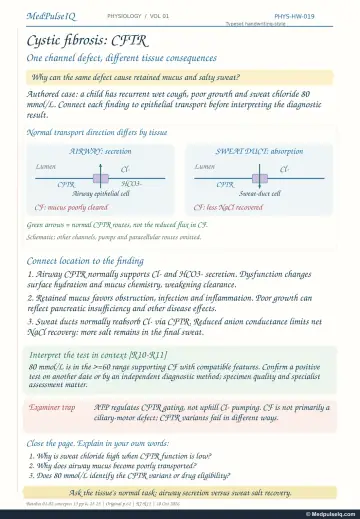
Concept 11
Cystic Fibrosis: one channel, many organs
⚡ Rapid revision
The whole Part on one screen — read it the night before.
The 3G lens for the cell
- Gradient: concentration, electrical and osmotic gradients are created by pumps (Na⁺/K⁺‑ATPase: 3 Na⁺ out, 2 K⁺ in per ATP) and spent by channels, carriers and osmosis.
- Gate: the lipid core excludes ions and large polar solutes; channels (fast, passive), carriers (saturable, passive or active) and vesicles (bulk cargo) provide routes.
- Governor: negative feedback (sensor → integrator → effector) defends regulated variables; gain = correction ÷ error; positive feedback needs an endpoint.
Transport anchors
- Fick: rate ∝ A × D × K × ΔC ÷ thickness; diffusion time ∝ distance².
- Saturation proves a carrier, not active transport.
- Primary active = ATP at the transporter; secondary active = rides the Na⁺ gradient (SGLT2 1:1, SGLT1 2:1, NKCC2, NCC, NCX 3:1, NHE3).
- Insulin and β₂‑agonists stimulate Na⁺/K⁺‑ATPase → K⁺ moves into cells.
- Botulinum A/E → SNAP‑25; B/D/F/G → synaptobrevin; C → syntaxin; tetanus → synaptobrevin in inhibitory interneurons.
Organelles and junctions
- Signal peptide → SRP → rough ER → COPII → Golgi → TGN; M6P → lysosome (I‑cell disease = no M6P).
- Kinesin anterograde, dynein retrograde; PCD = dynein arm defect.
- Desmosome (Dsg) → pemphigus (intraepidermal); hemidesmosome (BP180/230) → pemphigoid (subepidermal); Cx26 → deafness.
- Apoptosis: intrinsic (BAX/BAK, cytochrome c, caspase‑9) and extrinsic (Fas/TNF, caspase‑8) → caspase‑3/7; no inflammation.
Fluids and osmoles
- 60–40–20 rule; ISF ¾ and plasma ¼ of ECF; blood volume ≈ 70 mL/kg.
- Volume = amount ÷ concentration; ICF = TBW − ECF; blood volume = plasma volume ÷ (1 − Hct).
- Calculated osmolality = 2Na + glucose/18 + BUN/2.8; effective omits BUN; osmolar gap > 10 → toxic alcohols, mannitol.
- 1 L isotonic → ~250 mL plasma; 1 L free water → ~80 mL plasma.
- Serum Na⁺ is a water ratio, not total sodium.
- Sweat Cl⁻ ≥ 60 mmol/L supports CF; F508del = class II folding defect.
🎯 Single‑best‑answer MCQs
Pick an answer to see the explanation — and the concept to revisit if you missed it. Your answers are saved on this device.
Score 0 / 00 of 20 answered
Question 1
A disturbance would raise arterial pressure by 60 mmHg without reflexes, but with reflexes it rises by 20 mmHg. The gain of the control system is:
Question 2
Which of the following is an example of physiological positive feedback?
Question 3
Which substance crosses a pure lipid bilayer most readily?
Question 4
Paroxysmal nocturnal haemoglobinuria results from loss of which type of membrane protein attachment?
Question 5
In early apoptosis, which change is detected by annexin V?
Question 6
Cholera toxin binds which membrane molecule?
Question 7
In a simple diffusion barrier, area is doubled and thickness is doubled. The total diffusion rate:
Question 8
Antibodies against which channel cause neuromyelitis optica spectrum disorder?
Question 9
Which feature, on its own, proves that a transport process is carrier‑mediated but not necessarily active?
Question 10
Treatment of hyperkalaemia with insulin works mainly by:
Question 11
SGLT2 inhibitors lower plasma glucose primarily by blocking glucose reabsorption in the:
Question 12
Tetanus produces spastic rather than flaccid paralysis because the toxin:
Question 13
A child has coarse facies and very high plasma lysosomal enzyme activities. The defect is most likely in:
Question 14
Which pairing is correct?
Question 15
A tense subepidermal blister with linear IgG at the basement membrane zone implicates antibodies to:
Question 16
Which feature distinguishes apoptosis from necrosis?
Question 17
50 mg of a tracer is injected; after equilibration its plasma concentration is 4 mg/L, and 10 mg has been excreted. The distribution volume is:
Question 18
Plasma volume is 3 L and haematocrit is 0.40. Blood volume is:
Question 19
Na⁺ 140 mmol/L, glucose 90 mg/dL, BUN 14 mg/dL; measured osmolality 315 mOsm/kg. The osmolar gap is:
Question 20
Which disturbance produces hyposmotic volume expansion?
🃏 Flashcards
Say the answer out loud before you flip. Shuffle once you know the order.
Card 1 of 20
🩺 Staged clinical cases
Read the presentation, decide what is going on and what you would do — then reveal the reasoning.
Case 1 — The child with salty skin
Stage A: A 2‑year‑old has recurrent productive cough, bulky greasy stools and weight below the 3rd centile. During a hot summer she became lethargic with vomiting; bloods showed Na⁺ 126 mmol/L, K⁺ 2.9 mmol/L, Cl⁻ 78 mmol/L and HCO₃⁻ 36 mmol/L.
Case 2 — One litre, three bags
Stage A: A 70 kg man (TBW 42 L, ICF 28 L, ECF 14 L, osmolality 300) receives 1 L of fluid. Predict the distribution if the bag is (a) 0.9% saline, (b) 5% dextrose, (c) 3% saline.
Case 3 — Digoxin and potassium
Stage A: A 78‑year‑old on digoxin and a loop diuretic presents with nausea, yellow‑tinged vision and palpitations. K⁺ is 2.8 mmol/L.
Case 4 — Blisters that tell you the junction
Stage A: Patient A (50 years) has painful oral erosions and flaccid skin blisters that extend with lateral pressure. Patient B (80 years) has itchy, tense blisters on the limbs and no mucosal involvement.
Linked concepts: 8. How Cells Talk and How They Die, 2. The Cell Membrane: a smart boundary
🎤 Viva practice
Answer aloud as if an examiner asked you — then check the model points.
Viva 1
Define homeostasis and gain.
Viva 2
Why do ions need proteins to cross membranes?
Viva 3
What does the fluid mosaic model mean?
Viva 4
State Fick's law of diffusion.
Viva 5
Why is the Na⁺/K⁺ pump electrogenic?
Viva 6
What is secondary active transport? Give two examples.
Viva 7
How does digoxin increase contractility?
Viva 8
What is the role of mannose‑6‑phosphate?
Viva 9
Name the junctions and one disease of each.
Viva 10
How is ICF volume measured?
Viva 11
Differentiate osmolality and tonicity.
Viva 12
Why is sweat salty in cystic fibrosis?
Viva 13
Why does 5% dextrose behave as free water?
Viva 14
What is the Gibbs–Donnan effect?
Viva 15
Why does ATP depletion cause cell swelling?
Keep going
Educational only — not a substitute for clinical judgement, supervision, or local guidelines.