Loading…
🩻 Radiology · Part 2 revision hub
Contrast Media, Nuclear Medicine and Radiotherapy
Everything you need to revise this Part in one place — the one‑page note for every concept, a rapid‑revision sheet, exam‑style questions that point you back to the right concept, flashcards, staged cases and viva practice.
11 concepts20 MCQs20 flashcards4 cases15 viva questions
📝 The plate wall
Every concept in this Part as a one‑page handwritten note. Open one to read it in full and zoom.
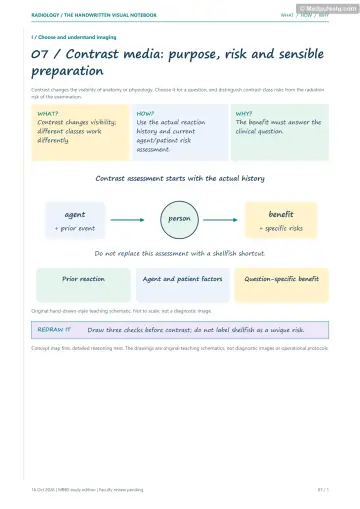
Concept 15
Why We Use Contrast
Concept 16
When Contrast Causes Trouble
Concept 17
Contrast for MRI and Ultrasound
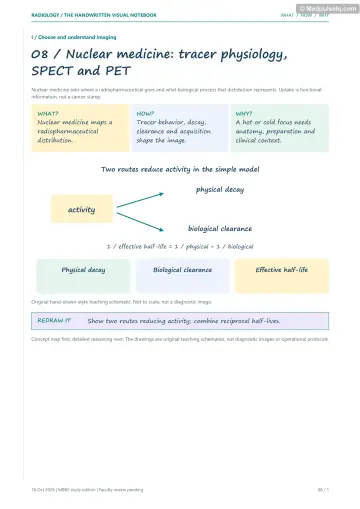
Concept 18
Glowing Tracers
Concept 19
PET: Seeing Sugar-Hungry Cells
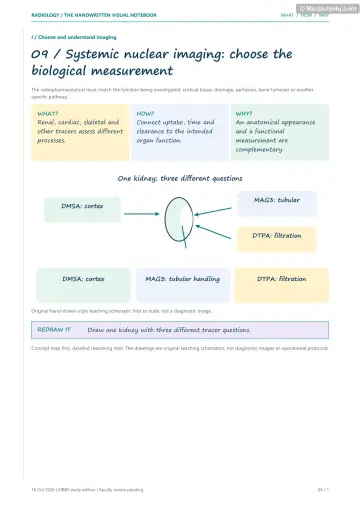
Concept 20
Scanning Kidneys and Hearts
Concept 21
Scanning Lungs, Gut and Liver
Concept 22
Scanning Bones, Brain, Glands and Infection
Concept 23
How Radiation Kills Cancer
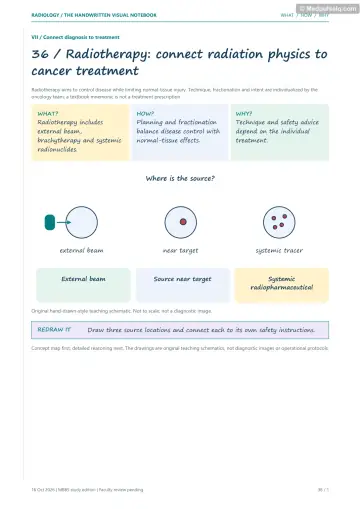
Concept 24
Ways of Giving Radiotherapy
Concept 25
Which Cancers Melt and Which Resist
⚡ Rapid revision
The whole Part on one screen — read it the night before.
Contrast media
- Negative contrast: air, CO₂, water, mannitol. Positive: barium (GI only, insoluble), iodinated (water‑soluble, IV/intracavitary).
- Barium: swallow (oesophagus), meal (stomach/duodenum), follow‑through (small bowel), enteroclysis (NJ tube), enema (colon). Absolute CI: perforation. Relative: LBO, toxic megacolon.
- Iodinated classes: ionic monomer HOCM (ratio 1.5, diatrizoate) → ionic dimer (3) → non‑ionic monomer LOCM (3, iohexol: most used) → non‑ionic dimer IOCM (6, iodixanol: iso‑osmolar, best tolerated).
- Strongest risk factor for an allergic‑like reaction: previous contrast reaction. Shellfish allergy is not a specific risk.
- Anaphylaxis: IM adrenaline 0.5 mg (1:1000) adult. Vasovagal: bradycardia + hypotension → legs up, fluids, atropine.
- CA-AKI is temporal association; CI-AKI is causation. Risk assessment matters especially in AKI/eGFR < 30. Use justified diagnostic contrast and consider IV isotonic hydration when appropriate. NAC is not recommended; bicarbonate is not superior to saline. ACR metformin interruption also covers arterial catheter procedures that may embolise renal arteries; restart after the required reassessment.
- GBCA: T1 shortening (bright). NSF in severe CKD with group I linear agents (gadodiamide); macrocyclic safest. Avoid in pregnancy unless essential.
- Microbubbles (SF₆, SonoVue): intravascular, exhaled, non‑nephrotoxic; CEUS for liver lesions, Bosniak cysts, VUR.
Nuclear medicine
- Tc‑99m: pure gamma 140 keV, t½ 6 h, from Mo‑99 generator (t½ 66 h). Camera crystal: NaI(Tl).
- Tc agents: pertechnetate (thyroid, Meckel's), MDP (bone), DTPA (GFR), MAG3 (obstruction, neonates, transplant), DMSA (scars), MAA (perfusion), RBC (GI bleed, MUGA, haemangioma), HMPAO (brain, WBC), sestamibi (heart, parathyroid), HIDA (gallbladder).
- PET: F‑18 (t½ 110 min) → positron → 2 × 511 keV at 180°. FDG trapped after hexokinase. False +: TB, sarcoid, infection, post‑op, brown fat. False −: < 8 mm, AIS/BAC, carcinoid, RCC, prostate, well‑differentiated HCC, hyperglycaemia.
- MPI: reversible defect = ischaemia, fixed = scar. Viability: FDG PET mismatch (↓flow, ↑FDG) = hibernating. Thallium = K⁺ analogue.
- V/Q: PE = mismatch; V/Q preferred in pregnancy, contrast allergy, CKD, CTEPH.
- GI bleed: Tc‑RBC detects ~0.1 mL/min (intermittent); CTA ~0.3–0.5; angiography ~0.5–1 mL/min.
- HIDA: persistent non-filling of the GB under an appropriate protocol supports acute cholecystitis. No bowel excretion in a jaundiced infant raises concern for biliary atresia but is not specific; specialist evaluation is urgent.
- 3‑phase bone scan: osteomyelitis ↑ all phases; cellulitis not in phase 3. Superscan: absent kidneys. Myeloma: cold.
- MIBG: phaeo, neuroblastoma; Ga‑68 DOTATATE: NETs; PSMA: prostate; gallium sarcoid: panda + lambda.
Radiotherapy
- Alpha (Z−2, A−4) > beta (isobaric) > gamma (isomeric) in ionisation; penetration reverse.
- Indirect action via free radicals; oxygen fixes damage (OER ~3). G2/M most sensitive, late S least.
- 5 Rs: repair, redistribution, repopulation, reoxygenation, radiosensitivity. Conventional 1.8–2 Gy/day; hyperfractionation (SCLC, H&N); hypofractionation (palliation 8 Gy × 1, breast, prostate).
- Co‑60: t½ 5.27 yr, ~1.25 MeV. LINAC most common. IMRT spares parotids. SRS single fraction (Gamma Knife ~201 Co‑60 sources). Protons: Bragg peak.
- Brachytherapy: intracavitary (cervix), interstitial (prostate seeds), plaque (ocular melanoma). HDR Ir‑192.
- Systemic: I‑131 (papillary/follicular thyroid), Lu‑177 DOTATATE/PSMA, Ra‑223, Y‑90 SIRT.
- Radiosensitive: WELMS + SCLC, dysgerminoma. Radioresistant: melanoma, osteosarcoma, RCC, pancreas, HCC.
- Sensitisers: oxygen, nimorazole, cisplatin, 5‑FU. Protector: amifostine. Cord compression: steroids + urgent whole‑spine MRI.
🎯 Single‑best‑answer MCQs
Pick an answer to see the explanation — and the concept to revisit if you missed it. Your answers are saved on this device.
Score 0 / 00 of 20 answered
Question 1
The absolute contraindication to a barium study is:
Question 2
Which iodinated contrast agent is iso‑osmolar with plasma?
Question 3
The strongest risk factor for an allergic‑like reaction to iodinated contrast is:
Question 4
The first‑line drug for anaphylaxis after IV contrast in an adult is:
Question 5
Which measure has the clearest rationale to reduce contrast‑induced AKI risk in a high‑risk patient?
Question 6
The gadolinium agent most associated with nephrogenic systemic fibrosis is:
Question 7
Ultrasound contrast microbubbles are eliminated mainly by:
Question 8
The half‑life of the parent radionuclide in a technetium generator is about:
Question 9
The scintillation crystal in a conventional gamma camera is:
Question 10
FDG is trapped in tumour cells after phosphorylation by:
Question 11
Which lung lesion is classically FDG‑negative or only weakly avid?
Question 12
The best radionuclide study to detect renal cortical scarring is:
Question 13
On FDG PET, a myocardial segment with reduced perfusion but preserved FDG uptake indicates:
Question 14
A V/Q scan shows segmental perfusion defects with normal ventilation. This suggests:
Question 15
The investigation of choice for a suspected bleeding Meckel's diverticulum is:
Question 16
On a three‑phase bone scan, osteomyelitis differs from cellulitis by:
Question 17
A parathyroid adenoma is best localised with:
Question 18
The most radiosensitive phase of the cell cycle is:
Question 19
The physical property that makes proton therapy valuable in childhood tumours is:
Question 20
Which tumour is classically most radioresistant?
🃏 Flashcards
Say the answer out loud before you flip. Shuffle once you know the order.
Card 1 of 20
🩺 Staged clinical cases
Read the presentation, decide what is going on and what you would do — then reveal the reasoning.
Case 1 — The dye reaction
Stage A: Ninety seconds into a contrast CT abdomen, a 52‑year‑old man becomes flushed, wheezy and lightheaded. BP is 78/40 mmHg, pulse 128/min.
Linked concepts: 16. When Contrast Causes Trouble
Case 2 — The bleeding child
Stage A: A 2‑year‑old has passed a large amount of painless maroon blood per rectum. He is pale but haemodynamically stable after a transfusion. Upper endoscopy is normal.
Linked concepts: 21. Scanning Lungs, Gut and Liver
Case 3 — The hot node in Bihar
Stage A: A 62‑year‑old smoker with a 2.5 cm right upper lobe adenocarcinoma has FDG PET‑CT for staging. The primary is FDG‑avid (SUVmax 9). A 14 mm subcarinal node shows SUVmax 5.
Linked concepts: 19. PET: Seeing Sugar-Hungry Cells
Case 4 — Back pain in breast cancer
Stage A: A 55‑year‑old with known metastatic breast cancer has two weeks of worsening thoracic back pain and, today, difficulty climbing stairs.
🎤 Viva practice
Answer aloud as if an examiner asked you — then check the model points.
Viva 1
Why is barium contraindicated in suspected perforation?
Viva 2
Classify iodinated contrast media.
Viva 3
How do you differentiate a vasovagal from an anaphylactic contrast reaction?
Viva 4
What is NSF and how is it prevented?
Viva 5
Why is Tc‑99m ideal for imaging?
Viva 6
Explain PET coincidence detection.
Viva 7
List four causes of false‑positive FDG PET.
Viva 8
Which renal scan would you choose for a child with recurrent UTI?
Viva 9
What is a superscan?
Viva 10
What are the 5 Rs of radiobiology?
Viva 11
Why does oxygen enhance radiation effect?
Viva 12
Differentiate teletherapy and brachytherapy with examples.
Viva 13
What is the Bragg peak?
Viva 14
Name four radiosensitive and four radioresistant tumours.
Viva 15
How would you manage suspected malignant cord compression?
Keep going
Educational only — not a substitute for clinical judgement, supervision, or local guidelines.