Loading…
🌏 Community Medicine · Part 10 revision hub
Reproductive, Maternal, Newborn, Child and Adolescent Health
Everything you need to revise this Part in one place — the one‑page note for every concept, a rapid‑revision sheet, exam‑style questions that point you back to the right concept, flashcards, staged cases and viva practice.
9 concepts20 MCQs20 flashcards4 cases15 viva questions
📝 The plate wall
Every concept in this Part as a one‑page handwritten note. Open one to read it in full and zoom.
Concept 93
Measuring Mother and Child Health
Concept 94
Care Before Birth
Concept 95
Safe Birth and After
Concept 96
Caring for Newborns
Concept 97
Watching a Child Grow
Concept 98
Feeding Babies and Young Children
Concept 99
Keeping Children Alive and Well
Concept 100
Adolescents and School Health
Concept 101
Genes, Gender and Child Protection
⚡ Rapid revision
The whole Part on one screen — read it the night before.
Indicators and causes
- Maternal death: during pregnancy or within 42 days, related to or aggravated by pregnancy; accidental/incidental excluded. Direct vs indirect.
- MMR 88 (SRS 2021–23; SDG < 70). IMR 25, U5MR 29 (SRS 2023). NMR ≈ 18–19. Early NMR ≈ ¾ of neonatal deaths.
- Perinatal mortality = (stillbirths + early neonatal deaths)/(live births + stillbirths) × 1,000.
- Maternal causes: haemorrhage (largest), sepsis, hypertensive disorders, abortion, obstructed labour; anaemia. Neonatal: prematurity/LBW, asphyxia, sepsis, anomalies.
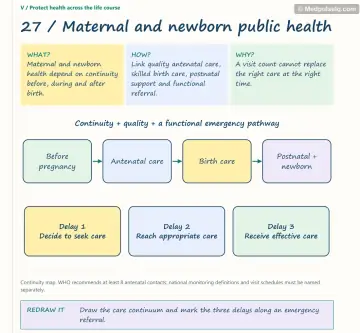
- Three delays (Thaddeus and Maine): decide, reach, receive. MDSR: no‑blame review → response.
ANC, delivery, PNC
- India: ≥ 4 ANC (first ≤ 12 weeks); WHO: 8 contacts. NFHS‑6: 1st‑trimester ANC 76.2%; ANC4+ 65.2%; institutional delivery 90.6%.
- IFA 60 mg + 500 µg daily × 180 days from 2nd trimester (and 180 days postpartum); calcium 1 g/day; albendazole; Td.
- HRP: age < 18 or > 35, height < 145 cm, Hb < 7, HTN, GDM, previous CS, BOH, multiple pregnancy, malpresentation.
- PMSMA (2016): 9th of every month; e‑PMSMA (2022) HRP tracking.
- BEmONC 7 signal functions; CEmONC + CS + blood. FRU criteria. AMTSL (oxytocin 10 IU IM). MgSO₄ for eclampsia. TXA within 3 h for PPH.
- JSY (2005) cash (LPS rural ₹1,400 + ASHA ₹600); JSSK (2011) all free incl. transport, diet, blood, sick infants; LaQshya (2017) quality; SUMAN (2019) respectful; PMMVY (2017) ₹5,000 (+ ₹6,000 for second girl).
- PNC: 48‑h stay; HBNC visits 3, 7, 14, 21, 28, 42 (+ day 1 home births).
Newborn and child
- LBW < 2,500 g (≈ 18%); VLBW < 1,500; ELBW < 1,000. Preterm < 37 weeks.
- ENC: warm chain, breathing (NSSK), breastfeed within 1 h, cord care, vitamin K, vaccines. KMC/iKMC (−25% mortality). NBCC → NBSU → SNCU → NICU. INAP (2014): single‑digit NMR by 2030.
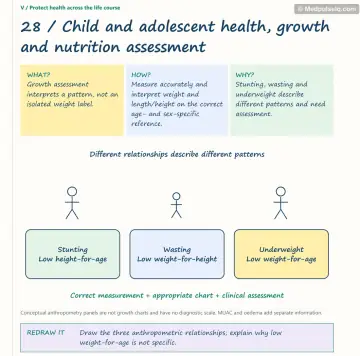
- WHO standards: HAZ < −2 stunting; WHZ < −2 wasting; WAZ < −2 underweight; MUAC < 11.5 cm SAM. NFHS‑6 stunting 29.3%, severe wasting 5.2%.
- Weight doubles at 5 months, triples at 1 year, quadruples at 2 years. Milestones: smile 6–8 weeks, neck 3 months, sits 8 months, pincer 9–10 months, walks 12–15 months.
- IYCF: breastfeed within 1 h; EBF 6 months; complementary at 6 months; continue to 2 years. NFHS‑5: early initiation 41.8%, EBF 63.7%, MAD ≈ 11%. MAA 2016; IMS Act 1992; maternity leave 26 weeks.
- IMNCI: pink (refer), yellow (treat), green (home). RBSK (2013): 0–18 years, 4 D's; MHTs (AWC twice/year, schools once/year); DEIC. HBYC 3, 6, 9, 12, 15 months.
Adolescents, genetics, protection
- Adolescents 10–19 (≈ 1/5 of population). RKSK (2014): 6 themes; AFHCs (Ujjwal), Saathiya peer educators, WIFS (blue tablet weekly), menstrual hygiene. School Health and Wellness Programme (2020): 2 HWAs/school, 11 themes.
- Sickle Cell Mission (1 July 2023): screen 7 crore aged 0–40 in tribal areas; eliminate by 2047. AR inheritance: 25% affected when both parents are carriers. β‑thal trait HbA2 > 3.5%.
- PCMA 2006 (girls 18, boys 21); POCSO 2012 mandatory reporting (s19, s21); PWDVA 2005; One Stop Centres; 181, 1098.
🎯 Single‑best‑answer MCQs
Pick an answer to see the explanation — and the concept to revisit if you missed it. Your answers are saved on this device.
Score 0 / 00 of 20 answered
Question 1
A maternal death is defined as death during pregnancy or within how many days of its termination?
Question 2
The denominator of the maternal mortality ratio is:
Question 3
The leading direct cause of maternal death in India is:
Question 4
Under India's ANC guidelines, the first ANC visit should be:
Question 5
PMSMA provides specialist antenatal care on:
Question 6
Which is NOT a BEmONC signal function?
Question 7
Free transport, drugs, diet and caesarean section for pregnant women are entitlements under:
Question 8
Under HBNC, an ASHA visits a baby born in a facility on days:
Question 9
Low birth weight is defined as birth weight below:
Question 10
The level of newborn care unit at district hospitals in India is the:
Question 11
Low height‑for‑age indicates:
Question 12
Stunting among children under 5 in NFHS‑6 (2023–24) was approximately:
Question 13
A child typically triples birth weight by:
Question 14
Minimum dietary diversity for children aged 6–23 months requires consumption of at least:
Question 15
The law regulating promotion of infant formula in India is the:
Question 16
In IMNCI, a pink classification means:
Question 17
The 4 D's of RBSK are:
Question 18
RKSK covers adolescents aged:
Question 19
If both parents carry sickle cell trait, the probability that a child will have sickle cell disease is:
Question 20
Under POCSO, a doctor who suspects sexual abuse of a child must:
🃏 Flashcards
Say the answer out loud before you flip. Shuffle once you know the order.
Card 1 of 20
🩺 Staged clinical cases
Read the presentation, decide what is going on and what you would do — then reveal the reasoning.
Case 1 — Death within hours of arrival
Stage A: A 24‑year‑old para 2 delivers at home with a dai, bleeds heavily, and reaches the district hospital 3 hours later via a private vehicle after the family "waited to see". She dies 2 hours after admission; blood was unavailable for 90 minutes.
Linked concepts: 93. Measuring Mother and Child Health, 95. Safe Birth and After
Case 2 — The high‑risk adolescent
Stage A: A 17‑year‑old at 28 weeks registers late. Hb 6.5 g/dL, height 142 cm, BP normal.
Linked concepts: 94. Care Before Birth, 100. Adolescents and School Health
Case 3 — The 1.6 kg baby
Stage A: A baby is born at 34 weeks at a CHC, weighing 1.6 kg, breathing well, and able to suck weakly.
Linked concepts: 96. Caring for Newborns, 98. Feeding Babies and Young Children
Case 4 — The flat growth line
Stage A: A 13‑month‑old's weight has not increased for 3 months. WHZ −2.4, MUAC 12.1 cm, no oedema. Diet: mainly breast milk and rice water.
🎤 Viva practice
Answer aloud as if an examiner asked you — then check the model points.
Viva 1
Define maternal death and MMR.
Viva 2
Causes of maternal deaths in India?
Viva 3
What are the three delays?
Viva 4
Components of antenatal care?
Viva 5
List high‑risk pregnancy criteria.
Viva 6
What is AMTSL?
Viva 7
Differentiate JSY and JSSK.
Viva 8
What are the signal functions of EmONC?
Viva 9
Define LBW and its causes.
Viva 10
What is kangaroo mother care?
Viva 11
Differentiate stunting, wasting and underweight.
Viva 12
IYCF recommendations?
Viva 13
What is IMNCI?
Viva 14
What is RBSK?
Viva 15
Components of RKSK?
Keep going
Educational only — not a substitute for clinical judgement, supervision, or local guidelines.