Loading…
🌏 Community Medicine · Part 12 revision hub
Environmental and Occupational Health
Everything you need to revise this Part in one place — the one‑page note for every concept, a rapid‑revision sheet, exam‑style questions that point you back to the right concept, flashcards, staged cases and viva practice.
11 concepts20 MCQs20 flashcards4 cases15 viva questions
📝 The plate wall
Every concept in this Part as a one‑page handwritten note. Open one to read it in full and zoom.
Concept 111
Safe Water — Sources and Purification
Concept 112
Chlorine and Clean Water
Concept 113
Clean Air
Concept 114
Homes, Light, Noise and Radiation
Concept 115
Heat and a Changing Climate
Concept 116
Toilets and Sewage
Concept 117
Rubbish and Hospital Waste
Concept 118
Stopping Infections in Hospitals
Concept 119
Health at Work
Concept 120
Dusty Lungs and Toxic Metals
Concept 121
Protecting Workers
⚡ Rapid revision
The whole Part on one screen — read it the night before.
Water
- Requirement: WHO minimum 15–20 L/person/day; JJM rural 55 lpcd (FHTC); urban 135 lpcd (sewered).
- Sanitary well: ≥ 15 m from latrines, lined ≥ 6 m, parapet ≥ 70–75 cm, platform, cover, hand pump.
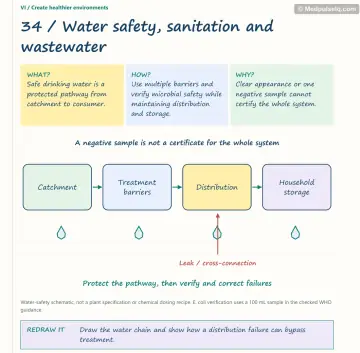
- Large‑scale: storage → coagulation (alum) → sedimentation → filtration → chlorination. Slow sand: schmutzdecke, scraping, 99.9% bacteria. Rapid sand: alum, backwashing, 40–50× faster.
- Chlorine: HOCl (70–80× OCl⁻), best at pH ≈ 7; breakpoint; free residual 0.5 mg/L after 1 h; consumer end ≥ 0.2 mg/L. Doesn't reliably kill spores, Cryptosporidium, hepatitis A/E at usual doses. OT/OTA/DPD tests. Double‑pot method; Horrocks' apparatus.
- BIS IS 10500:2012: turbidity 1 (5) NTU; pH 6.5–8.5; TDS 500 (2,000); fluoride 1.0 (1.5); nitrate 45; arsenic 0.01 mg/L; **E. coli not detectable in 100 mL**.
Air, housing, noise, radiation, heat
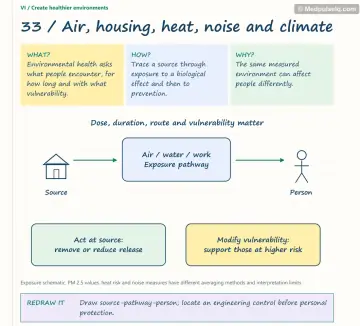
- WHO AQG 2021: PM₂.₅ 5 annual / 15 24‑h; PM₁₀ 15/45. NAAQS: PM₂.₅ 40/60; PM₁₀ 60/100. AQI 0–500 in 6 bands. NCAP 2019 (131 cities); Ujjwala 2016; BS‑VI 2020.
- Ventilation: 3,000 ft³/person/hour; AIIR ≥ 12 ACH. CET comfort 25–27 °C. WBGT for work.
- Overcrowding: 1 room 2, 2 rooms 3, 3 rooms 5, 4 rooms 7, 5+ rooms 10 (+2 each); infants not counted, 1–10 years = ½.
- Noise: occupational 90 dB(A) × 8 h (action 85); NIHL notch at 4 kHz; silence zone 50/40 dB within 100 m of hospitals.
- Radiation: ICRP/AERB 20 mSv/year (workers, 5‑year average), 1 mSv/year (public); justification, ALARA, limits; time, distance, shielding; TLD badges.
- Heatstroke: > 40 °C + CNS dysfunction → cool first. IMD heat wave: ≥ 40 °C plains with departure ≥ 4.5 °C, or ≥ 45 °C. NPCCHH 2019; Ahmedabad HAP 2013.
Sanitation and waste
- F‑diagram: sanitation = primary barrier. JMP ladder → safely managed.
- Twin‑pit pour‑flush (rural India); septic tank (24 h retention); trench latrines in camps.
- Sewage: preliminary → primary sedimentation → secondary (activated sludge, trickling filter, oxidation pond) → tertiary. BOD₅ (5 days, 20 °C).
- SBM 2014; ODF (rural) 2019; ODF Plus; manual scavenging banned (2013); NAMASTE.
- SWM Rules 2016: wet, dry, domestic hazardous. Composting: Indore (aerobic), Bangalore (anaerobic).
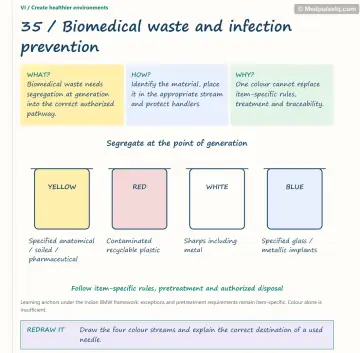
- BMW Rules 2016: yellow (anatomical, soiled, medicines, chemical, lab pre‑treated → incineration), red (contaminated plastics → autoclave + shred), white (sharps → puncture‑proof), blue (glass, metal implants). Storage ≤ 48 h; bar codes; no chlorinated bags.
Hospital IPC and occupational health
- HAI ≥ 48 h after admission: CAUTI, CLABSI, VAP, SSI. WHO 5 moments; ABHR 20–30 s. Standard + contact/droplet/airborne precautions. Bundles. Kayakalp 2015; NAP‑AMR 2017.
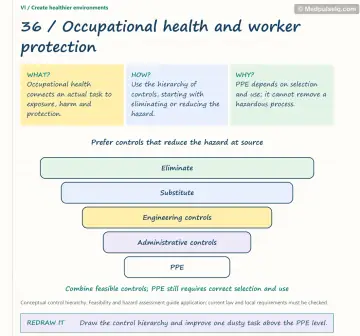
- Hazards: physical, chemical, biological, mechanical, ergonomic, psychosocial. Hierarchy: eliminate → substitute → engineer → administer → PPE.
- Silicosis (upper zones, eggshell calcification, ↑ TB); asbestosis (lower zones, plaques, mesothelioma); byssinosis (Monday tightness); bagassosis and farmer's lung (HP).
- Lead: colic, anaemia with basophilic stippling, Burton's line, wrist drop; BLL; no safe level; CDC child reference 3.5 µg/dL.
- 🆕 Four labour codes in force 21 November 2025 (OSH Code, Social Security Code, IR Code, Wages Code). ESI benefits: medical, sickness (70% × 91 days), maternity (26 weeks), disablement (90%), dependants', funeral, unemployment.
🎯 Single‑best‑answer MCQs
Pick an answer to see the explanation — and the concept to revisit if you missed it. Your answers are saved on this device.
Score 0 / 00 of 20 answered
Question 1
The "vital layer" of a slow sand filter is called:
Question 2
Rapid sand filters are cleaned by:
Question 3
The recommended free residual chlorine after 1 hour of contact is:
Question 4
The most germicidal form of chlorine in water is:
Question 5
Under BIS standards, E. coli in drinking water must be:
Question 6
The WHO 2021 annual air quality guideline for PM₂.₅ is:
Question 7
Which AQI band is "very poor" in India?
Question 8
Noise‑induced hearing loss characteristically first affects the frequency of:
Question 9
The ICRP occupational dose limit (averaged over 5 years) is:
Question 10
Heatstroke is defined by core temperature above 40 °C with:
Question 11
The primary barrier in the F‑diagram is:
Question 12
BOD of sewage is measured over:
Question 13
Under the BMW Rules 2016, used IV tubing and catheters (without needles) go into the:
Question 14
The maximum storage time for untreated biomedical waste is:
Question 15
The single most effective measure to prevent healthcare‑associated infections is:
Question 16
Airborne precautions require:
Question 17
The most effective level in the hierarchy of controls is:
Question 18
Eggshell calcification of hilar lymph nodes is characteristic of:
Question 19
Basophilic stippling of red cells and a Burton's line suggest poisoning with:
Question 20
The four labour codes, including the OSH Code 2020, came into force on:
🃏 Flashcards
Say the answer out loud before you flip. Shuffle once you know the order.
Card 1 of 20
🩺 Staged clinical cases
Read the presentation, decide what is going on and what you would do — then reveal the reasoning.
Case 1 — No chlorine at the tap
Stage A: A ward reports 40 cases of jaundice in 3 weeks. The water works report residual chlorine of 1 mg/L at the outlet.
Linked concepts: 112. Chlorine and Clean Water, 111. Safe Water — Sources and Purification
Case 2 — Needles in the red bag
Stage A: A ward cleaner suffers a needle‑stick injury while tying a red bag.
Linked concepts: 117. Rubbish and Hospital Waste, 118. Stopping Infections in Hospitals
Case 3 — Breathless stone cutter
Stage A: A 35‑year‑old who has dry‑cut sandstone for 12 years presents with breathlessness and cough. CXR shows bilateral upper‑zone nodular opacities.
Linked concepts: 119. Health at Work, 120. Dusty Lungs and Toxic Metals, 61. Concept 61
Case 4 — Collapse at noon
Stage A: During a heat wave, a 52‑year‑old traffic constable collapses at 1 pm, confused, with a temperature of 41.5 °C.
Linked concepts: 115. Heat and a Changing Climate
🎤 Viva practice
Answer aloud as if an examiner asked you — then check the model points.
Viva 1
Differentiate slow and rapid sand filters.
Viva 2
What is breakpoint chlorination?
Viva 3
What is residual chlorine and its standard?
Viva 4
Bacteriological indicators of water quality?
Viva 5
WHO and Indian PM₂.₅ standards?
Viva 6
Criteria of overcrowding?
Viva 7
Effects of noise?
Viva 8
Principles of radiation protection?
Viva 9
Management of heatstroke?
Viva 10
What is a sanitary latrine?
Viva 11
Stages of sewage treatment?
Viva 12
Colour coding under BMW Rules 2016?
Viva 13
What are standard precautions?
Viva 14
Name the pneumoconioses.
Viva 15
Benefits under ESI?
Keep going
Educational only — not a substitute for clinical judgement, supervision, or local guidelines.