Loading…
🌏 Community Medicine · Part 6 revision hub
Communicable Disease Epidemiology, Surveillance and Immunisation
Everything you need to revise this Part in one place — the one‑page note for every concept, a rapid‑revision sheet, exam‑style questions that point you back to the right concept, flashcards, staged cases and viva practice.
11 concepts20 MCQs20 flashcards4 cases15 viva questions
📝 The plate wall
Every concept in this Part as a one‑page handwritten note. Open one to read it in full and zoom.
Concept 46
How Infections Spread in Populations
Concept 47
Breaking the Chain of Infection
Concept 48
Killing Germs Safely — Disinfection
Concept 49
Watching for Disease — Surveillance
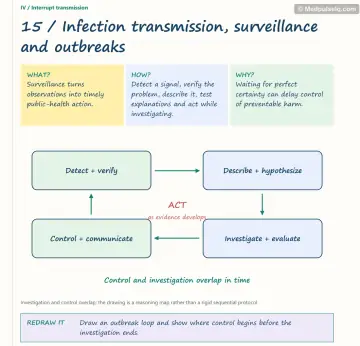
Concept 50
Investigating an Outbreak
Concept 51
How Vaccines Protect
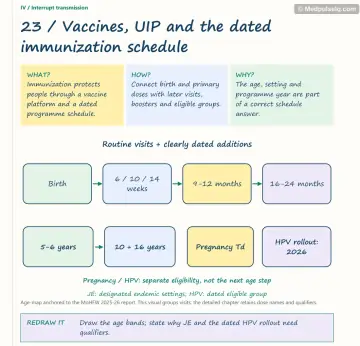
Concept 52
India's Immunisation Schedule
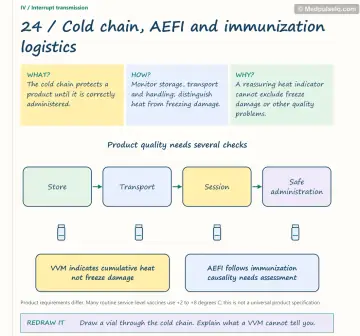
Concept 53
Keeping Vaccines Cold — The Cold Chain
Concept 54
When Vaccines Cause Concern — AEFI
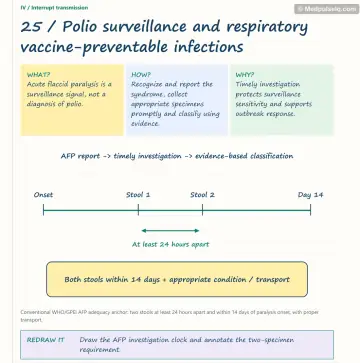
Concept 55
Polio — The Last Mile
Concept 56
Measles and Rubella
⚡ Rapid revision
The whole Part on one screen — read it the night before.
Transmission dynamics
- Chain: agent → reservoir → portal of exit → mode → portal of entry → susceptible host.
- Carriers: incubatory, convalescent, healthy; temporary or chronic. Dead‑end hosts: humans in JE, rabies, hydatid.
- Incubation (infection → symptoms) sets quarantine length; serial interval (onset → onset); generation time (infection → infection).
- HIT = 1 − 1/R₀; critical coverage Vc = HIT / VE. Measles R₀ 12–18 → about 93–95%.
- Isolation = infected; quarantine = exposed well persons (longest incubation period).
- Vector transmission: propagative (dengue, plague), cyclo‑developmental (filaria), cyclo‑propagative (malaria).
Disinfection
- Spaulding: critical → sterilise; semi‑critical → HLD; non‑critical → clean or low‑level disinfect.
- Autoclave 121 °C, 15 psi, 15–20 min (G. stearothermophilus); hot‑air oven 160 °C × 2 h (B. atrophaeus).
- 0.5% chlorine for spills and decontamination; clean before disinfecting. Concurrent vs terminal disinfection.
Surveillance and outbreaks
- IDSP (2004, NCDC) → IHIP (2021): S (health worker), P (MO), L (lab). Weekly Monday–Sunday; immediate outbreak alerts; RRTs.
- Types: passive, active, sentinel, syndromic, event‑based, lab, environmental.
- IHR 2005: notify WHO within 24 h of assessing a potential PHEIC.
- Outbreak steps: prepare → confirm outbreak → verify diagnosis → case definition → find cases (line list) → describe → hypothesise → test (attack rates/RR or OR) → control → communicate. Exposure never goes in the case definition.
Vaccines and UIP
- Live: BCG, OPV, MR, RVV, live JE (avoid in pregnancy and immunosuppression). Toxoids: T, D. Conjugate: Hib, PCV, TCV.
- Live parenteral vaccines: same day or ≥ 4 weeks apart. Never restart a series.
- Schedule (MoHFW AR 2025–26): birth (BCG, OPV‑0, HepB‑0) → 6/10/14 weeks (OPV, Penta, RVV; fIPV at 6 and 14; PCV at 6 and 14) → 9–12 months (MR‑1, PCV‑B, fIPV‑3, JE‑1, Vit A) → 16–24 months (MR‑2, DPT‑B1, OPV‑B, JE‑2) → 5–6 years DPT‑B2 → 10 and 16 years Td; pregnancy Td‑1, Td‑2 or booster.
- 🆕 28 February 2026: single‑dose HPV for 14‑year‑old girls. FIC (NFHS‑6) 87.1%.
- Zero‑dose = no DTP‑1/Penta‑1. Dropout = (Penta‑1 − Penta‑3)/Penta‑1 × 100 (aim < 10%).
Cold chain and AEFI
- ILR +2 to +8 °C; deep freezer −15 to −25 °C. OPV most heat‑sensitive; Hep B, Penta, DPT, Td, PCV, IPV freeze‑sensitive.
- VVM = cumulative heat only; stage 3–4 discard. Shake test for freezing. FEFO.
- Open vial policy: eligible liquid vaccines up to 28 days; reconstituted BCG/MR/JE discard within 4 h or at session end.
- Wastage factor = 1/(1 − wastage rate).
- AEFI causes: product, quality defect, immunisation error, anxiety, coincidental. TSS cluster = contaminated reconstituted vial. Adrenaline 1:1,000 0.01 mL/kg IM; observe 30 min.
Polio and MR
- Last WPV case India 13 January 2011; certified 27 March 2014. WPV2 (2015), WPV3 (2019) eradicated; WPV1 in Pakistan and Afghanistan.
- AFP < 15 years: 2 stools ≥ 24 h apart within 14 days; 60‑day follow‑up; NPAFP ≥ 2/100,000; stool adequacy ≥ 80%.
- Measles: R₀ 12–18; 3 C's; Koplik spots; communicable 4 days before to 4 days after rash; vitamin A × 2 days. CRS: cataract, deafness, PDA; highest risk < 12 weeks. MR elimination target 2026.
🎯 Single‑best‑answer MCQs
Pick an answer to see the explanation — and the concept to revisit if you missed it. Your answers are saved on this device.
Score 0 / 00 of 20 answered
Question 1
If R₀ for a disease is 5, the herd immunity threshold is:
Question 2
Herd immunity does NOT protect against:
Question 3
The period from infection to the first symptom is the:
Question 4
Restricting the movement of healthy contacts of a case for the longest incubation period is:
Question 5
Development of microfilariae in Culex mosquitoes without multiplication is an example of:
Question 6
The standard autoclave cycle is:
Question 7
According to the Spaulding classification, a vaginal speculum requires at least:
Question 8
In IDSP/IHIP, the "P" form is filled by:
Question 9
Under IHR (2005), countries must notify WHO of a potential PHEIC within:
Question 10
Which should NOT be part of an outbreak case definition?
Question 11
Which of the following is a live attenuated vaccine?
Question 12
Conjugate vaccines are effective in infants because conjugation:
Question 13
The third dose of fIPV in India's schedule is given at:
Question 14
India's nationwide HPV campaign launched in February 2026 targets:
Question 15
The most heat‑sensitive vaccine in UIP is:
Question 16
A vaccine vial monitor indicates:
Question 17
Reconstituted MR vaccine must be discarded:
Question 18
Fainting of an adolescent immediately after Td injection is classified as:
Question 19
The non‑polio AFP rate target in India is at least:
Question 20
The classic triad of congenital rubella syndrome is:
🃏 Flashcards
Say the answer out loud before you flip. Shuffle once you know the order.
Card 1 of 20
🩺 Staged clinical cases
Read the presentation, decide what is going on and what you would do — then reveal the reasoning.
Case 1 — The hostel paneer
Stage A: 52 of 140 students in a hostel develop vomiting and abdominal cramps 2–5 hours after Sunday dinner. No cases among day scholars.
Linked concepts: 50. Investigating an Outbreak, 14. Concept 14
Case 2 — Frozen overnight
Stage A: At a PHC, the ILR thermometer reads −4 °C on Monday morning. The thermostat had been turned to its coldest setting on Friday.
Linked concepts: 53. Keeping Vaccines Cold — The Cold Chain
Case 3 — Three children, one vial
Stage A: At an evening outreach session, three children develop vomiting, high fever and lethargy within hours of MR vaccination. One dies overnight.
Case 4 — Weakness in a migrant child
Stage A: A 3‑year‑old from a brick‑kiln settlement develops acute flaccid weakness of the right leg after 3 days of fever. Vaccination card unavailable.
Linked concepts: 55. Polio — The Last Mile, 52. India's Immunisation Schedule
🎤 Viva practice
Answer aloud as if an examiner asked you — then check the model points.
Viva 1
Describe the chain of infection.
Viva 2
What is herd immunity, and how is the threshold calculated?
Viva 3
Differentiate isolation and quarantine.
Viva 4
What is the Spaulding classification?
Viva 5
Define surveillance.
Viva 6
What are the S, P and L forms?
Viva 7
List the steps of an outbreak investigation.
Viva 8
Differentiate active and passive immunity.
Viva 9
Give India's National Immunisation Schedule.
Viva 10
What is the cold chain?
Viva 11
Explain VVM and the shake test.
Viva 12
What is the open vial policy?
Viva 13
Classify AEFI.
Viva 14
Describe AFP surveillance.
Viva 15
Why give vitamin A in measles?
Keep going
Educational only — not a substitute for clinical judgement, supervision, or local guidelines.