Loading…
🩺 Medicine · Part 1 revision hub
Cardiovascular Medicine
Everything you need to revise this Part in one place — the one‑page note for every concept, a rapid‑revision sheet, exam‑style questions that point you back to the right concept, flashcards, staged cases and viva practice.
19 concepts20 MCQs20 flashcards4 cases15 viva questions
📝 The plate wall
Every concept in this Part as a one‑page handwritten note. Open one to read it in full and zoom.
Concept 1
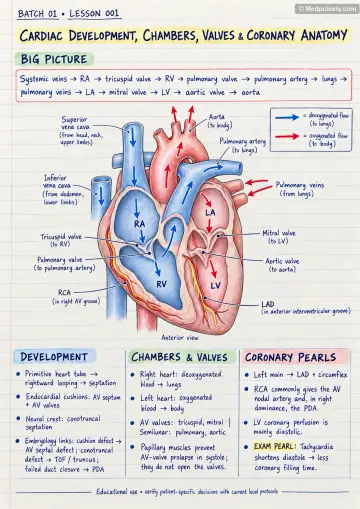
The Heart's Map
Concept 2
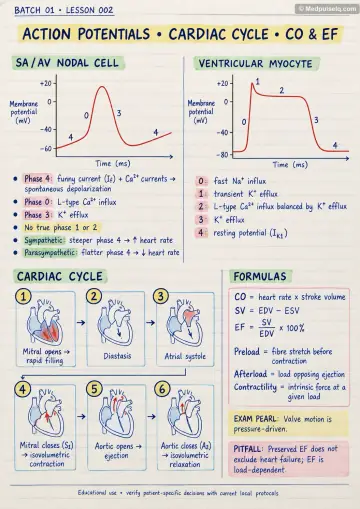
How the Heart Beats and Pumps
Concept 3
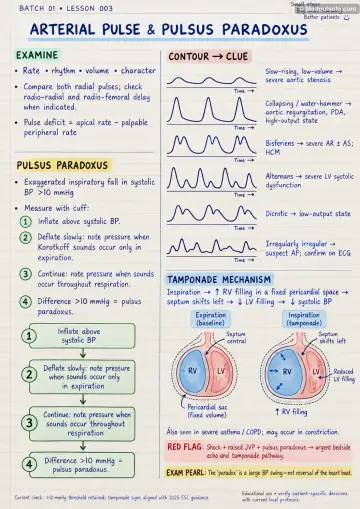
The Pulse: the heart's handwriting
Concept 4
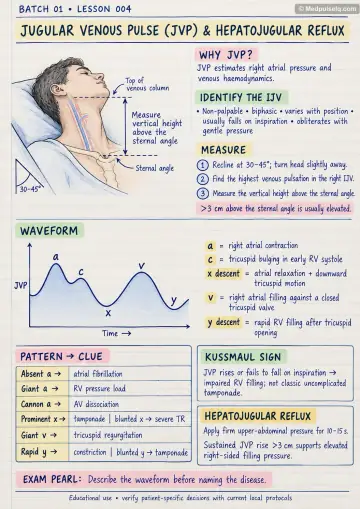
The Neck Veins (JVP)
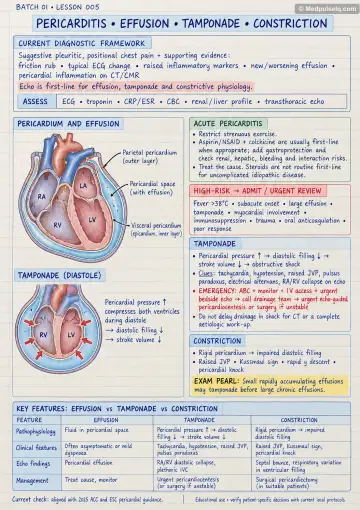
Concept 5
The Heart's Outer Bag: the pericardium
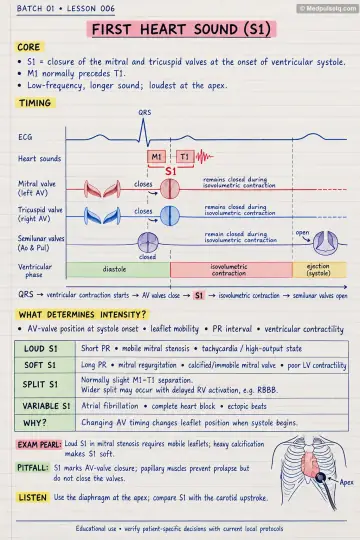
Concept 6
The First Heart Sound — "lub"
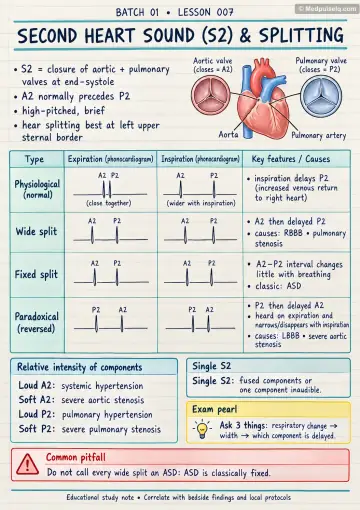
Concept 7
The Second Heart Sound — "dub"
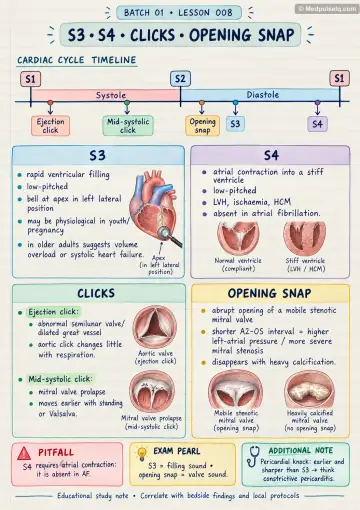
Concept 8
Extra Heart Sounds
Concept 9
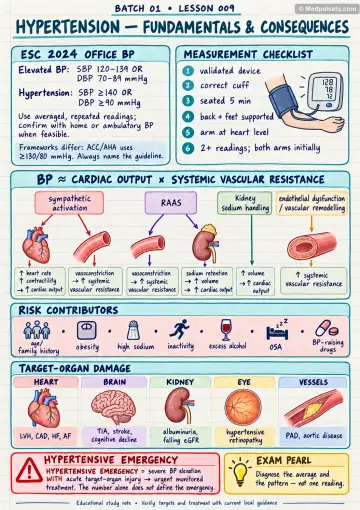
High Blood Pressure: what it is
Concept 10
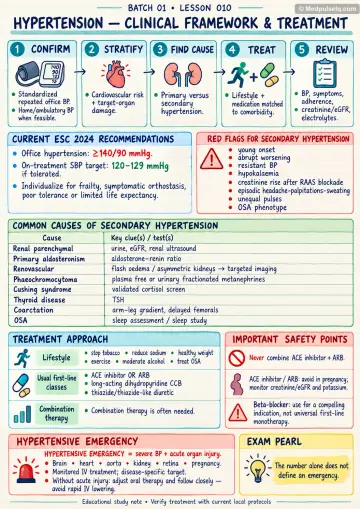
High Blood Pressure: bringing it down safely
Concept 11
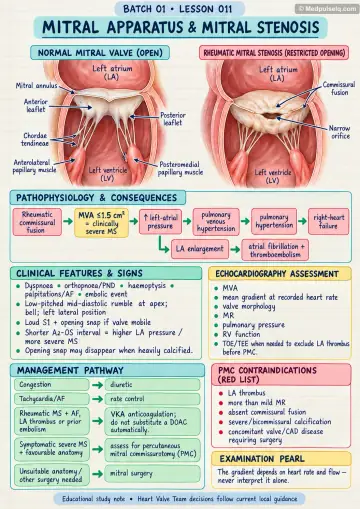
Mitral Stenosis: a door that won't open
Concept 12
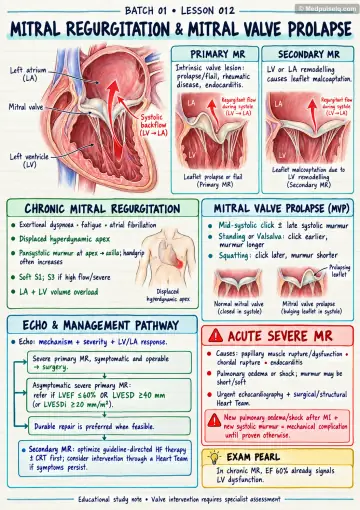
Mitral Regurgitation: a door that won't shut
Concept 13
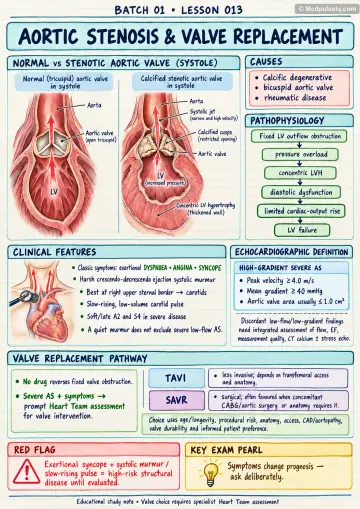
Aortic Stenosis: a narrow exit
Concept 14
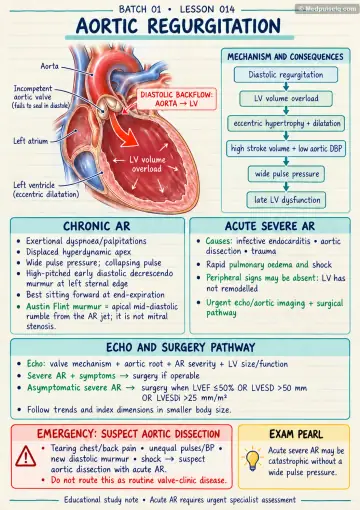
Aortic Regurgitation: a leaky exit
Concept 15
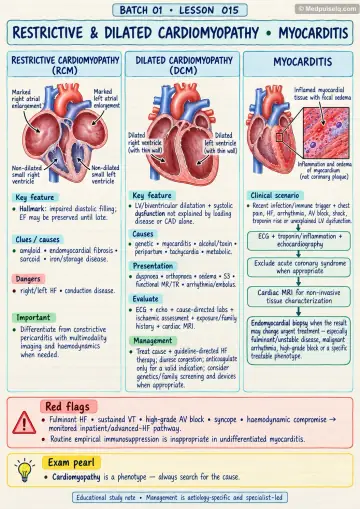
When the Heart Muscle Stretches or Stiffens
Concept 16
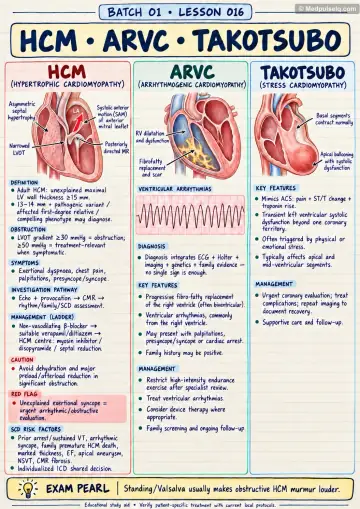
The Thick Heart and Other Surprises
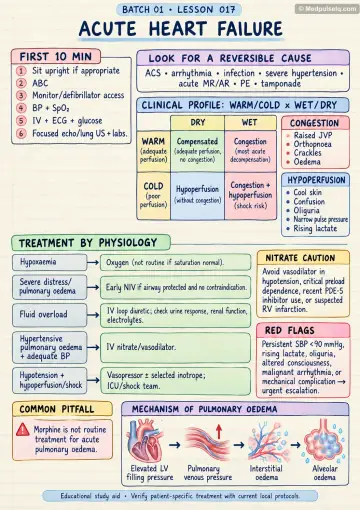
Concept 17
Acute Heart Failure: when the pump suddenly struggles
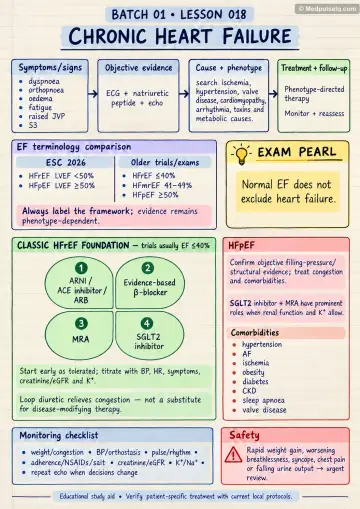
Concept 18
Living with Heart Failure
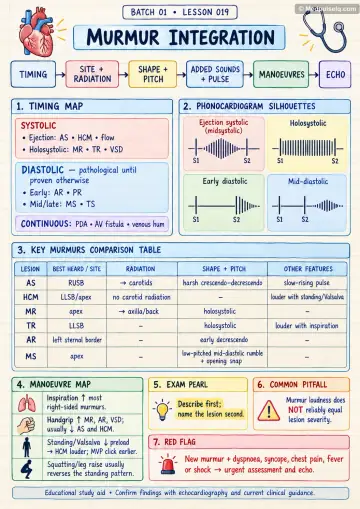
Concept 19
Putting Murmurs Together
⚡ Rapid revision
The whole Part on one screen — read it the night before.
Bedside anchors
- Slow-rising pulse → AS; collapsing pulse → AR; alternans → severe LV dysfunction.
- a wave = atrial contraction; absent in AF, cannon in AV dissociation.
- Tamponade: high JVP, pulsus paradoxus, blunted y; constriction: Kussmaul + rapid y + knock.
- S3 = rapid filling/volume; S4 = stiff ventricle + atrial kick; no S4 in AF.
- Diastolic murmur is pathological until proven otherwise.
- Inspiration generally increases right-sided murmurs.
- Standing/Valsalva: HCM louder; MVP click earlier.
Threshold anchors
- ESC office hypertension: ≥140/90; treated SBP goal 120–129 if tolerated.
- Severe MS: MVA ≤1.5 cm².
- Severe primary MR LV trigger: EF ≤60% or LVESD ≥40 mm.
- High-gradient severe AS: Vmax ≥4 m/s or mean gradient ≥40 mmHg; AVA typically ≤1.0 cm².
- Severe AR LV trigger: EF ≤50% or LVESD >50 mm/indexed >25 mm/m².
- HCM: wall thickness usually ≥15 mm; obstruction ≥30 mmHg; ≥50 mmHg treatment-relevant.
- Pulsus paradoxus: inspiratory SBP fall >10 mmHg.
Emergency anchors
- BP number alone ≠ hypertensive emergency; look for acute organ injury.
- Tamponade shock → urgent drainage; avoid preload-reducing treatment.
- Acute pulmonary oedema → NIV if suitable, oxygen if hypoxaemic, diuretic for overload, nitrate if hypertensive.
- Cardiogenic shock → define cause, norepinephrine for pressure, selected inotrope for output; do not treat EF alone.
- Acute severe MR/AR may be quiet and requires urgent echo/team escalation.
Chronic HF anchors
- Diagnose syndrome + objective cardiac abnormality; EF alone is insufficient.
- Search cause and trigger every time.
- Classic four pillars: beta blocker + RAAS inhibitor/ARNI + MRA + SGLT2 inhibitor.
- Diuretics improve congestion, not the underlying survival pathway.
- ESC 2026: HFrEF <50%; HFpEF ≥50%; older literature may retain ≤40/41–49/≥50.
- Normal EF does not exclude HF.
🎯 Single‑best‑answer MCQs
Pick an answer to see the explanation — and the concept to revisit if you missed it. Your answers are saved on this device.
Score 0 / 00 of 20 answered
Question 1
A patient with AF has no visible JVP a wave. Why?
Question 2
Which JVP pattern most strongly favours tamponade over constriction?
Question 3
An inspiratory fall in systolic BP of 14 mmHg is called:
Question 4
Which condition classically produces fixed splitting of S2?
Question 5
Which finding is impossible in established AF?
Question 6
Office BP is 190/116 mmHg after repeat correct measurement, but the patient is asymptomatic with no acute organ injury. The best principle is:
Question 7
Which finding makes primary aldosteronism especially likely?
Question 8
In rheumatic MS with AF, the preferred established anticoagulant is:
Question 9
Which finding contraindicates PMC for rheumatic MS?
Question 10
Why can LVEF 58% represent LV dysfunction in chronic severe MR?
Question 11
The classic high-gradient severe AS threshold includes:
Question 12
Which pulse best matches chronic severe AR?
Question 13
A murmur increases with standing and Valsalva. Which diagnosis is most likely?
Question 14
Which is a contemporary principle in HCM?
Question 15
Which patient most warrants endomyocardial biopsy consideration?
Question 16
Which drug should generally not be newly started during cardiogenic shock?
Question 17
Routine oxygen in acute HF is indicated primarily when:
Question 18
Which is not one of the classic four foundational therapies for trial-defined HFrEF ≤40%?
Question 19
After an ACE inhibitor, the minimum washout before sacubitril/valsartan is:
Question 20
Which statement about the 2026 ESC EF nomenclature is correct?
🃏 Flashcards
Say the answer out loud before you flip. Shuffle once you know the order.
Card 1 of 20
🩺 Staged clinical cases
Read the presentation, decide what is going on and what you would do — then reveal the reasoning.
Case 1 — Breathlessness with very high BP
Stage A: A 62-year-old has abrupt severe dyspnoea, BP 224/126 mmHg, SpO₂ 82%, diaphoresis, diffuse crackles, and warm extremities.
Case 2 — Rheumatic MS with AF
Stage A: A 34-year-old woman has progressive dyspnoea and palpitations. Pulse is irregularly irregular, S1 is loud, and there is an apical opening snap followed by a diastolic rumble.
Linked concepts: 11. Mitral Stenosis: a door that won't open
Case 3 — Exertional syncope and a systolic murmur
Stage A: A 19-year-old athlete collapses during sprinting. His uncle died suddenly at 32. There is a harsh systolic murmur that increases on standing and decreases with handgrip.
Linked concepts: 16. The Thick Heart and Other Surprises
Case 4 — New pulmonary oedema after MI
Stage A: Three days after an inferior MI, a 68-year-old becomes hypotensive and acutely breathless. A new apical systolic murmur is present but not very loud.
🎤 Viva practice
Answer aloud as if an examiner asked you — then check the model points.
Viva 1
What is pulse deficit?
Viva 2
How do you distinguish JVP from carotid?
Viva 3
Why is S4 absent in AF?
Viva 4
What causes an opening snap?
Viva 5
Define pulsus paradoxus.
Viva 6
What is Kussmaul sign?
Viva 7
Name two PMC contraindications.
Viva 8
Why is EF ≤60% a concern in severe MR?
Viva 9
Give high-gradient severe AS echo criteria.
Viva 10
Why does standing increase HCM murmur?
Viva 11
What is hypertensive emergency?
Viva 12
Name the classic four HFrEF pillars.
Viva 13
What does wet–cold mean?
Viva 14
When is oxygen used in acute HF?
Viva 15
What is the immediate treatment of unstable tamponade?
Keep going
Educational only — not a substitute for clinical judgement, supervision, or local guidelines.