Loading…
🩺 Medicine · Part 2 revision hub
Respiratory Medicine
Everything you need to revise this Part in one place — the one‑page note for every concept, a rapid‑revision sheet, exam‑style questions that point you back to the right concept, flashcards, staged cases and viva practice.
24 concepts20 MCQs20 flashcards4 cases15 viva questions
📝 The plate wall
Every concept in this Part as a one‑page handwritten note. Open one to read it in full and zoom.
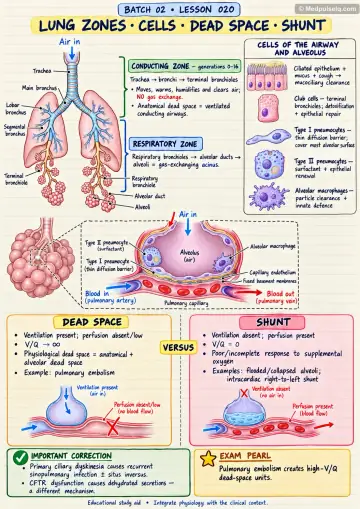
Concept 20
Lung Zones, Cells, Dead Space and Shunt
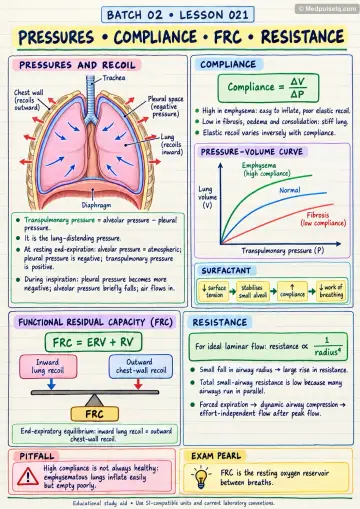
Concept 21
Pressure, Compliance, FRC and Resistance
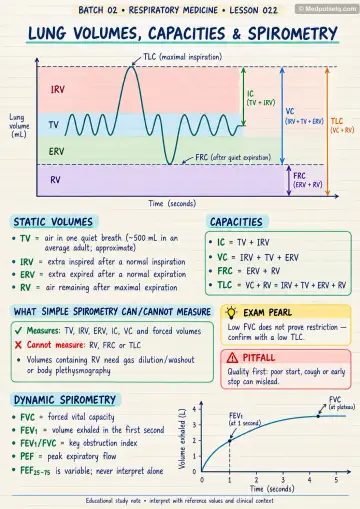
Concept 22
Lung Volumes and Spirometry Basics
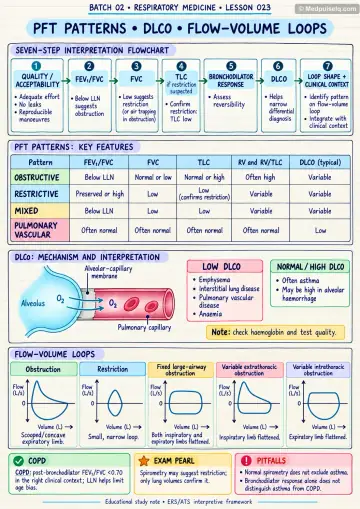
Concept 23
Reading PFT Patterns and DLCO
Concept 24
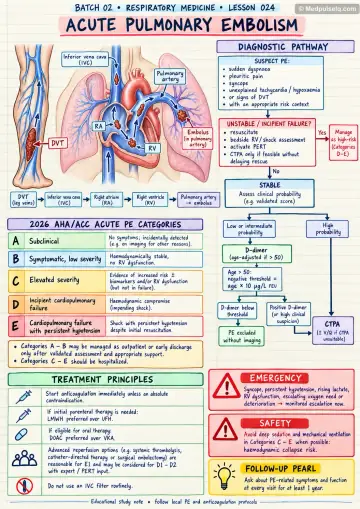
Acute Pulmonary Embolism
Concept 25
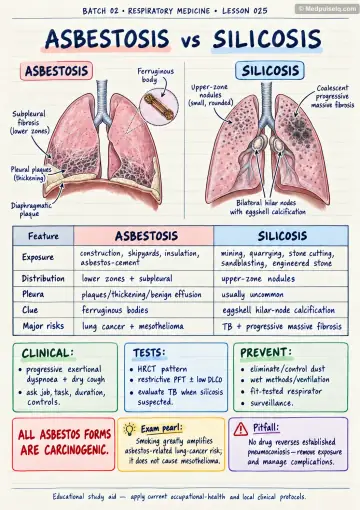
Asbestosis versus Silicosis
Concept 26
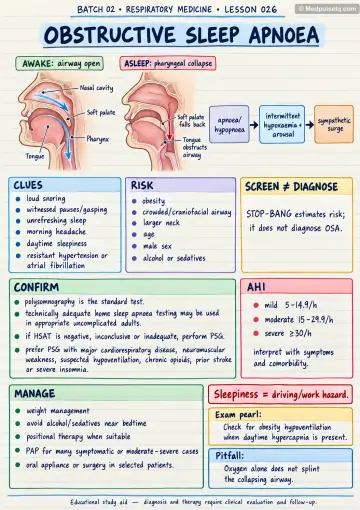
Obstructive Sleep Apnoea
Concept 27
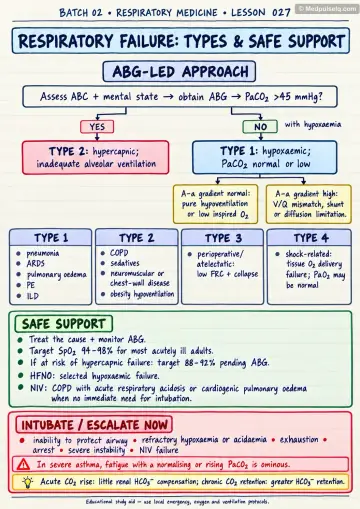
Respiratory Failure and Safe Support
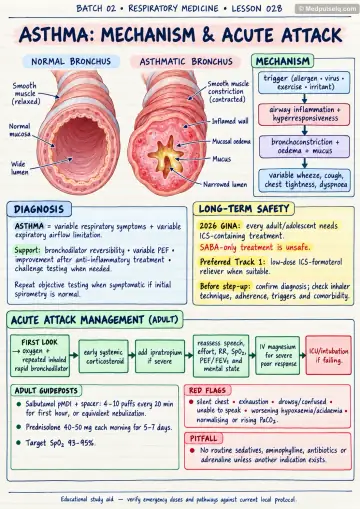
Concept 28
Asthma Mechanism and Acute Attack
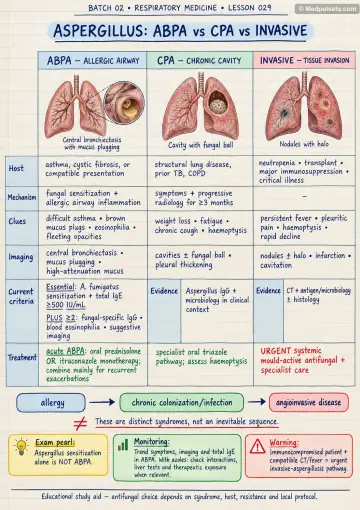
Concept 29
Aspergillus: ABPA, Chronic Cavitary Disease and Invasive Infection
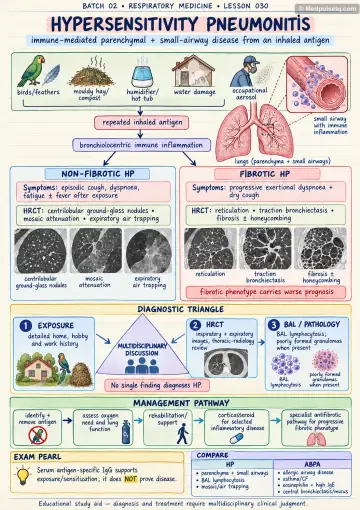
Concept 30
Hypersensitivity Pneumonitis
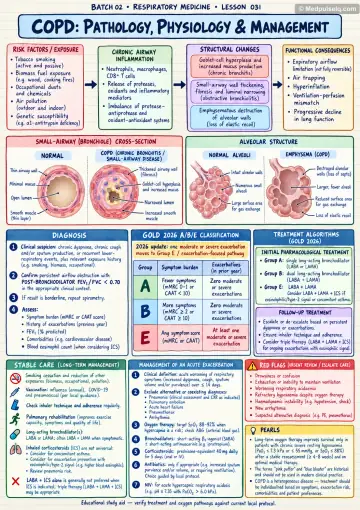
Concept 31
COPD: Chronic Obstructive Pulmonary Disease
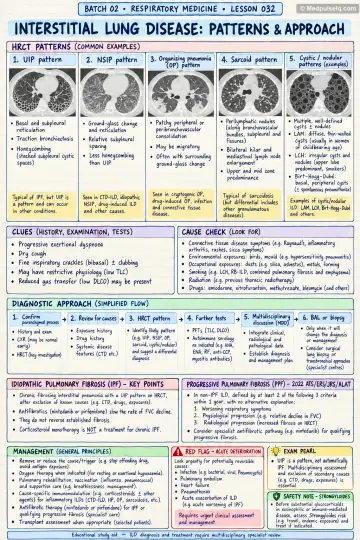
Concept 32
Interstitial Lung Disease: when the lung fabric scars
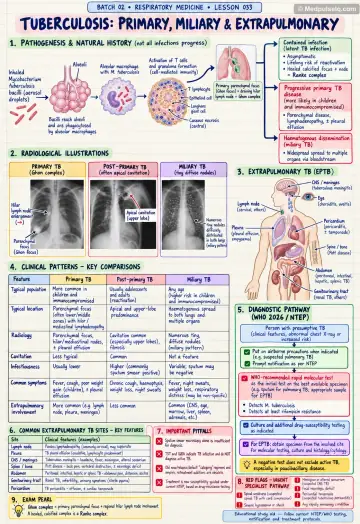
Concept 33
Tuberculosis Patterns: primary, miliary and beyond the lung
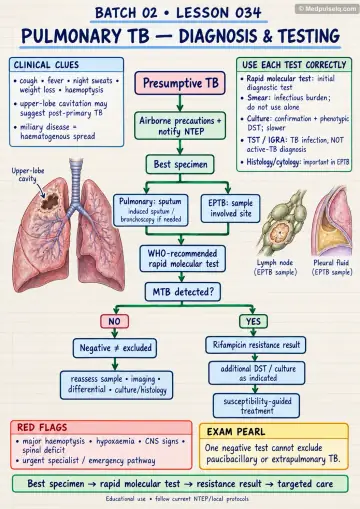
Concept 34
Pulmonary TB Diagnosis: prove the germ and resistance
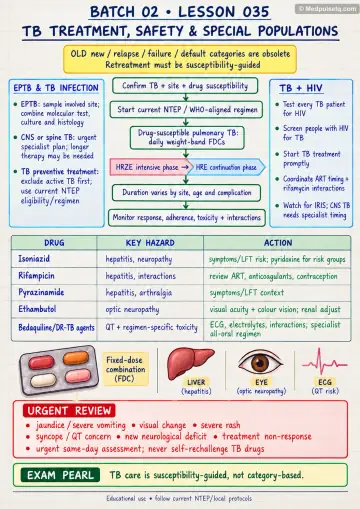
Concept 35
TB Treatment Safety: finish the course safely
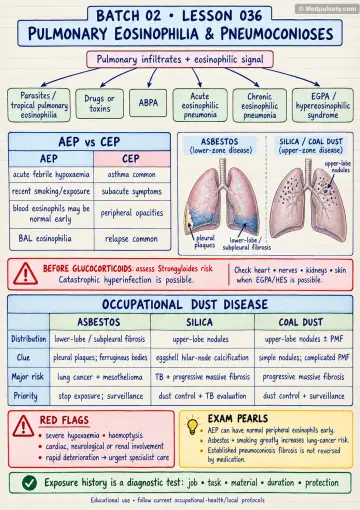
Concept 36
Eosinophils and Dust: lungs reacting to parasites, allergy or work
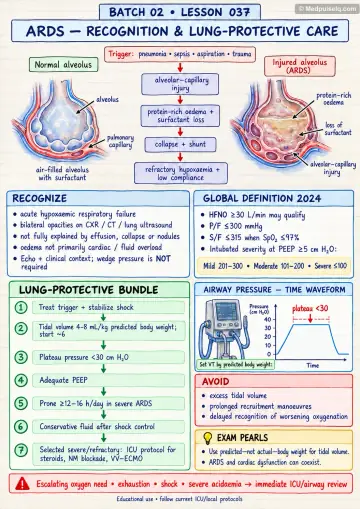
Concept 37
ARDS: flooded air sacs and protective breathing support
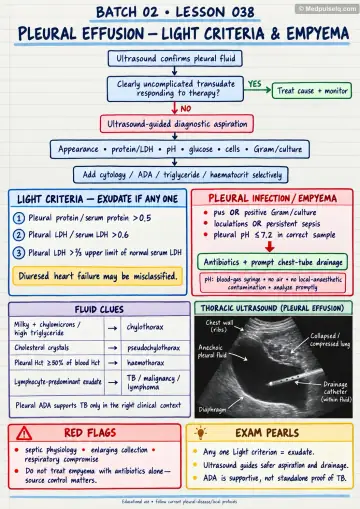
Concept 38
Pleural Effusion: reading fluid around the lung
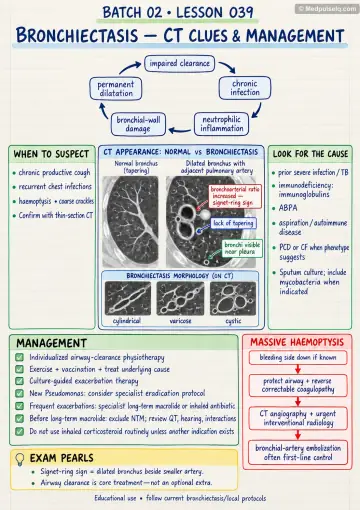
Concept 39
Bronchiectasis: damaged airways that keep infecting
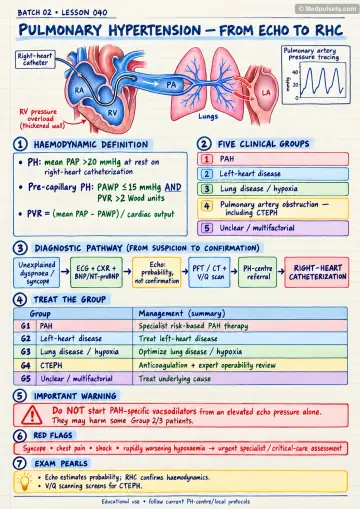
Concept 40
Pulmonary Hypertension: high pressure in the lung vessels
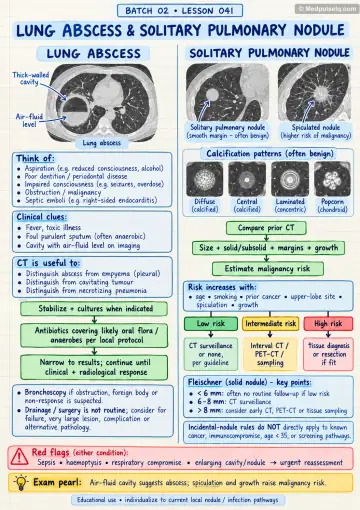
Concept 41
Lung Abscess and Pulmonary Nodule: cavities and spots on scans
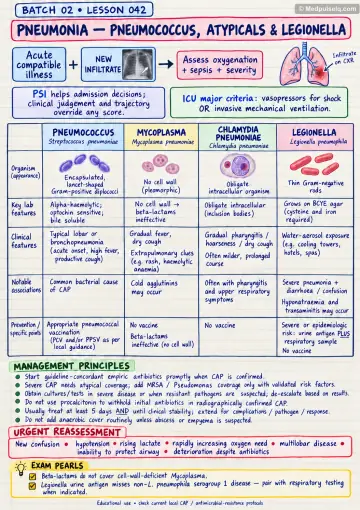
Concept 42
Pneumonia Germs: pneumococcus, atypicals and Legionella
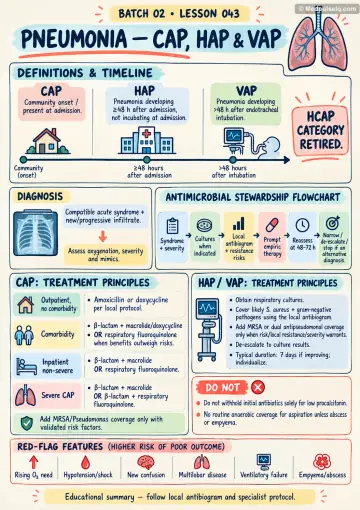
Concept 43
Pneumonia Pathways: CAP, HAP and VAP
⚡ Rapid revision
The whole Part on one screen — read it the night before.
Physiology and PFT
- Hypoventilation gives a normal A-a gradient; V/Q mismatch, shunt and diffusion limitation raise it.
- Dead space = ventilation without enough perfusion; shunt = perfusion without enough ventilation.
- FRC = ERV + RV; it is the resting oxygen reservoir between breaths.
- Simple spirometry cannot measure RV, FRC or TLC.
- Low FVC with preserved ratio suggests restriction, but low TLC confirms it.
- DLCO is low in emphysema, ILD, pulmonary vascular disease and anaemia; asthma often has normal or high DLCO.
- Inspiratory loop flattening suggests variable extrathoracic obstruction; expiratory flattening suggests variable intrathoracic obstruction; both limbs flattened suggests fixed large-airway obstruction.
Obstructive and immune airway disease
- Asthma = variable symptoms plus variable expiratory airflow limitation; SABA-only care is unsafe for adults/adolescents.
- Life-threatening asthma clues include silent chest, drowsiness, exhaustion, inability to speak and rising PaCO2.
- ABPA requires Aspergillus sensitization, total IgE at least 500 IU/mL and supportive features.
- HP depends on exposure history plus HRCT, BAL/pathology and multidisciplinary judgement; serum IgG alone does not diagnose it.
- COPD requires persistent post-bronchodilator FEV1/FVC below 0.70 in clinical context.
- COPD care targets smoking/biomass exposure, vaccination, inhaler technique, pulmonary rehabilitation, bronchodilators, exacerbations and comorbidities.
Infection, vascular and critical care
- Stable low/intermediate probability PE can use D-dimer; high-probability or unstable PE needs imaging/escalation without D-dimer reassurance.
- Hypercapnia-risk oxygen target is commonly 88–92% pending ABG and reassessment.
- Upfront rapid molecular testing with resistance detection is central for suspected active TB in India.
- ARDS can be recognized in non-intubated patients on HFNO when global criteria are met; manage trigger plus lung-protective strategy if ventilated.
- Pleural pus, positive Gram/culture, loculation or low pH needs antibiotics plus drainage/source control.
- PH is mPAP >20 mmHg on right-heart catheterization; pre-capillary disease also needs PAWP ≤15 and PVR >2 Wood units.
- HCAP is retired; pneumonia broadening depends on validated resistance risks, severity, cultures and local antibiogram.
Emergency anchors
- Unstable PE, quiet/drowsy asthma, massive haemoptysis, tension pneumothorax, empyema and ARDS trajectory need monitored escalation.
- Do not withhold oxygen from a hypoxaemic COPD patient; titrate and check ABG.
- Massive haemoptysis kills by asphyxia: protect airway, position bleeding side down if known and arrange embolization pathway.
- Long-term oxygen in COPD improves survival only in chronic severe resting hypoxaemia after stable reassessment.
🎯 Single‑best‑answer MCQs
Pick an answer to see the explanation — and the concept to revisit if you missed it. Your answers are saved on this device.
Score 0 / 00 of 20 answered
Question 1
Which component cannot be measured by simple spirometry?
Question 2
A low FVC with normal or high FEV1/FVC proves restriction.
Question 3
Low DLCO with obstruction most strongly suggests:
Question 4
In a haemodynamically stable patient with low PE probability, the usual next test is:
Question 5
The preferred current safety principle for adult asthma is:
Question 6
Mandatory modern ABPA evidence includes fungal sensitization and total IgE at least:
Question 7
COPD diagnosis requires:
Question 8
Which chronic COPD therapy is indicated for dyspnoea despite normal resting oxygen?
Question 9
UIP pattern classically includes:
Question 10
Best initial principle for suspected pulmonary TB in India:
Question 11
Which anti-TB drug most directly requires visual acuity and colour-vision monitoring?
Question 12
The global ARDS definition newly permits:
Question 13
For ventilated ARDS, tidal volume should be based on:
Question 14
An exudative effusion is present when:
Question 15
Pus in the pleural space requires:
Question 16
The preferred screening test for CTEPH in PH evaluation is:
Question 17
Current haemodynamic PH definition is resting mPAP:
Question 18
Routine anaerobic coverage in CAP is recommended:
Question 19
Which label should no longer drive broad pneumonia therapy?
Question 20
In severe asthma, a rising PaCO2 with fatigue means:
🃏 Flashcards
Say the answer out loud before you flip. Shuffle once you know the order.
Card 1 of 20
🩺 Staged clinical cases
Read the presentation, decide what is going on and what you would do — then reveal the reasoning.
Case 1 — Sudden dyspnoea after surgery
Stage A: A 58-year-old on postoperative day 5 develops pleuritic chest pain, tachycardia and SpO2 89%; BP is 118/74.
Linked concepts: 24. Acute Pulmonary Embolism, 27. Respiratory Failure and Safe Support
Case 2 — Asthma becoming quiet
Stage A: A 24-year-old with asthma speaks single words, sits upright, RR 34/min and SpO2 90% with diffuse wheeze.
Case 3 — Fever, cavity and weight loss
Stage A: A 42-year-old has 6 weeks of cough, evening fever, weight loss and an upper-lobe cavity.
Case 4 — Sepsis with bilateral opacities
Stage A: A 67-year-old with pneumonia needs HFNO 50 L/min; SpO2 is 94% on FiO2 0.60. Bilateral opacities are present and echo shows no dominant LV failure.
🎤 Viva practice
Answer aloud as if an examiner asked you — then check the model points.
Viva 1
Define physiological dead space.
Viva 2
Why is shunt poorly corrected by oxygen?
Viva 3
How do you confirm restriction?
Viva 4
What does a flattened inspiratory loop suggest?
Viva 5
When can D-dimer rule out PE?
Viva 6
What is the modern asthma reliever principle?
Viva 7
State updated ABPA core criteria.
Viva 8
How is COPD confirmed?
Viva 9
Why target 88–92% in hypercapnia risk?
Viva 10
What test does not diagnose active TB?
Viva 11
Give three ARDS ventilation anchors.
Viva 12
State Light criteria.
Viva 13
What are CT clues to bronchiectasis?
Viva 14
Define pre-capillary PH.
Viva 15
Why is HCAP obsolete?
Keep going
Educational only — not a substitute for clinical judgement, supervision, or local guidelines.