Loading…
🌏 Community Medicine · Part 8 revision hub
Intestinal, Vector-Borne and Zoonotic Diseases
Everything you need to revise this Part in one place — the one‑page note for every concept, a rapid‑revision sheet, exam‑style questions that point you back to the right concept, flashcards, staged cases and viva practice.
14 concepts20 MCQs20 flashcards4 cases15 viva questions
📝 The plate wall
Every concept in this Part as a one‑page handwritten note. Open one to read it in full and zoom.
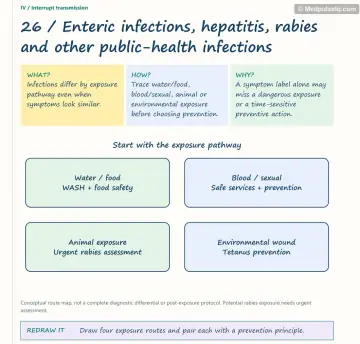
Concept 68
Diarrhoea and ORS
Concept 69
Cholera and Typhoid
Concept 70
Viral Hepatitis
Concept 71
Food Poisoning and Intestinal Worms
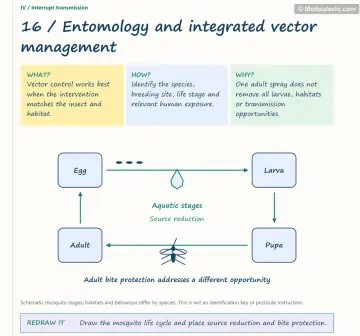
Concept 72
Mosquitoes — Know the Enemy
Concept 73
Flies, Fleas, Lice, Ticks and Mites
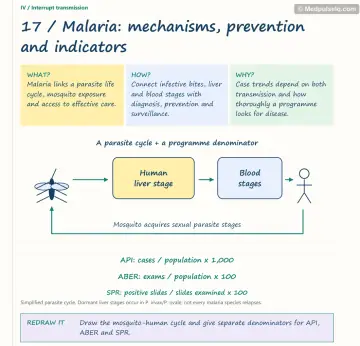
Concept 74
Malaria — The Parasite and the Numbers
Concept 75
Ending Malaria
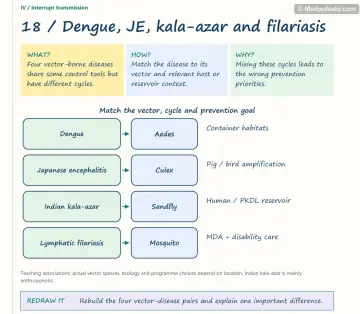
Concept 76
Dengue and Chikungunya
Concept 77
Japanese Encephalitis and Brain Fever
Concept 78
Lymphatic Filariasis
Concept 79
Kala-azar
Concept 80
Rabies — 100% Fatal, 100% Preventable
Concept 81
Other Diseases from Animals
⚡ Rapid revision
The whole Part on one screen — read it the night before.
Faeco‑oral diseases
- Low‑osmolarity ORS: 245 mOsm/L (Na 75, glucose 75, K 20, Cl 65, citrate 10 mmol/L). Zinc 10 mg (< 6 months) / 20 mg × 14 days.
- IMNCI: Plan A (no dehydration), Plan B 75 mL/kg over 4 h, Plan C IV RL 100 mL/kg (30 + 70 split). Dysentery → antibiotic; persistent ≥ 14 days.
- F‑diagram: sanitation is the primary barrier. Stop Diarrhoea Campaign; ORS Day 29 July; rotavirus vaccine (2016).
- Cholera: O1 (El Tor; Ogawa/Inaba), O139; incubation hours to 5 days; rice‑water stools; doxycycline 300 mg single (adults), azithromycin (children/pregnancy); OCV 2 doses; no mass chemoprophylaxis.
- Typhoid: human reservoir; chronic carriers 2–5% (gallbladder); blood culture in week 1; TCV; XDR typhoid.
- Hepatitis: A, E faeco‑oral; B, C blood. HBV chronicity 90% if perinatal. Birth dose within 24 h + HBIG for HBsAg+ mothers. HCV cured by DAAs. HEV severe in 3rd trimester. NVHCP 28 July 2018.
- Food poisoning: 1–6 h S. aureus / B. cereus emetic; 8–16 h C. perfringens; 12–72 h Salmonella; botulism: descending paralysis, clear sensorium.
- NDD: 10 February and 10 August, albendazole 400 mg (200 mg at 1–2 years), ages 1–19.
Vectors
- Anopheles: malaria; spotted wings; rests at an angle; larva parallel, no siphon; eggs with floats. An. culicifacies (rural), An. stephensi (urban), An. fluviatilis (hills).
- Aedes aegypti: dengue/chikungunya/Zika; day‑biter; artificial containers; black‑white stripes.
- Culex quinquefasciatus: filaria (polluted water); C. tritaeniorhynchus: JE (rice fields). Mansonia: Brugian filaria (Pistia).
- Sandfly: kala‑azar; rat flea: plague (cheopis index > 1); louse: epidemic typhus; Haemaphysalis: KFD; chigger mite: scrub typhus.
- IVM: environmental → biological (Gambusia, guppy, Bti) → personal → chemical. IRS up to 6 ft for sandflies; kill fleas before rats.
Malaria
- Man = intermediate host; mosquito = definitive host. Hypnozoites (Pv, Po) → relapse.
- API = cases/population × 1,000; ABER = examined/population × 100 (≥ 10%); SPR, SfR, AFI. Infant positive = local transmission.
- Pv: chloroquine 3 days + primaquine 0.25 mg/kg × 14 days. Pf: ACT‑SP (ACT‑AL in north‑east) + single‑dose primaquine. Severe: injectable artesunate.
- NFME 2016–2030: zero indigenous cases by 2027, elimination by 2030. Cases and deaths down ≈ 80% (2015–2025).
Arboviruses, LF, kala‑azar, rabies, zoonoses
- Dengue: DENV 1–4; critical phase around defervescence; warning signs; NS1 (≤ day 5), IgM (≥ day 5); paracetamol only. HI, CI, BI = positive containers/100 houses. National Dengue Day 16 May.
- JE: birds (reservoir) → Culex tritaeniorhynchus → pigs (amplifiers) → humans (dead‑end). SA 14‑14‑2 at 9–12 and 16–24 months; adult JE vaccination. AES: also scrub typhus, litchi hypoglycaemia.
- LF: W. bancrofti nocturnal; night smear 8:30 pm–12:30 am; FTS antigen test; MDA DA or IDA (2018); ≥ 65% ingestion; TAS; MMDP; target 2027.
- Kala‑azar: L. donovani, P. argentipes, human reservoir; rK39; single‑dose L‑AmB 10 mg/kg; PKDL; IRS alpha‑cypermethrin; < 1/10,000 per block reached 2023; validation needs 3 years.
- Rabies: wash 15 min; Cat I none, Cat II vaccine, Cat III vaccine + RIG (HRIG 20 IU/kg, ERIG 40 IU/kg infiltrated). IM Essen 0‑3‑7‑14‑28; ID 0‑3‑7‑28. Previously vaccinated: days 0 and 3, no RIG. NAPRE: zero by 2030; dog vaccination ≥ 70%.
- Leptospirosis: rat urine, floods; Weil's disease; doxycycline 200 mg weekly prophylaxis. Scrub typhus: eschar; doxycycline/azithromycin. KFD: Shimoga 1957, ticks, monkey deaths. Brucellosis: raw milk. Plague: Surat 1994.
🎯 Single‑best‑answer MCQs
Pick an answer to see the explanation — and the concept to revisit if you missed it. Your answers are saved on this device.
Score 0 / 00 of 20 answered
Question 1
The osmolarity of WHO low‑osmolarity ORS is:
Question 2
A 10 kg child with some dehydration needs ORS under Plan B of:
Question 3
The single‑dose antibiotic of choice for adult cholera (where susceptible) is:
Question 4
The best diagnostic test for typhoid in the first week of illness is:
Question 5
The risk of chronic hepatitis B infection is highest when infection is acquired:
Question 6
Hepatitis E is most dangerous in:
Question 7
Vomiting 2 hours after eating custard at a party is most likely due to:
Question 8
National Deworming Day is observed on:
Question 9
A mosquito larva lying parallel to the water surface without a siphon tube belongs to:
Question 10
The vector of urban malaria in India is:
Question 11
In a plague focus, the correct sequence of control is:
Question 12
Scrub typhus is transmitted by:
Question 13
The annual blood examination rate (ABER) is expressed per:
Question 14
Primaquine for 14 days is given in P. vivax malaria to:
Question 15
The Breteau index is the number of:
Question 16
In dengue, the risk of shock is highest:
Question 17
The amplifying host of Japanese encephalitis is the:
Question 18
The triple‑drug MDA regimen for lymphatic filariasis consists of:
Question 19
The kala‑azar elimination target in India is fewer than 1 case per:
Question 20
A previously fully vaccinated person with a category III bite should receive:
🃏 Flashcards
Say the answer out loud before you flip. Shuffle once you know the order.
Card 1 of 20
🩺 Staged clinical cases
Read the presentation, decide what is going on and what you would do — then reveal the reasoning.
Case 1 — Monsoon fever with an eschar
Stage A: In a Himalayan district, several farmers present with fever for 6 days, headache and myalgia. One child is drowsy with a seizure. Malaria RDTs are negative.
Linked concepts: 81. Other Diseases from Animals, 77. Japanese Encephalitis and Brain Fever
Case 2 — Low API, low ABER
Stage A: A forested block reports API 0.6 with ABER 2.8%. The adjacent block reports API 3.1 with ABER 13%.
Linked concepts: 74. Malaria — The Parasite and the Numbers, 75. Ending Malaria
Case 3 — The bitten child with a stitched wound
Stage A: A 9‑year‑old was bitten on the cheek by a street dog yesterday. A private clinic stitched the wound and gave a tetanus injection only.
Linked concepts: 80. Rabies — 100% Fatal, 100% Preventable
Case 4 — Jaundice in a town
Stage A: Over 3 weeks, a town of 80,000 reports 210 jaundice cases, mostly young adults; two pregnant women in their third trimester have died.
Linked concepts: 70. Viral Hepatitis, 69. Cholera and Typhoid
🎤 Viva practice
Answer aloud as if an examiner asked you — then check the model points.
Viva 1
Composition of low‑osmolarity ORS?
Viva 2
IMNCI plans for dehydration?
Viva 3
Why is zinc given in diarrhoea?
Viva 4
Control measures in a cholera outbreak?
Viva 5
Differentiate hepatitis A, B, C, E.
Viva 6
Classify food poisoning by incubation period.
Viva 7
Differentiate Anopheles, Culex and Aedes.
Viva 8
What is integrated vector management?
Viva 9
Malaria indicators?
Viva 10
Treatment of P. vivax and P. falciparum malaria under the national policy?
Viva 11
Warning signs of dengue?
Viva 12
Describe the JE transmission cycle.
Viva 13
What is MDA for filariasis?
Viva 14
What is PKDL and why does it matter?
Viva 15
Explain rabies exposure categories and PEP.
Keep going
Educational only — not a substitute for clinical judgement, supervision, or local guidelines.