Loading…
🩺 Medicine · Part 9 revision hub
Haematology
Everything you need to revise this Part in one place — the one‑page note for every concept, a rapid‑revision sheet, exam‑style questions that point you back to the right concept, flashcards, staged cases and viva practice.
24 concepts20 MCQs20 flashcards5 cases15 viva questions
📝 The plate wall
Every concept in this Part as a one‑page handwritten note. Open one to read it in full and zoom.
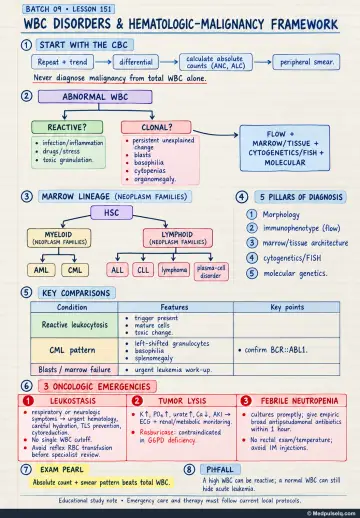
Concept 151
White Cells and Blood Cancer: reading the first clues
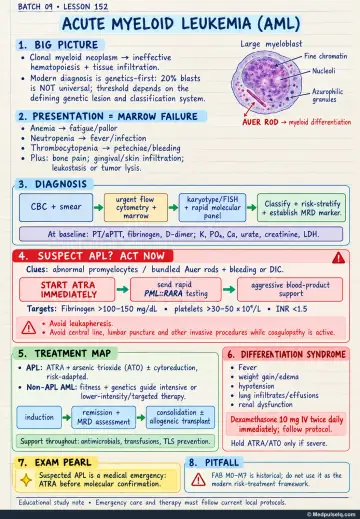
Concept 152
AML and APL: blasts that crowd the marrow
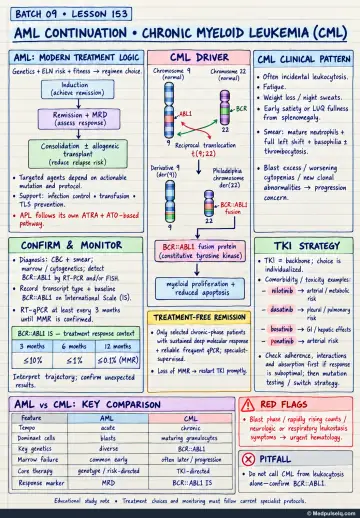
Concept 153
CML: the Philadelphia-chromosome leukaemia
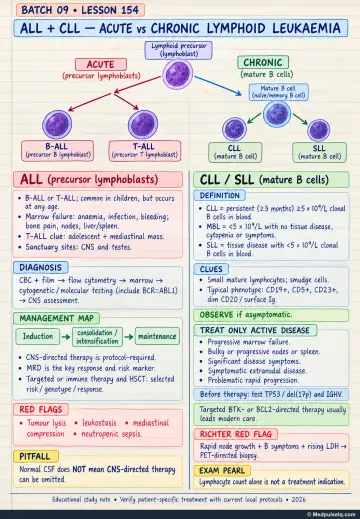
Concept 154
ALL and CLL: lymphoid leukaemias at two speeds
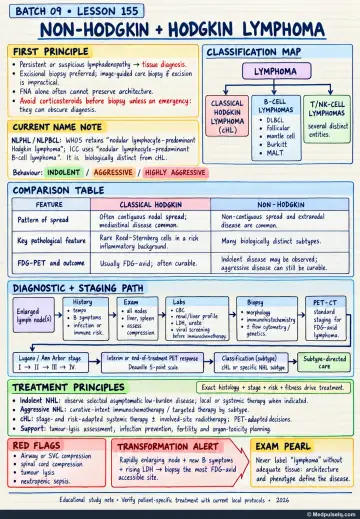
Concept 155
Lymphoma: when lymph nodes tell the story
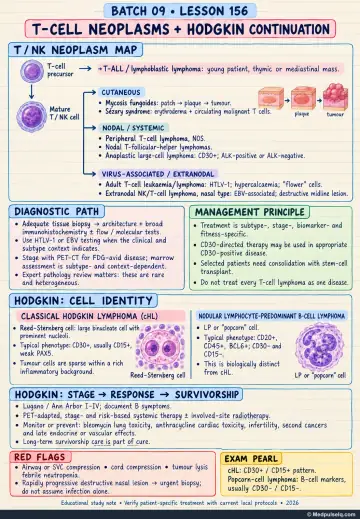
Concept 156
Hodgkin and T-cell lymphomas: not every node behaves the same
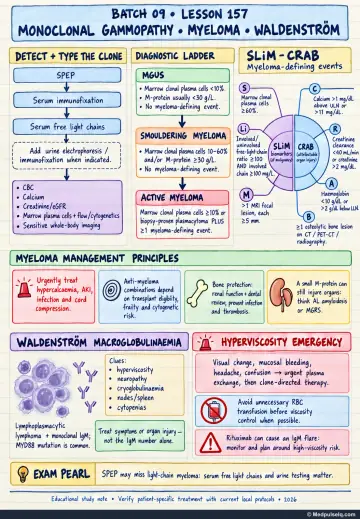
Concept 157
Myeloma and Monoclonal Proteins: the SLiM-CRAB clue set
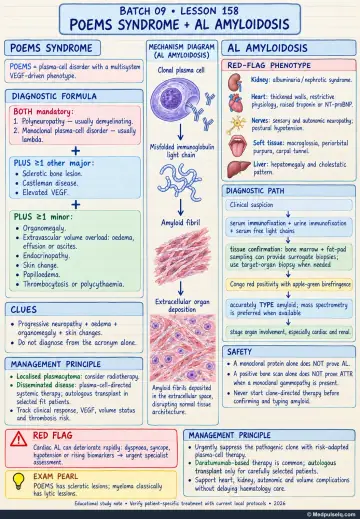
Concept 158
Waldenström, AL Amyloidosis and POEMS: small clones, big effects
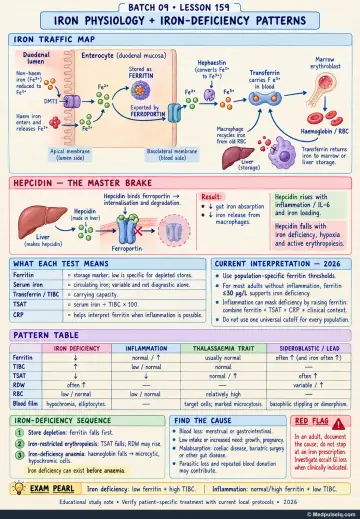
Concept 159
Iron: the body's oxygen-carrying metal budget
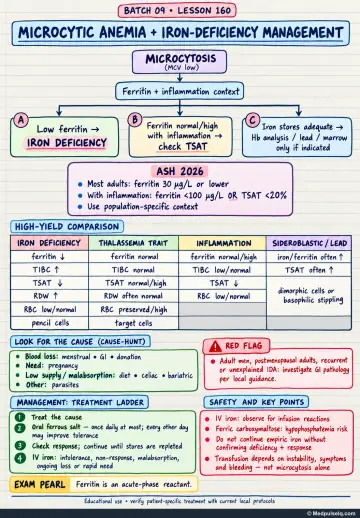
Concept 160
Microcytic Anaemia: small red cells, different causes
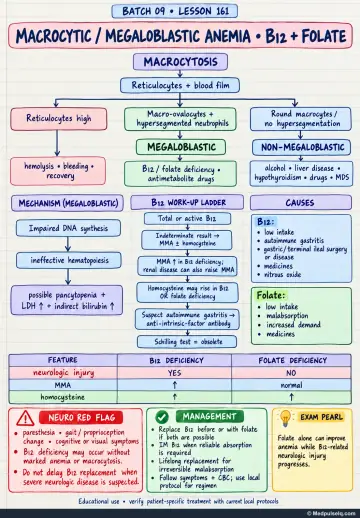
Concept 161
Macrocytic Anaemia: large red cells and the B12 warning
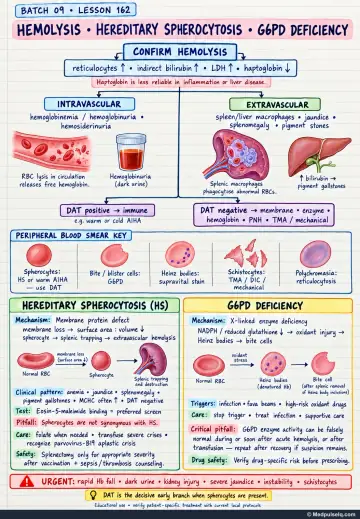
Concept 162
Haemolysis: when red cells are destroyed too fast
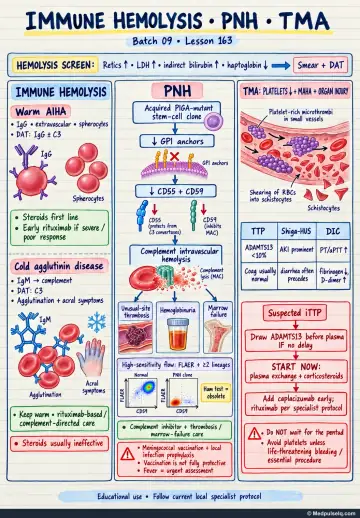
Concept 163
When red cells are destroyed too fast
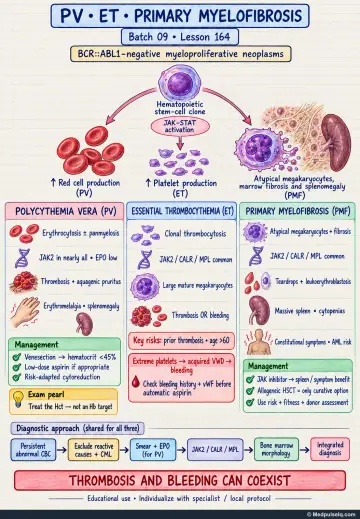
Concept 164
When the marrow makes too many cells
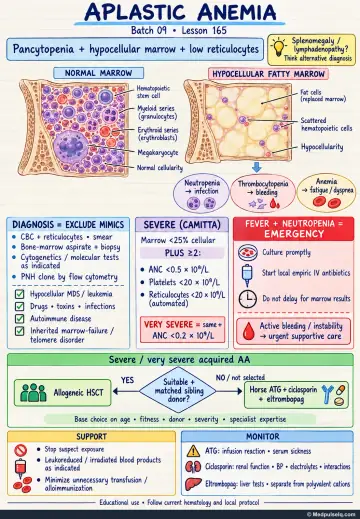
Concept 165
Aplastic anaemia: the quiet marrow
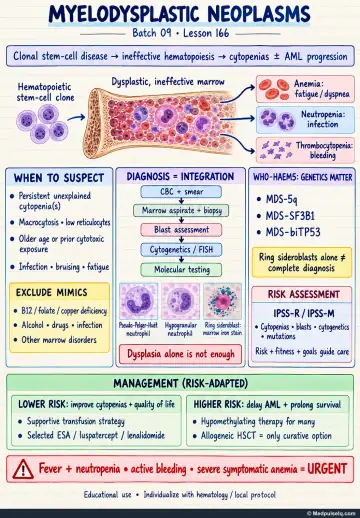
Concept 166
Myelodysplastic neoplasms: faulty blood-making
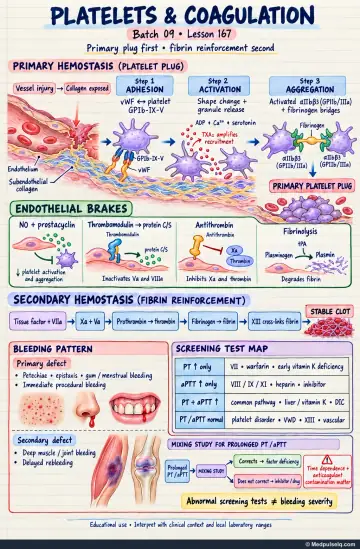
Concept 167
Platelets, clotting and the two styles of bleeding
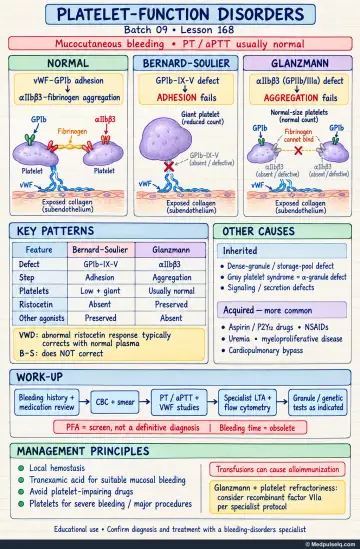
Concept 168
Platelets that are present but do not work
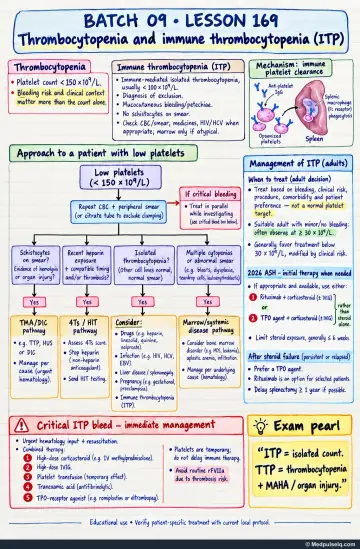
Concept 169
Low platelets and ITP
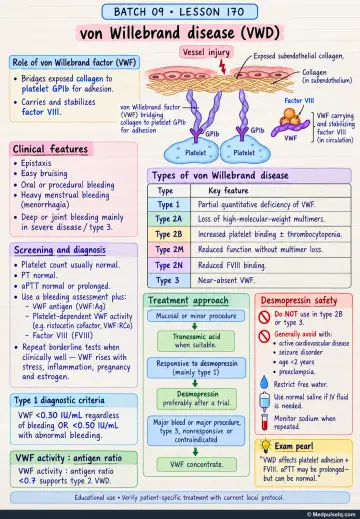
Concept 170
Von Willebrand disease
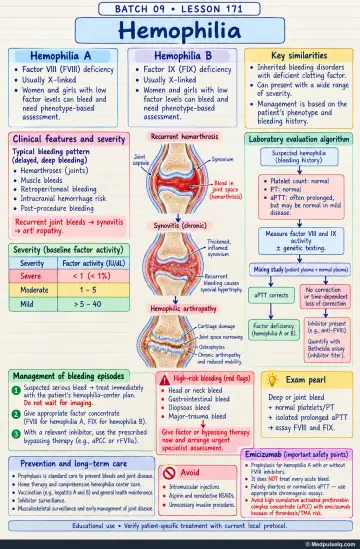
Concept 171
Haemophilia: bleeding into joints and muscles
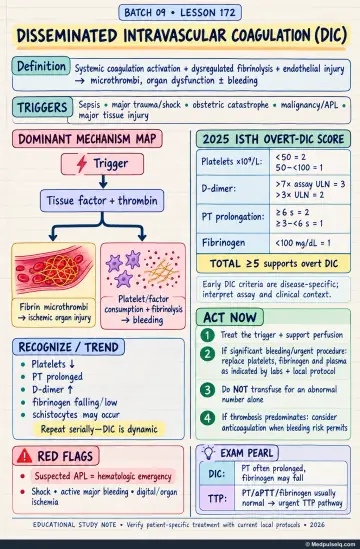
Concept 172
DIC: bleeding and clotting together
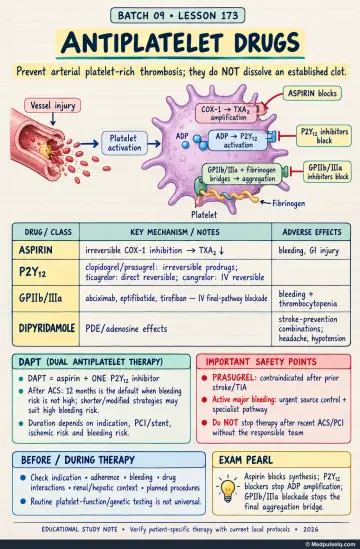
Concept 173
Antiplatelet medicines
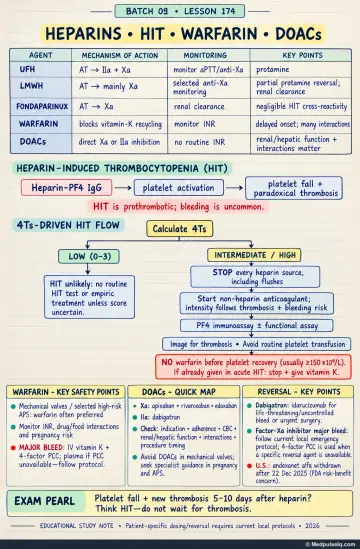
Concept 174
Anticoagulants, HIT and DOAC safety
⚡ Rapid revision
The whole Part on one screen — read it the night before.
CBC and smear anchors
- Verify sample, trend and patient identity before labelling disease.
- Read all three lines: red cells, white cells and platelets.
- Reticulocytes are the marrow's answer: high suggests loss/destruction; low suggests production failure or ineffective production.
- Blasts, Auer rods, schistocytes, spherocytes, macro-ovalocytes, hypersegmented neutrophils, target cells, bite cells and rouleaux are decision clues.
- Platelet clumping can create pseudothrombocytopenia; cold agglutinins can distort indices.
Malignant haematology anchors
- Acute leukaemia: cytopenias plus blasts; classify by flow, marrow and genetics.
- Suspected APL: ATRA now, support coagulopathy, confirm PML::RARA urgently.
- CML: BCR::ABL1 with mature myeloid leukocytosis, basophilia and splenomegaly; monitor molecular response.
- ALL: precursor B/T disease; therapy includes CNS-directed treatment even if initial CSF is normal.
- CLL: treat active disease, not lymphocyte count alone.
- Lymphoma: adequate tissue architecture before steroids when stable.
- Myeloma: SLiM-CRAB; a small monoclonal protein can still cause organ injury.
Anaemia and haemolysis anchors
- Anaemia algorithm: stability, bleeding, reticulocyte response, MCV, smear and targeted tests.
- Microcytosis: iron deficiency, thalassaemia trait, inflammation, sideroblastic/lead patterns.
- Ferritin can be falsely high in inflammation; pair it with transferrin saturation and context.
- Macrocytosis: megaloblastic versus non-megaloblastic; replace B12 before or with folate if uncertain.
- Haemolysis: LDH up, indirect bilirubin up, haptoglobin down, retics up; DAT defines immune branch.
- G6PD assay can be falsely normal during acute haemolysis; repeat later if suspicion persists.
Haemostasis and antithrombotic anchors
- Mucocutaneous bleeding suggests platelet/VWF; deep joint or muscle bleeding suggests coagulation factors.
- TTP: thrombocytopenia plus MAHA; PT/aPTT usually normal; start plasma exchange pathway urgently.
- DIC: treat the trigger; component support is guided by bleeding and serial labs.
- ITP: isolated thrombocytopenia diagnosis of exclusion; target safe haemostasis, not a normal count.
- HIT: use 4Ts; intermediate/high probability means stop all heparin and use a non-heparin anticoagulant.
- Warfarin major bleeding: IV vitamin K plus 4-factor PCC when indicated.
- Dabigatran antidote: idarucizumab; selected Xa-inhibitor reversal uses andexanet alfa or PCC pathway by availability.
🎯 Single‑best‑answer MCQs
Pick an answer to see the explanation — and the concept to revisit if you missed it. Your answers are saved on this device.
Score 0 / 00 of 20 answered
Question 1
A patient with suspected APL and active coagulopathy should first receive:
Question 2
The defining molecular lesion of CML is:
Question 3
Which is a myeloma-defining SLiM biomarker?
Question 4
Best initial branch point for anaemia physiology is:
Question 5
Disproportionate microcytosis with a relatively high RBC count suggests:
Question 6
Which statement about G6PD testing is correct?
Question 7
Thrombocytopenia, schistocytes and normal coagulation tests most urgently suggest:
Question 8
The classic TTP pentad is:
Question 9
PNH is best confirmed by:
Question 10
Very high platelets with new mucosal bleeding in essential thrombocythaemia should prompt assessment for:
Question 11
Aplastic anaemia usually features:
Question 12
Primary-haemostasis bleeding is typically:
Question 13
Desmopressin should generally be avoided in:
Question 14
In haemophilia A on emicizumab, which test is misleading?
Question 15
The cornerstone of DIC management is:
Question 16
A low 4Ts score for HIT generally supports:
Question 17
In acute HIT, warfarin should:
Question 18
Urgent warfarin reversal for major bleeding usually requires:
Question 19
Which reverses dabigatran specifically?
Question 20
A normal PT/INR in a patient taking apixaban means:
🃏 Flashcards
Say the answer out loud before you flip. Shuffle once you know the order.
Card 1 of 20
🩺 Staged clinical cases
Read the presentation, decide what is going on and what you would do — then reveal the reasoning.
Case 1 — Fatigue, bruising and infection-like fever
Stage A: A 32-year-old has fatigue, gingival bleeding and fever. Hb is 7.8 g/dL, platelets 18 × 10⁹/L and WBC 24 × 10⁹/L. Smear shows abnormal promyelocytes with Auer-rod bundles.
Case 2 — Thrombocytopenia with confusion
Stage A: A 40-year-old develops headache and confusion. Platelets are 14 × 10⁹/L, Hb 8.9 g/dL, reticulocytes and LDH are high, haptoglobin is low and schistocytes are present. PT and aPTT are normal.
Case 3 — Microcytosis that did not respond to iron
Stage A: A 24-year-old has Hb 10.5 g/dL, MCV 62 fL, RBC count 5.8 × 10¹²/L and only mild RDW elevation. Ferritin is normal and repeated iron has not improved the count.
Case 4 — Platelets fall after surgery
Stage A: On postoperative day 7 after unfractionated heparin exposure, platelets fall from 240 to 82 × 10⁹/L and the patient develops a painful swollen leg.
Case 5 — Bone pain, anaemia and AKI
Stage A: A 66-year-old has back pain, Hb 8.7 g/dL, creatinine 2.2 mg/dL, corrected calcium 11.4 mg/dL and high total protein.
🎤 Viva practice
Answer aloud as if an examiner asked you — then check the model points.
Viva 1
Why correct the reticulocyte count?
Viva 2
Name three causes of schistocytes.
Viva 3
What makes APL an emergency?
Viva 4
How is CML confirmed?
Viva 5
What are CRAB and SLiM?
Viva 6
Why can ferritin mislead?
Viva 7
Why not give folate alone in uncertain macrocytosis?
Viva 8
How do hereditary spherocytosis and warm AIHA separate?
Viva 9
What is the decisive laboratory hallmark of TTP?
Viva 10
Why can essential thrombocythaemia bleed?
Viva 11
What is the hallmark marrow finding in aplastic anaemia?
Viva 12
What is a mixing study for?
Viva 13
Why is aPTT unreliable with emicizumab?
Viva 14
What is the first action in suspected HIT?
Viva 15
Why is INR not a DOAC monitor?
Keep going
Educational only — not a substitute for clinical judgement, supervision, or local guidelines.